---
title: "Third Culture Kids and Five Centuries of Mixed Heritage"
subtitle: "How in-between kids develop, what it costs them, what it gives them, and what five centuries of mixed-heritage groups say about whether they are becoming a people."
description: "An evidence review of children who differ from the locals in how they look, speak, and think, joined to a coded library of 28 historical mixed groups, asking whether they are becoming a people."
author: "Han Ngo"
url: https://truonghan.com/third-culture-kids/
date: 2026-10-26
lastmod: 2026-10-27
tags: ["identity","history"]
---
# Third Culture Kids and Five Centuries of Mixed Heritage
**Short answers.** Six questions the paper was written to answer, each with the paper's confidence in its own answer: strong, moderate, or weak. The sections named carry the evidence, the population it was measured on, and its limits. Most of that evidence comes from lives written down because they were exceptional, or from comfortable samples; section 4.1 says what that does to each answer, and a fifth anchor, the children of marriage migrants in Korea and Taiwan, carries the ordinary case.
1. **What happened to mixed people in history, and over the generations?** In the paper's library of 28 historical groups, more were absorbed into a majority or a parent group (9) than persisted as named groups (5); 9 dispersed abroad and 5 could not be traced. The five that persist each held a territory, a language, or a state category (sections 10 and 11) [18, 155, 359]. Confidence: moderate; the library is not a sample, one coder read it, 22 of its 28 rows carry a weak code, and 9 is an upper count (two pairs of rows overlap, and the pardos hold a state category).
2. **Is being unmixed worth more than being mixed?** No, not as a trait: every present population is a past mixture [74, 131, 133, 191, 203, 271, 289], and a premium on being unmixed exists only where a majority or a state builds it [205]. The one practical cost found is in the bone-marrow registry, which rewards being typical rather than being unmixed, and the measured costs of being mixed are social, tracking discrimination aimed at mixedness; the largest genetic studies measure a cost of close kinship, not a bonus for distance (section 11.1) [25, 93, 130, 166]. Confidence: moderate.
3. **Stay or leave: which family line thrives?** Leaving buys income, 263 percent more within a year in the one lottery experiment, and, in group averages, schooling; it loses the heritage language in about two generations, and by the third 42 percent of Asian-origin children (55 percent with one Asian side) are no longer identified as Asian [101, 106, 218, 284]. Leavers arrive healthier than the destination population, partly by selection; the advantage erodes with time, is weaker in childhood, and fails on some Asian outcomes; well-being is mixed, belonging is unmeasured on both sides, and no study measures what the line that stays keeps (section 12) [7, 10, 116, 135, 350]. Confidence: moderate for income, weak to moderate for the first generation's health, weak for the rest.
4. **How do third culture kids develop, where do they struggle, and how do they use their edge?** Difference registers early and the label moves in adolescence: infants prefer a native accent at five to six months, and about half of the Black-white and Asian-white teenagers in one national sample, 57 and 53 percent, kept their label six years on (sections 5 and 6) [98, 180]. The paper reads the measured harm as tracking invalidation and discrimination more than mixedness, with the household (family structure, poverty) explaining part of what remains, and the best-supported edges are creativity and the bridging seat, which pays and burdens whoever holds it; both are context effects open to anyone, whether in-between people hold more bridging seats is an inference, and the bilingual brain is not among them (sections 7 and 14) [47, 93, 200, 207]. The edge has a life cycle: early arrival and strength in both languages build it, bridging seats and diverse teams' creativity pay it rather than team performance, the loss of the heritage language thins it, a growing supply of speakers may thin it further on one cross-section, and a clash between the two countries turns it on its holder (section 8) [3, 17, 38, 86, 310]. Confidence: moderate on development and costs, moderate on building the edge, weak on using it.
5. **How do today's Euro-Asian children compare with the historical Eurasians?** Many of the old Eurasian groups had a legal category or a protected niche from a colonial patron, and most lost them with the empire (India's Anglo-Indian seats lasted to 2020); Hong Kong's families also married among themselves. Today's children have no legal category of their own (England and Wales offer a census box), no niche, and no patron, and their label thins by the third generation (section 10.9) [101, 199, 364, 367]. In England, where they are counted at school, they outscore the White British majority inside and outside free school meals, and by 19 enter higher education at 56 against 38 percent [87, 89]. Confidence: moderate on the history; on the present, moderate for schooling (one country's official series) and weak for identity and work (88 US respondents, no labour-market split).
6. **Are they becoming a new people?** No. By four tests (a label most members use, a boundary, institutions, transmission) in-between kids today are a category with a vocabulary and a few organisations, not a group: 61 percent of mixed-background Americans do not call themselves multiracial, and 55 percent of third-generation children with one Asian side are not identified as Asian (section 11) [101, 262]. Confidence: moderate for the United States (two single surveys and the paper's judgement), weak elsewhere, where no comparable count exists.
Some children differ from the people around them in how they look, how they speak, and how they think, and so they cannot blend in. This paper calls them in-between kids; the core case is a child of mixed heritage raised across cultures. It asks what happens to such a child across one life and across three generations of her family, and what that tells a family deciding whether to stay or to leave. It reads the evidence through Pollock and Van Reken's two questions (do you look like the locals, do you think like them) plus a third the paper adds (do you sound like them). The method is a research synthesis in which each finding names the population it was measured on and whether it replicated, joined to a coded library of 28 historical mixed groups, read by one coder and not a sample. Four lives run through the paper: Barack Obama from a Honolulu classroom in 1971, Ariana Miyamoto from a Sasebo schoolyard, the Ho Tung family of Hong Kong across three generations to a camp gate in 1942, and two Vietnamese Amerasians, one who left in 1985 and one who stayed; each is on record because of what made them exceptional. A fifth anchor is a cohort with no memoir: the children of marriage migrants in Korea and Taiwan, many with Vietnamese mothers, from families their ministry describes as tending to low incomes, measured in national surveys. Scale is unknowable but bounded: 304 million people live outside their birth country, and no census counts third culture kids. The findings, in short: in the paper's library more mixed groups were absorbed (9 of 28) than persisted as named groups (5), with 9 dispersed; leaving buys income, loses the language in about two generations and thins the label by the third, and what staying keeps is unmeasured; in-between kids today are a category with a vocabulary, not a people; and no recommendation in the playbook reaches grade A for mixed-heritage children. The paper begins where most of these lives begin to be recorded: on the first day at a new school.
## 1. Introduction
In 1971 a ten-year-old boy walks into a fifth-grade classroom at Punahou School in Honolulu. The teacher reads his full name from the roll, and titters cross the room. A classmate says, "I thought your name was Barry." Asked about his father, the boy says the family tribe is Luo, and another boy repeats the word in a loud hoot, like the sound of a monkey. A girl asks to touch his hair. A boy asks whether his father eats people. The only other Black child in the grade is a girl named Coretta, and the two of them keep apart, as if contact would sharpen the isolation. When a playground chant calls her his girlfriend, he shoves her away, and the shove buys him some room from the other children [248]. In the frame this paper uses, Barack Obama on that day looks different from his classmates, sounds like them in the paper's reading (born in Honolulu and raised there to about 6; no card records his speech at Punahou), and thinks partly like them and partly not.
This paper is about people like that boy. It calls them in-between kids: people who differ from the locals in how they look, how they speak, and how they think, and so cannot blend in. The core case is a child of mixed heritage raised across cultures. Two comparison groups frame it: the plain third culture kid, who moves between countries with a parent's job but is not of mixed heritage, and the mixed child raised in one place. "In-between kid" is the paper's own working definition, not a term of art in any literature it reviews. Figure 1 shows the frame, with the four lives placed in their cells, one of them twice, before and after a move, and an arriving cohort beside them ([Figure 1](https://truonghan.com/third-culture-kids/#fig-01-look-speak-think)).
> [**Figure 1**: Look, speak, think: the identity box with a third axis. Two yes-or-no questions give four positions; asking whether a person sounds local splits each one in two. Move a person and the cell changes: Miyamoto in Arkansas did not sound local, nor did most Amerasians arriving in the US.]
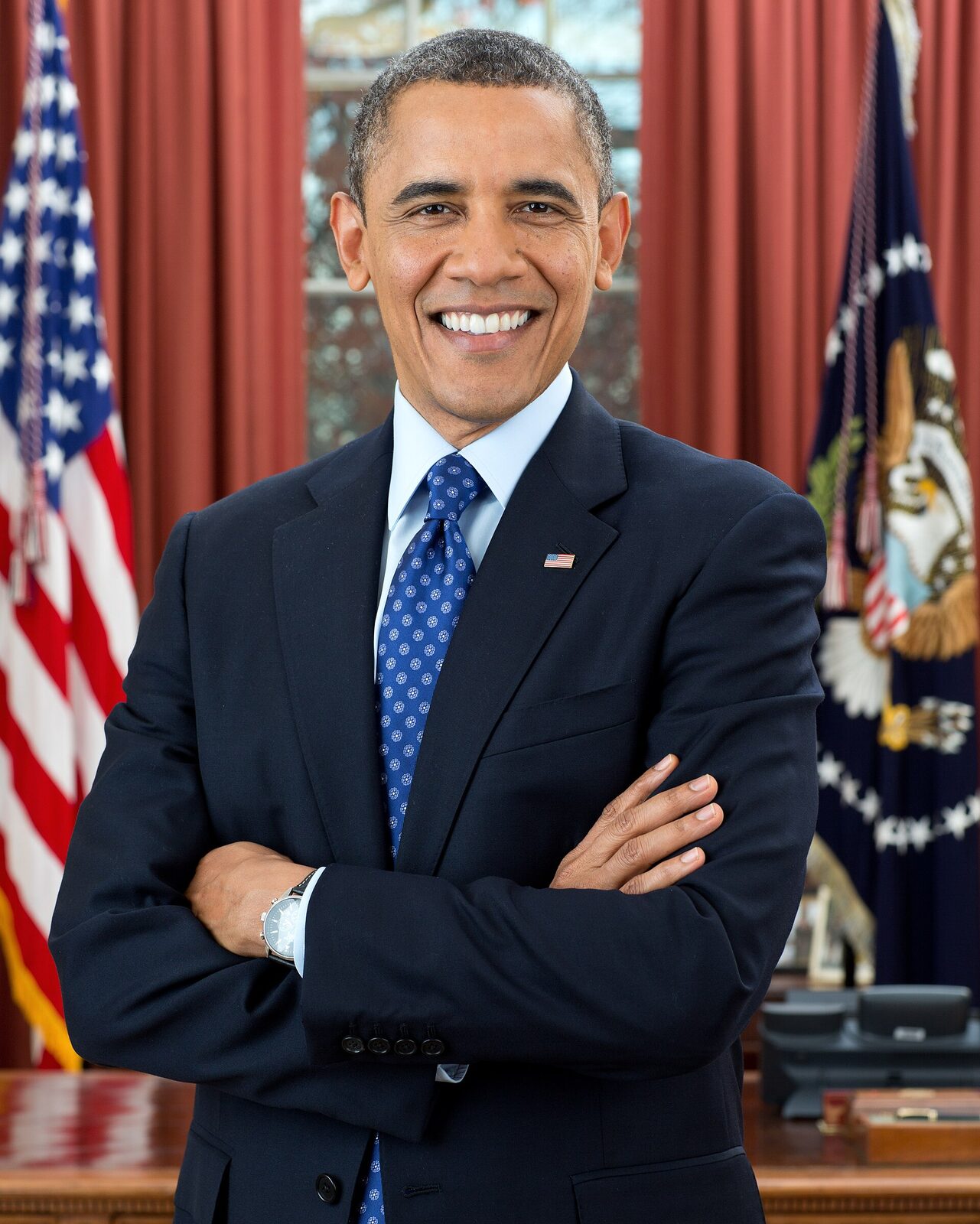
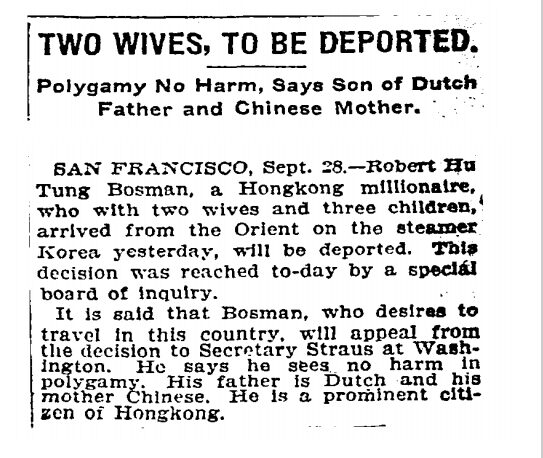
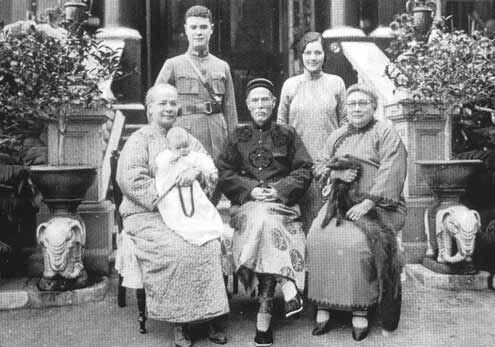
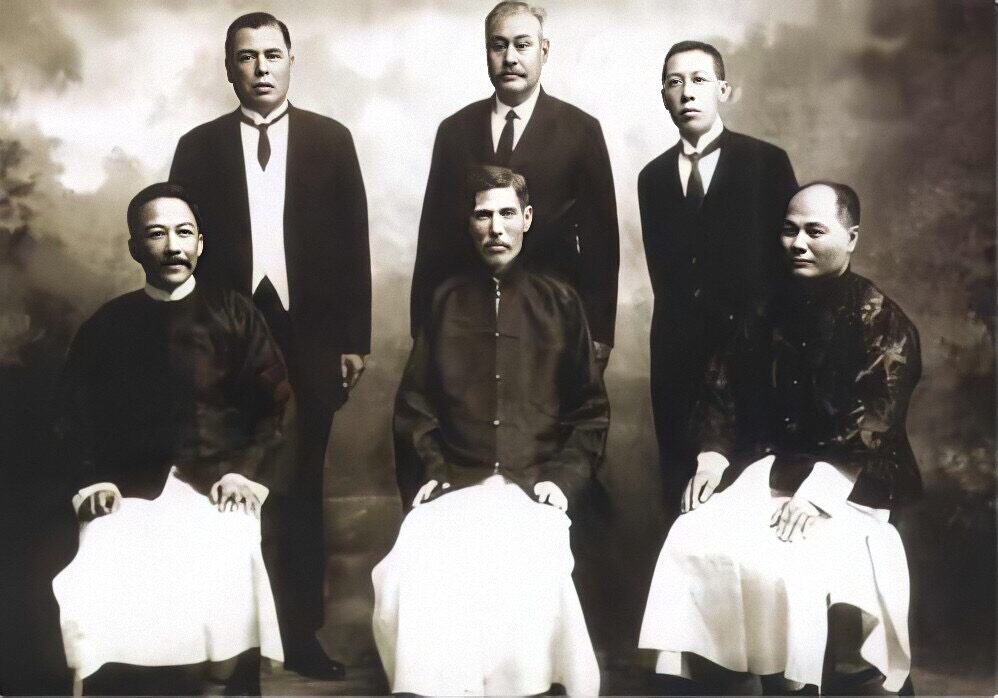
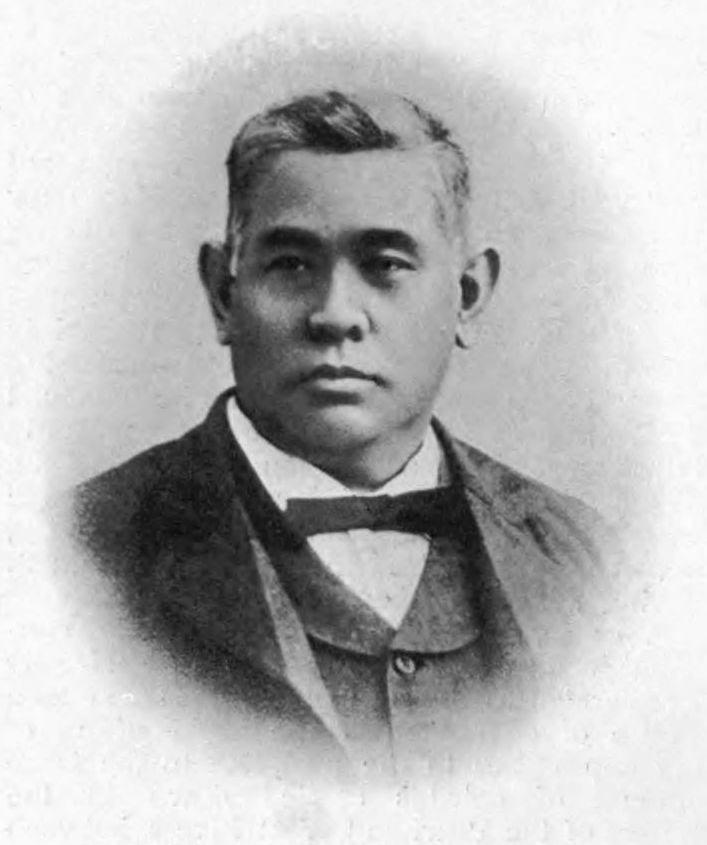
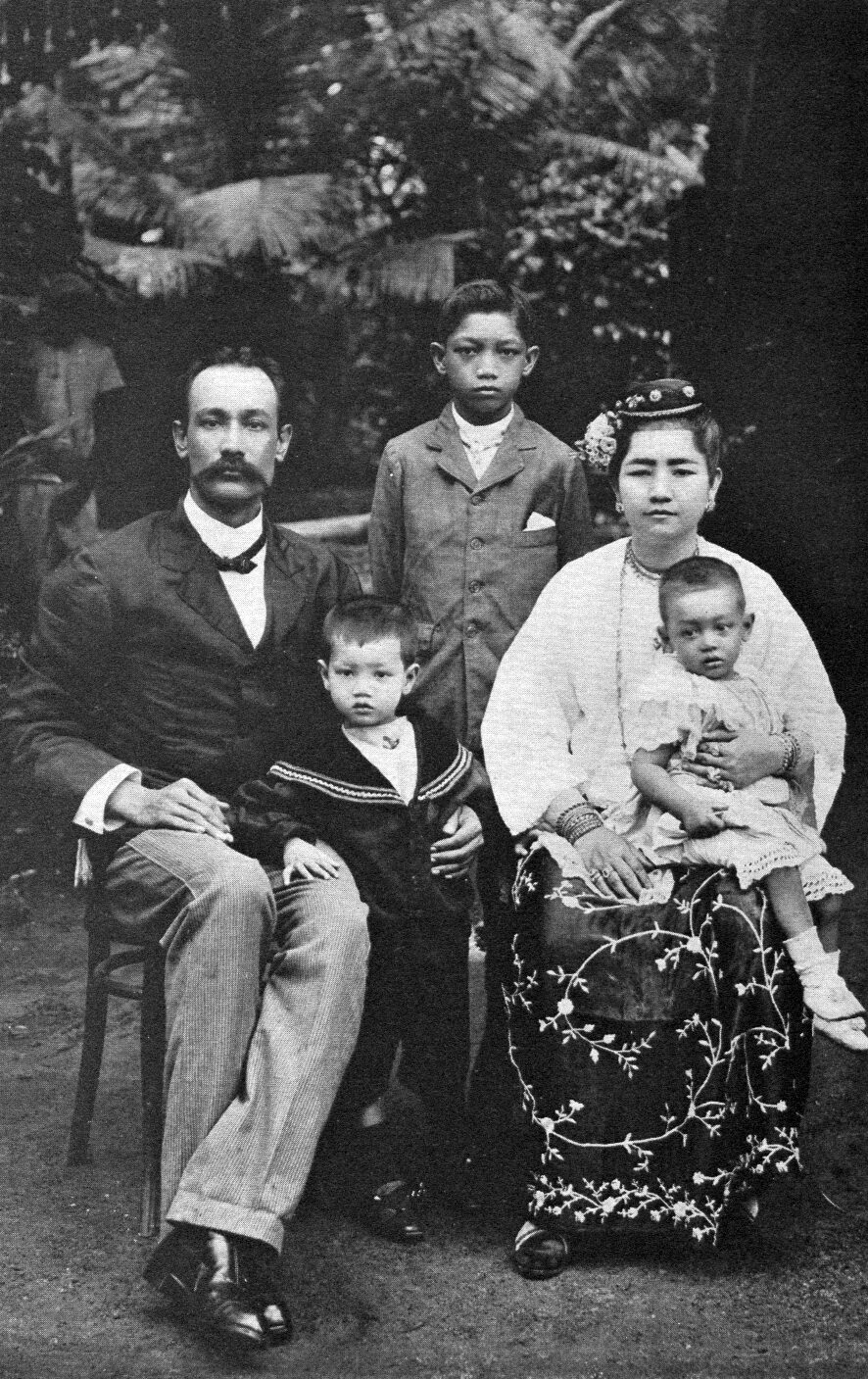
The paper follows four lives and one cohort from here to the conclusion, because a frame is not a story and the evidence on these children comes in pieces that only a life can hold together. Barack Obama, born in 1961 to a Kenyan father and a white American mother, was raised in Jakarta and Honolulu (Plate 1) [248]. Ariana Miyamoto, born in Sasebo in 1994 to a Japanese mother and an African American sailor, was crowned Miss Universe Japan in 2015 [143, 298]. Robert Ho Tung, born in Hong Kong in 1862 to a Dutch merchant and a Chinese mother, was reputed the richest man in the colony, and is followed through his daughter Jean and the grandchildren [58, 325, 364]. Kien Nguyen, born in Nha Trang in 1967 to an American father, left Vietnam in 1985; Bi Thi Loan, a Black American soldier's daughter, had not left when interviewed at about 39, in about 2005 [243, 290, 349]. Each of the four is on record because of what made them exceptional: a presidency, a crown, a fortune, a memoir and a wire feature (section 4.1). The fifth anchor is a cohort, not a person: the children of marriage migrants in Korea and Taiwan, many with Vietnamese mothers, about 152,000 children of international marriages among Korea's 210,838 multicultural students in 2026, 138,736 of them born in Korea, from families the Ministry of Education describes as tending to low incomes, and measured in national surveys and panels rather than in memoirs [54, 103]. Table 1.1 introduces them once. After it the text names the person, the age, and the year, and goes on.
Table 1.1. The anchors: four lives and a cohort
| Anchor | Parents | Where raised | Box cell (look, speak, think) | Life stages on record | Sections carried |
|---|---|---|---|---|---|
| Barack Obama, born 1961 | Kenyan father, white American mother | Jakarta, about 6 to 10; Honolulu, 10 to 18; then the US mainland | looks different; sounds local in Honolulu in the paper's reading, Jakarta not on record; thinks local and not | 6 to 22 in his memoir; mid-twenties in Chicago; 46 in a 2008 speech [247, 248] | 1, 2, 4, 5, 6, 7, 9, 14, 15 |
| Ariana Miyamoto, born 1994 | Japanese mother, African American father | Sasebo, Nagasaki, outside the US base; a stretch of her mid-teens in Jacksonville, Arkansas | looks different; sounds local in Sasebo, not in Arkansas at about 14 to 16; thinks local in Sasebo, not in Arkansas; accepts the label "hāfu" because "Japanese" is refused | school years; mid-teens; 20 in 2015; 23 in 2017; 29 in 2024 [139, 143, 298] | 1, 2, 4, 5, 6, 7, 9, 11, 13, 14, 15 |
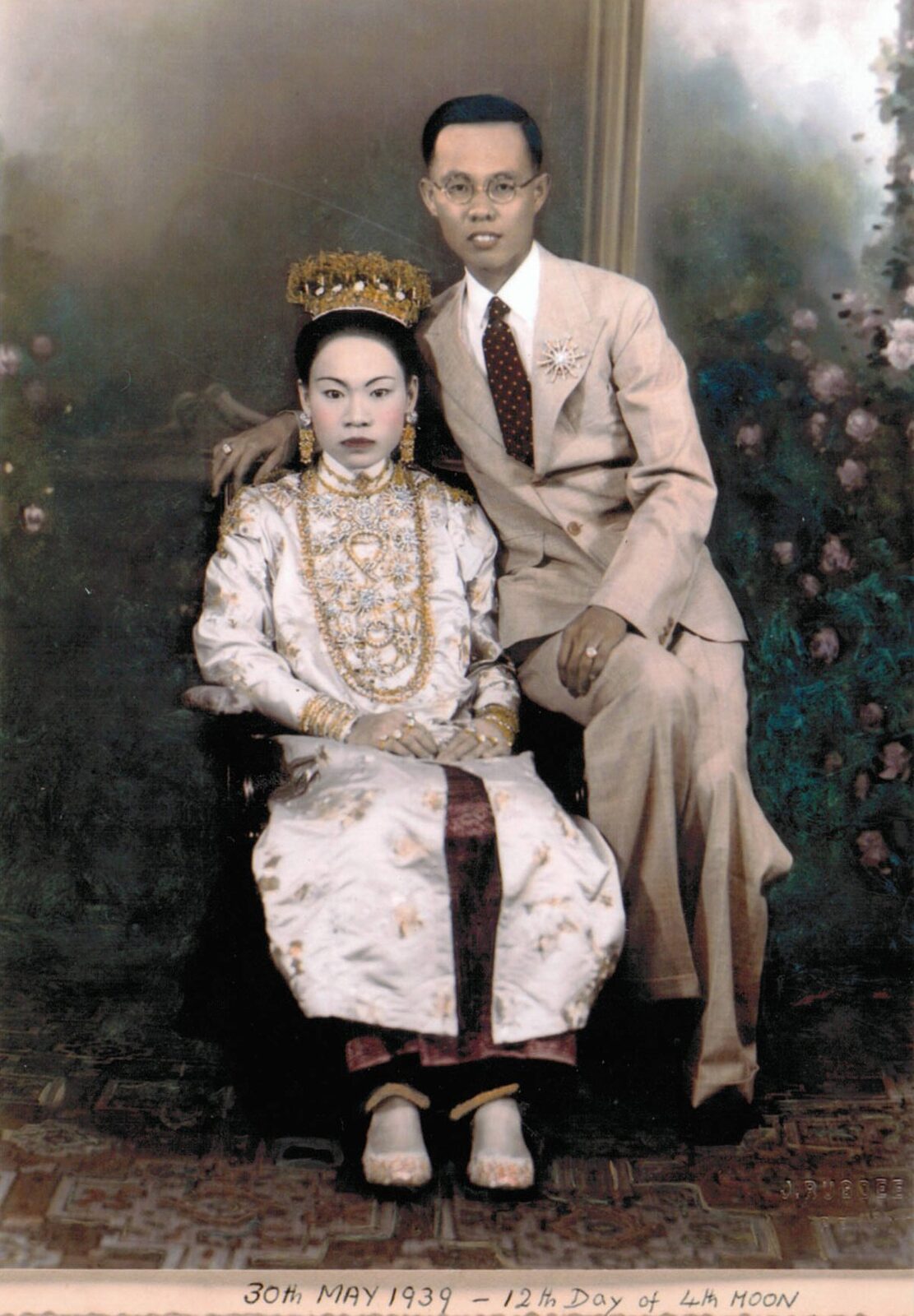
| The Ho Tung line: Robert, 1862 to 1956; Jean Gittins, 1908 to 1995; the grandchildren | Robert: Dutch father, Chinese mother. Jean: daughter of Robert and Clara | Hong Kong; the Peak from 1906; Macau in the war; the third generation in Shanghai, London, Melbourne | Robert looked European in one historian's words, had a Chinese upbringing, and chose to live as Chinese; Jean held two nationalities and chose between them in 1942 | Robert 17 to 93; Jean 19 to 33 in her memoir; the grandchildren by name [127, 202, 305, 325] | 1, 2, 3, 4, 5, 7, 8, 9, 10, 11, 12, 13, 14, 15 |
| The Vietnamese Amerasian pair: Kien Nguyen, born 1967, left 1985; Bi Thi Loan, about 39 when interviewed, stayed | American fathers, Vietnamese mothers | Nha Trang, then New York and California; Minh Hai province, then Saigon | looked foreign; raised in Vietnam, and so in the paper's reading sounding and thinking local; read as the enemy's children | Kien 5 to 38; Loan from two months to about 39 [243, 290, 349] | 1, 2, 4, 5, 6, 7, 9, 10, 11, 12, 13, 14, 15 |
| The marriage-migrant cohort: children of Korean and Taiwanese fathers and immigrant mothers, born about 1985 to 2015 | Mothers from Vietnam, China, the Philippines, Indonesia and Japan; Vietnamese mothers the largest group of foreign wives in Korea | Korea (about 152,000 children of international marriages among 210,838 multicultural students in 2026); Taiwan | look not on record; sound local, mostly born there; think local; read as "damunhwa" or "new immigrant" children | 9 to 24 in Korea's panel and national surveys; 18 to 40 in Taiwan's one adult study [54, 63, 66, 226, 333] | 1, 4, 5, 6, 8, 12, 14 |
Plate 1. Barack Obama, 6 December 2012, one of two anchors with a licensed photograph; the Ho Tung line is the other (Plates 8, 11, 17, 18). No childhood image of him exists on Wikimedia Commons. Official White House photo by Pete Souza, 2012. Public domain, via Wikimedia Commons.
Nobody knows how many in-between kids there are, but the number has bounds. The United Nations counted 304 million people living outside their country of birth in 2024, up from 154 million in 1990, while the share of the world's population rose only from 2.9 to 3.7 percent [341]. No census anywhere counts third culture kids; the "220 million TCKs" that circulates online traces to a 2013 remark by the writer Pico Iyer and matches the UN's 2010 migrant stock, a match that is this paper's inference [109].
The paper asks eight questions, each a piece of the one question above. Who in-between kids are and how many there are (RQ1) is the ground, sections 2 to 4. How they develop (RQ2), what it costs them (RQ3), which advantages survive replication (RQ4), and what helps them accept their identity and use their edge (RQ5) are the one life, sections 5 to 9. How earlier in-between groups fared across generations (RQ6) is section 10. Whether they are becoming a new group (RQ7) is section 11, and whether the line that stays or the line that leaves thrives more (RQ8) is the family's decision, section 12.
**Contributions.** This paper makes five contributions.
1. A three-axis frame: Pollock and Van Reken's look and think, plus the paper's own sound axis. The third axis adds what the two-axis box cannot show: a move changes the cell. Miyamoto in Sasebo sounded local and in Arkansas at about 14 to 16 did not, and 69 percent of the Amerasians who had reached the United States by March 1992 arrived with Vietnamese and no English (section 2, Figure 1).
2. An evidence review in which each finding names the population it was measured on and whether it replicated, with counter-findings beside the findings they challenge (sections 3 to 9).
3. A coded library of 28 historical mixed groups, each scored on the same five variables, with cross-tabulations (section 10 and Appendix A).
4. Four tests for whether a category has become a people, applied to in-between kids today (section 11).
5. A playbook for the person, parents, schools, and employers, with an evidence grade on each recommendation (section 14).
> [!NOTE]
> **For a family deciding.** If you came to this paper with a choice to make, four passages carry what the evidence can say, and each names its limit.
>
> *Stay or leave* (section 12). Leaving buys income: in the one lottery experiment, 263 percent more within a year, and the gain reaches the household that goes [123, 124, 218]. Group averages give leavers' children more schooling, with selection and the place they land doing part of the work [106, 265]. The heritage language lasts about two generations after a move, and by the third 42 percent of Asian-origin children are no longer identified as Asian, 55 percent with one Asian side [101, 284]. The first generation arrives healthier than the destination population, partly by selection; the weight advantage erodes within ten to fifteen years in the country, and the advantage is weaker at the ages a child moves [7, 10, 135, 350]. Well-being is mixed, and no study measures belonging on either side or what the line that stays keeps.
>
> *Where the mixed child pays most* (section 6.4). The worst measured costs in this paper fall on the mixed child who stays in a society that treats mixing as a flaw: children of multicultural families in Korea, a group that includes mixed children, met school violence at 10 against 1.9 percent and trailed by 31 points in higher education in 2021, 13 in 2024 [192, 226, 227].
>
> *Is unmixed worth more* (section 11.1). No, not as a trait. Every present population is a past mixture, the premium on being unmixed exists only where a majority or a state builds it, and the one practical cost of mixedness found is in the bone-marrow registry, which rewards being typical [74, 130, 205]. The largest genetic studies measure a cost of close kinship, not a bonus for distance [166].
>
> *Using the edge* (sections 8 and 14). Build it early and keep both languages, including reading and writing; expect it to pay in bridging seats, to thin as the heritage language goes, and to turn against the child when the two countries clash [3, 38, 86]. Sell the position, not the heritage: the pay in the evidence sits in the broker's seat, whoever holds it, and the first move is to make that bridging work visible and paid [47, 108]. The speak axis is the one to price: a missing language cost Miyamoto status at home and nothing abroad [298]. The bilingual brain edge is not in the evidence [200].
>
> None of the four rests on a study of mixed-heritage third culture kids themselves; every finding is borrowed from a comparison group (Limitations), and no recommendation in section 14 reaches grade A.
The road is the spine. Sections 2 to 4 set the terms, the theories, and the literature. Sections 5 to 9 follow one life, stage by stage. Sections 10 and 11 follow three generations and ask whether anyone has made a people out of this position. Section 12 is the decision, and sections 13 to 15 are what follows from it. Before the evidence, the words, because the words were waiting for each of these children before they arrived.
## 2. Who they are: terms, the model, size
June 2015. Ariana Miyamoto, 21, has held the title of Miss Universe Japan for three months, and strangers online have said that a hāfu should not represent Japan. She tells the BBC why she uses their word. "If I say I am 'Japanese' the reply would be: 'No, you can't be'. People will not believe that. But if I say I am 'hafu', people agree" [360]. She was born and raised in Japan and speaks unaccented Japanese [221, 360]. In the frame she looks different, sounds local, and thinks local. The word she is allowed came before her. This section defines the words, builds the frame, and bounds the numbers.
### 2.1 Terms
"Third culture" came from fieldwork. In 1952 the sociologists Ruth and John Useem went to India for a year, returned about five years later to study Americans working there, and began to use "third culture" for the style of life of people who relate two societies to each other [346]. The phrase is in print by 1963, in a paper about adults [344]. Ruth Useem's writing on the children begins in the 1960s; no primary text of the first use of "third culture kid" was found, so the term was not "coined in 1963" [346].
The standard definition is Pollock and Van Reken's: a third culture kid is "a person who has spent a significant part of his or her developmental years outside the parents' culture" [264]. Van Reken's wider term, cross-cultural kid (CCK), covers anyone raised among two or more cultural environments, mixed-heritage children raised in one place included [264]. "Global nomad", Norma McCaig's 1984 label for the same group, is a third name [109].
### 2.2 Local words
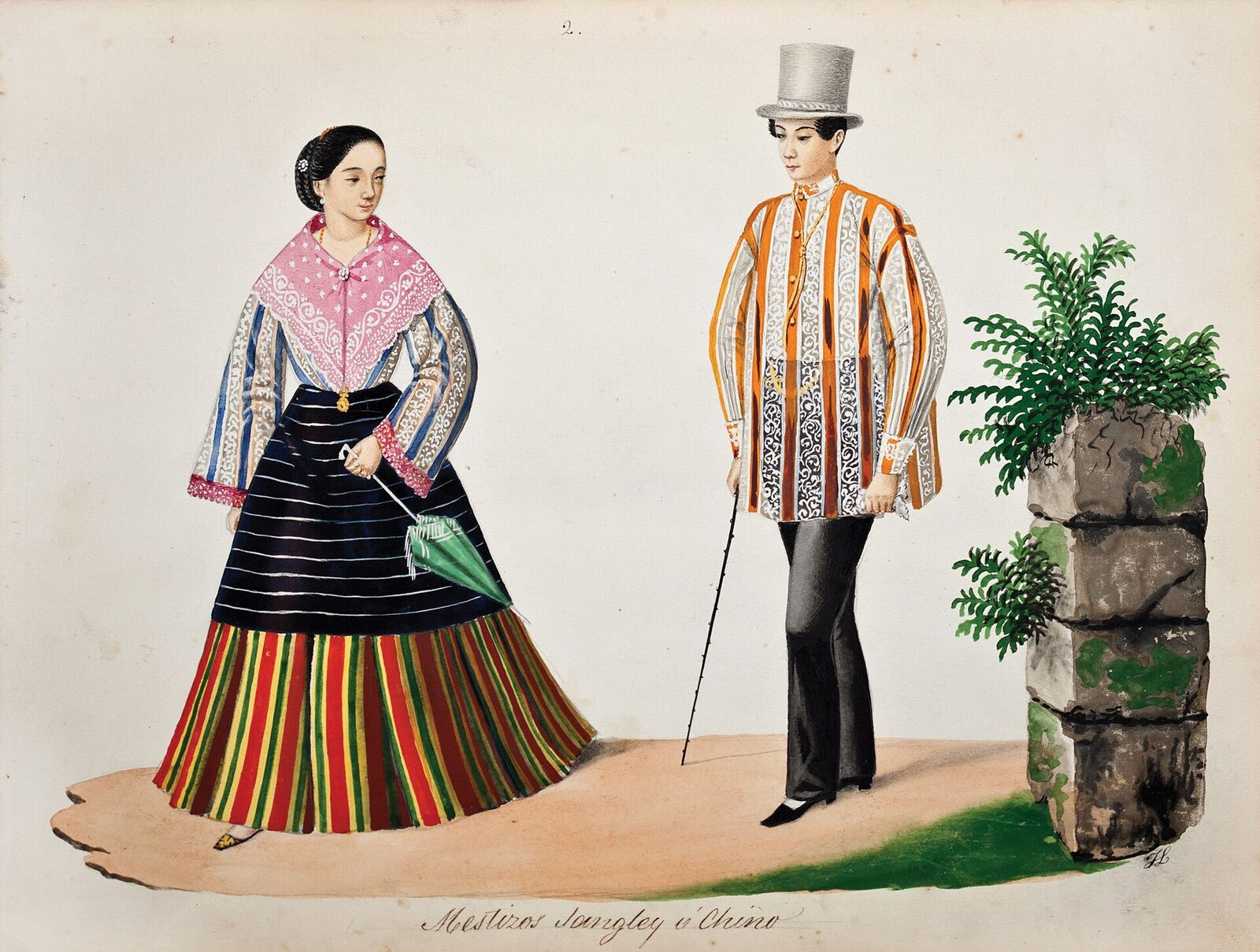
Every host society has its own word for the mixed child, and each word carries its history and its period (Table 2.1). In Japan the word is hāfu, from the English "half". It replaced the older konketsuji ("mixed-blood child"), and it has rivals, daburu ("double") among them [293]. Hapa, Hawaiian for mixed or part, was adopted on the US mainland over some Native Hawaiians' objection [26]. Luk khrueng, "half-child", is Thailand's word [5]. "Amerasian" is a legal category: a 1982 US law named five countries and told officers to "consider the physical appearance of the alien" as evidence of an American father [268]. Kien Nguyen and Bi Thi Loan carried that word; one Amerasian in Vietnam said people called her "Lai", the word for mixed, instead of a name [198]. Lai dai han names the children of Vietnamese mothers and South Korean soldiers [330]. In Singapore "Eurasian" is a census category inside the box called "Others" [301]. Korea's older slur is twigi (section 6) [15]. The colonial words in the lower half of the table were legal categories first (section 10).
Table 2.1. Words for the in-between child, by language and period
| Term | Language | Literal sense | Period of use | Status today |
|---|---|---|---|---|
| Third culture kid (TCK) | English (US sociology) | child of the "third culture" | developed from 1950s fieldwork; published from the 1960s | standard research term [109, 344] |
| Cross-cultural kid (CCK) | English | child among two or more cultures | not dated in a primary source | umbrella term [264] |
| Global nomad | English | mobile person | 1984 (obituary) | alternative label [109] |
| Konketsuji | Japanese | "mixed-blood child" | the occupation era; "mixed blood" children were surveyed in 1952 | older word, replaced by hāfu [293, 334] |
| Hāfu | Japanese | "half" | no year; sources conflict | contested; daburu as the positive rival [293] |
| Hapa | Hawaiian | mixed, part, half | not dated here | adopted on the US mainland; contested [26] |
| Luk khrueng | Thai | "half-child" | in use by the 1970s | common; tied to entertainment [5, 362] |
| Amerasian | English (US law) | American and Asian | 1982 Act; 1987 Act for Vietnam | legal category [268, 343] |
| Lai dai han | Vietnamese | child of Korean and Vietnamese parents | war years | stigmatised [330] |
| Con lai | Vietnamese | mixed child | not sourced | street word; no scholarly source found |
| Eurasian | English (Singapore, Hong Kong) | European and Asian parentage | colonial records; Hong Kong census 1897 to 1931 | census category inside "Others" in Singapore; a term of reproach in Hong Kong in 1901, in Lee's summary [199, 277, 301] |
| Damunhwa | Korean | multicultural (family) | not dated here | official school category [173] |
| Kikokushijo | Japanese | returnee child | official from 1977 | government-counted [171] |
| Twigi | Korean | mixed child | not dated here | slur [15] |
| Burgher | English (Ceylon) | citizen, from Dutch | defined by the father's line in law from 1883 | census count 37,100 (2012) [236, 309] |
| Anglo-Indian | English (India) | European father's line, born in India | reserved seat from 1919; last separate census 1931 | constitutional category; nominations lapsed 2020 [367] |
| Mestizo de sangley | Spanish (Philippines) | child of a Chinese father | 17th to 19th century; taxed at double the indio rate | absorbed into "Filipino" [359] |
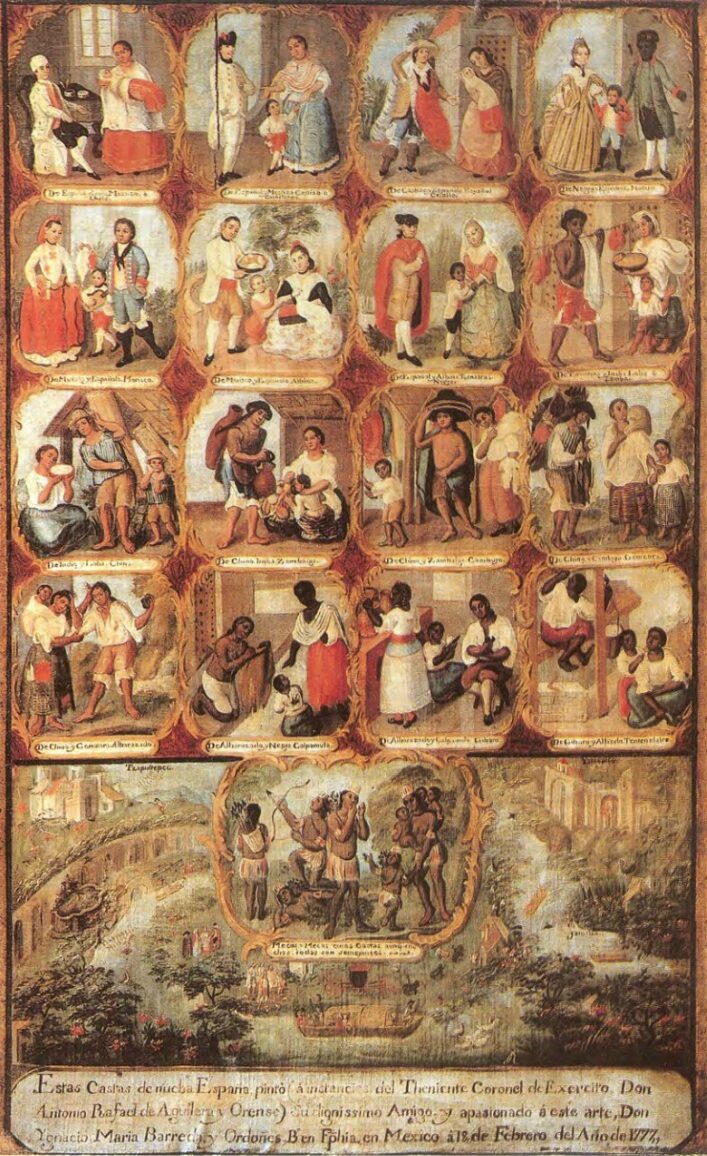
| Casta names (mulato, mestizo, castizo) | Spanish (New Spain) | legal and fiscal mixed categories | colonial period | the 1930 census stopped counting race [55, 238] |
| Mulatto | English (US law) | one-fourth or more "negro blood" in Virginia | 1785; line moved to one-sixteenth in 1910 | dropped; Virginia's 1924 law admitted "no trace whatsoever" [205] |
| Indo | Dutch (East Indies) | European and Indonesian parentage | European legal status; Dutch citizens expelled 1957 | 582,000 Indo-Dutch by 2001 [12, 347] |
| Coloured | English (South Africa) | "not a white person nor a native" | state category from 1950 | 8.2 percent of the population (2022) [28, 267] |
| Pardo | Portuguese (Brazil) | brown | census word from 1872 | the largest group in 2022 [155] |
### 2.3 The model
Pollock and Van Reken sort a third culture kid in a given place by two yes-or-no questions: do you look like the locals, and do you think like them. The answers give four cells. The foreigner looks different and thinks differently. The hidden immigrant looks alike and thinks differently. The adopted child looks different and thinks alike. The mirror is alike on both [126, 264]. Life is simplest in the foreigner and mirror cells, where what others expect matches who the child is. Miyamoto at school sits in the adopted cell; Obama at Punahou sits between adopted and foreigner.
This paper adds a third question: do you sound like the locals? Three lines of evidence say speech is its own axis. First, code-switching breaks the two-axis box: the writer Nathania Gilson, a third culture kid asked on a Melbourne tram whether she was "from here", wrote that the identity box "is rendered useless alongside an event of code-switching" [126]. One writer has already relabelled the four cells by language, with no data [126]. Second, accent steers social preference before any culture is learned: infants of five to six months look longer at a native-accented speaker (section 5.1) [180]. Third, speech and culture pull on each other: for eight Korean third culture kids, English was an edge and weak Korean a job barrier (section 14) [297]. Kazakh has a word for the cell: shala-Kazakh names a person with one Kazakh parent and, in online use, a Kazakh who does not speak Kazakh (section 10.7) [186]. One anchor shows the axis moving under a child, and one cohort shows it at scale ([Figure 1](https://truonghan.com/third-culture-kids/#fig-01-look-speak-think)). Miyamoto sounded local in Sasebo and, at about 14 to 16 in Arkansas, did not [298]. Of the 13,060 Amerasians who had reached the United States by March 1992, 69 percent knew Vietnamese and no English at class placement: a cohort arriving in the does-not-sound-local square [343]. Obama's Jakarta speech is not on record. The teasing he met there was over his pronunciation in religion-class Koran recitation, which is Arabic, and the one report on his Indonesian, a biographer's read only as a snippet, says his classmates took him for Indonesian [140, 210]. His Honolulu placement is the paper's inference from a birth and early childhood there; no card records his speech at Punahou. Kien Nguyen and Bi Thi Loan were raised in Vietnam, and so in the paper's reading sounded local; no card records Kien's English when he reached the United States at 17, so the figure places him only there [243, 290].
Side storyNathania Gilson on a Melbourne tram, about 2005A writer who says code-switching breaks the identity box.
Nathania Gilson was born in India to parents from Kerala, grew up in several countries, and moved to Melbourne as a teenager, in the year of the Cronulla riots. One afternoon she and a school friend were talking on a tram, "voices unselfconsciously loud", when an older woman interrupted: "Excuse me. Excuse me ... Are you... from here?" Gilson struggles to speak her parents' language, Malayalam, and on summer visits to India an older cousin called her "pardesi", a foreigner. In a 2018 essay she tried Pollock and Van Reken's identity box on herself. It worked until she opened her mouth: "While this model can be a useful starting point, it is rendered useless alongside an event of code-switching" [126]. She is a plain third culture kid, the comparison group rather than the core case. Her tram is the first of the paper's three reasons for a third axis. The box sorts a child by face and by mind; a stranger read her face while she talked, and her cousin the language she lacked.
The look axis needs its own line too, because looking different and looking the same each block a different thing. In 29 interviews in Japan, visibly mixed people could not pass as Japanese, while invisibly mixed people could pass but could not claim the mixed label [252]. Miyamoto is the first case; Robert Ho Tung, who looked European in one historian's words and was allowed to claim the Chinese label, is the rarer exception (section 10.3) [127, 202]. The paper found no peer-reviewed paper that adds a speech axis to the box; "none found in our searches" is the claim, not "none exists" [126].
### 2.4 Size: what can and cannot be counted
The world's migrant stock doubled from 154 million in 1990 to 304 million in 2024 ([Figure 2](https://truonghan.com/third-culture-kids/#fig-02-migrant-stock)) [341]. Asian hosts grew faster: Korea's foreign-born population went from 18,499 to 1.8 million [341]. These are outer bounds.
> [**Figure 2**: Migrants doubled; their share of humanity barely moved. 154 million people lived outside their birth country in 1990 and 304 million in 2024, still under 4 percent of all people. South Korea went from 18,499 to 1.8 million.]
Mixed births in East Asia can be counted, within a definition ([Figure 3](https://truonghan.com/third-culture-kids/#fig-03-mixed-births-east-asia)). In Japan, babies with one Japanese and one foreign parent rose from 0.7 percent of births in 1987 to 2.2 percent in 2007, and were 15,511, or 2.2 percent, of 709,051 births in 2024 [228]. In Korea, births to multicultural families peaked at 22,908 in 2012 and were 13,416 in 2024, 5.6 percent of a shrinking total [66]; in Taiwan, births with a new-immigrant parent fell from 13.4 percent in 2003 to 7.6 percent in 2018 [225]. Korea's share still rises because total births fell faster.
> [**Figure 3**: Mixed births in East Asia: 2 to 13 percent, by three measures. Japan has sat near 2 percent since 2006; South Korea's share roughly doubled while the count of such births fell; Taiwan's share fell from 13.4% to 7.6%.]
Intermarriage series tell the same story from the parents' side ([Figure 4](https://truonghan.com/third-culture-kids/#fig-04-intermarriage-series)). Singapore's inter-ethnic marriages rose from 5.8 percent of marriages in 1984 to 19.2 percent in 2025 [302]. Japan's marriages with a foreign spouse went from 4,156 in 1965 to 44,701 in 2006, then fell to 18,420 in 2024 [228]. Korea's international marriages peaked at 13.4 percent of marriages in 2005 and, under a wider definition, were 9.6 percent in 2024 [66]. US newlyweds who married across race or ethnicity went from 3 percent in 1967 to 17 percent in 2015 [204]. The US "Two or More Races" count went from 2.4 percent in 2000 to 10.2 percent in 2020, a jump the Census Bureau attributes largely to a redesigned question [165]. Vietnam sits on the sending side: Taiwan held 121,153 Vietnam-origin spouses in 2024, and one estimate put Vietnamese women married to Taiwanese or Korean men at up to 170,000 by 2015 [182, 229]. Kien Nguyen's cohort was the earlier Vietnamese mixing, made by a war: 68,558 Amerasians and relatives had arrived in the United States by August 1993 (section 10.5) [343].
> [**Figure 4**: Marrying across a line: two climbs, two peaks. Singapore and the United States kept climbing; Japan and South Korea peaked in 2006 and 2005 and fell back.]
Hong Kong shows what a count measures when the label hurts: 272 self-reported Eurasians in 1897, 42 in 1911, and 837 in 1931, while the Ho Tung family alone had twelve children (one adopted) and, through Clara, eighteen grandchildren [58, 199]. In 2021 the same city counted 66,732 residents of "Mixed" ethnicity (section 10.9) [53].
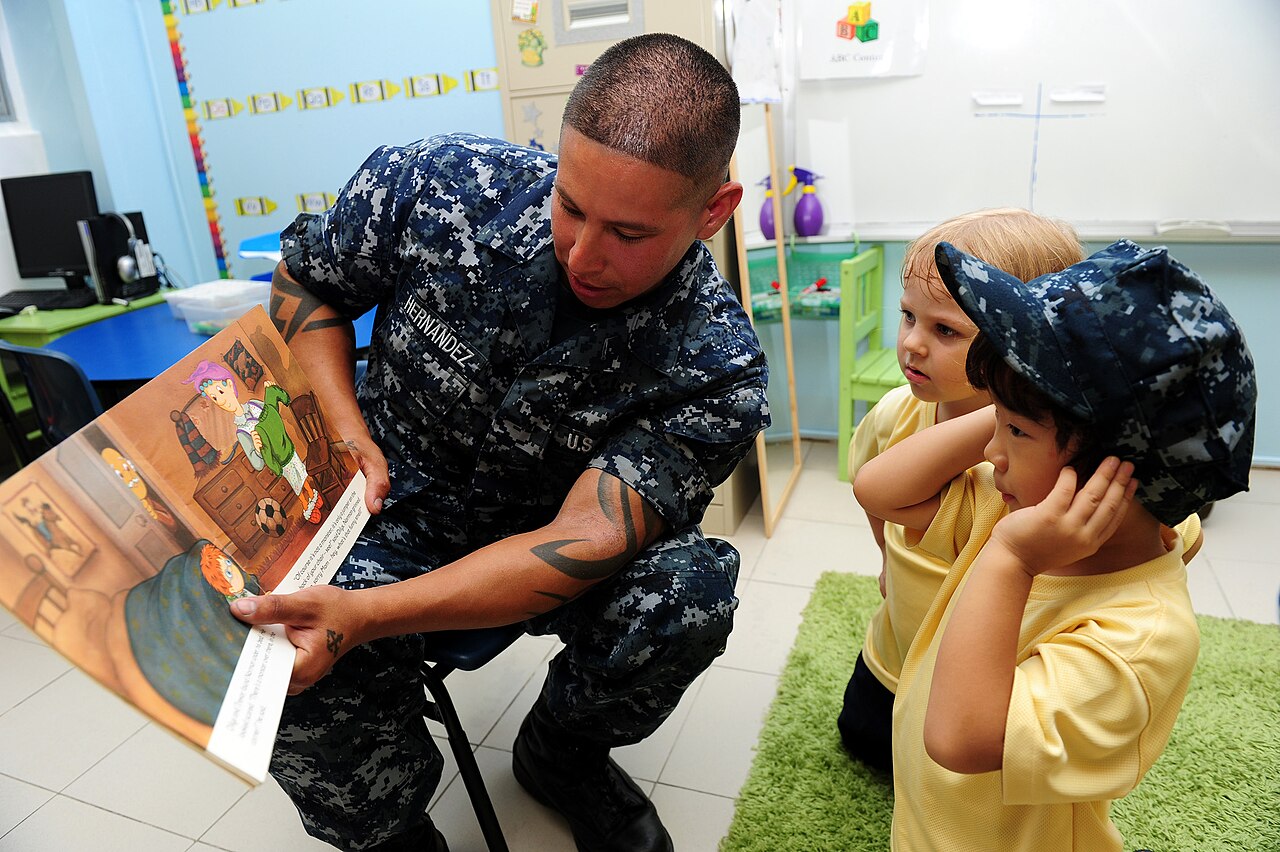
International schools are the last bound, on the mobile side (Plate 2; [Figure 5](https://truonghan.com/third-culture-kids/#fig-05-international-schools)). ISC Research counts 2,584 English-medium international schools with 969,000 pupils in 2000, on its revised back-series, and 15,075 with 7.6 million pupils in 2025 [111, 158]. In thirty years, by one relayed estimate, international school places went from 80 percent expatriate children to 80 percent local children [44]. Enrolment is a loose ceiling on the mobile population.
> [**Figure 5**: International schools grew 4.5-fold in twenty years, mostly for local children. From 2,584 schools and 969,000 pupils in 2000 to 15,075 schools and 7.6 million pupils in the 2025 release, most of them local children.]
Plate 2. A pre-school classroom at the International Community School Singapore, 8 September 2011, during a visit by the crew of USS Pinckney; the caption names no child's origin. Photo: MC2 Eddie Harrison, U.S. Navy, 2011. Public domain, via Wikimedia Commons.
### 2.5 A size is a definition
The size of a mixed group is a definition, not a count. One series puts the mestizo share at 23 percent in 1808, 43 percent in 1885, and 59 percent in 1921, with no source for the first figure [55, 238], and Chance found colonial census sources that "frequently contradict one another" [55]. When Mexico's genome institute studied "the Mexican Mestizo population", it sampled 300 people who called themselves mestizo, so the label came before the result [300]. Pew found 6.9 percent of US adults mixed by background once parents and grandparents count, against 2.1 percent by the census [262]. Singapore's census has no mixed box at all, and a Eurasian sits in "Others" [301]. The words are the host society's. The next section gives the ideas the researchers brought, and asks how far any of them would have predicted Robert Ho Tung.
## 3. Ground knowledge: the identity theories
Hong Kong, 1928. Robert Ho Tung is 65, "generally believed to be the wealthiest man in Hong Kong" [364]. He is barred from the Hong Kong Club and was the first chairman of the Chinese Club that the barred men formed, in 1899 by Carroll's date [364]. He is the only non-European allowed to live on the Peak, despite a 1904 law written to keep Chinese off it, and he has just built Ho Tung Gardens there [11]. In Chicago that year the sociologist Robert Park writes that migration produces a person, "who may or may not be a mixed blood", living in two cultural groups. "The effect is to produce an unstable character," he writes; this is "the 'marginal man'" [256]. The man and the theory sit side by side, and the theory has no cell for him. This section gives the ideas the rest of the paper leans on, each with its evidence and its critics ([Figure 6](https://truonghan.com/third-culture-kids/#fig-06-theory-timeline)).
> [**Figure 6**: Six identity theories and the tests that came decades later. Each row runs from the claim to its test (a meta-analysis, a critique, or a replication), most of them decades after the idea.]
### 3.1 The marginal man
Park's essay had no sample. Milton Goldberg argued in 1941 that a marginal situation need not make a marginal personality, because a "marginal culture" shared with similar people makes them at home; Hong Kong's intermarried Eurasian families were one (section 10.3) [128, 199]. A meta-analysis of 83 studies and 23,197 people found people engaged with both their heritage and the dominant culture better adjusted than people with only one, results that "clearly invalidate early sociological accounts" of biculturals as marginal [242]. A review of third culture kid studies says they "are not confused by the multiplicity of their identity" [96]. A 2021 reanalysis finds the link much weaker (section 7.1) [34].
### 3.2 Erikson and Marcia
Erik Erikson framed a life as eight stages, each a crisis to resolve; the fifth, "identity vs. role confusion", "becomes more prominent during adolescence" [148]. James Marcia turned the stage into four measurable statuses: diffusion, foreclosure, moratorium, achievement. A meta-analysis of 124 studies found that identity does mostly move forward in adolescence, but "large mean proportions of samples were not identity achieved by young adulthood" [185].
### 3.3 Phinney
Jean Phinney carried Erikson and Marcia into ethnic identity, a person's sense of belonging to an ethnic group, and built the scale most studies still use. Across 184 correlational studies of people of colour in North America, ethnic identity and well-being correlated at r = .17, a weak link [304].
### 3.4 Berry
John Berry's acculturation model asks how a person engages with the heritage culture and with the larger society, and sorts the answers into four strategies: integration, assimilation, separation, and marginalisation. Integration, "being engaged in both their heritage culture and in the larger society", tends to go with better adaptation [27]. Floyd Rudmin's critique says the model fails on logic and on evidence: two cultures in contact allow 16 types, not four, and "there is no robust evidence that biculturalism is most adaptive" [281]. Rudmin and the Nguyen and Benet-Martinez meta-analysis disagree, and the disagreement is live [242, 281]. Berry's boxes also assume a free choice; Ho Tung, a dual Chinese and British subject, chose Chinese, though China's rule by the father would have classed him European (section 11) [230].
### 3.5 Biracial models
The biracial models came in the 1990s, built for mixed people. Maria Root, a clinical psychologist born in the Philippines to a Filipina mother and a white father, who heard slurs from classmates as a child, wrote a charter in 1993, printed in 1996, for feelings mixed people had long had but not organised [280]. Her Bill of Rights claims the right "Not to justify my existence in this world", "To identify myself differently in different situations", and "To change my identity over my lifetime--and more than once" [280]. Rockquemore and Brunsma surveyed 177 Black-white biracial people and found four options: singular, border, protean, and transcendent identity [56, 278]. The field has judged its own theories: theory-building on multiracial identity has been "largely disconnected from empirical data" [279]. What the data show is movement: about half of the Black-white and Asian-white teenagers in one national sample, 57 and 53 percent, gave the same label six years later (section 5.3) [98].
### 3.6 Bicultural identity integration and frame switching
Bicultural identity integration (BII) is the degree to which a person sees their two cultures as compatible or in conflict. Shown Chinese primes, high-BII people made more external attributions, the Asian pattern; low-BII people did the reverse [24]. The underlying finding is cultural frame switching: bicultural people switch the frame they use to read events when shown culture-laden symbols, in priming experiments first run in Hong Kong [147]. A 2025 study replicated the Hong Kong result 25 years on [253]. In three studies of multiracial US adults, people who identified with different races in different settings reported lower well-being, less so if they tolerated ambiguity in the self; the data are correlational [288].
### 3.7 Why the question is never neutral
One more idea sits under every scene here. When Tajfel and colleagues split people into groups on a trivial basis, the subjects favoured their own group in handing out real rewards [320]. Social identity theory grew from that result. "Where are you from?" is a categorisation, and categorisation alone is enough to move rewards. Each theory was tested on somebody. Section 4 asks whether anyone like the four people in Table 1.1 was ever in a sample.
## 4. Related work and gaps
Put the four anchors against the two literatures and each falls through. Multiracial research would count Obama and Miyamoto as subjects but not Jakarta or Arkansas; it measures mixed heritage in one place. Third culture kid research would count the moves but not the face; it has no race variable. The Ho Tung family predates both fields [127, 202, 256]. The Vietnamese Amerasians have a small literature of their own, the nearest thing to a study of the core case [175, 215].
The first literature is multiracial research. A review of 125 US articles (133 studies) from 1990 to 2009 found Black-white samples in 55 percent, a West Coast tilt, and non-US studies excluded by design [56]. A 2024 systematic review of identity in non-Black-white mixed groups screened 1,846 articles and kept 18, all in the United States [371]. A narrative review of well-being found maladjustment only in clinical samples [295]. The second is third culture kid research, which is small and does not see race. A systematic review of adjustment during relocation screened 9,433 records and kept 14 studies, none longitudinal; a search of its full text finds no hit for "racism", "discrimination", "multiracial", or "mixed-race" [164]. A review of identity and belonging screened 509 articles and kept 6 [96].
Table 4.1. The reviews, and what they could see
| Review | Records screened | Studies kept | Region | Mobility measured | Race or mixed heritage measured |
|---|---|---|---|---|---|
| Charmaraman et al. 2014, multiracial methods [56] | not stated | 125 articles, 133 studies | US only, by design | no | yes (55 percent Black-white) |
| Zamora and Padilla 2024, non-Black-white identity [371] | 1,846 | 18 | US only | no | yes |
| Shih and Sanchez 2005, multiracial well-being [295] | narrative review | not stated | mostly US | no | yes |
| Jones et al. 2022, TCK adjustment [164] | 9,433 | 14 (10 quantitative, 0 longitudinal) | mixed | yes | no (0 text hits) |
| Donohue 2022, TCK identity and belonging [96] | 509 | 6 | mixed | yes | no |
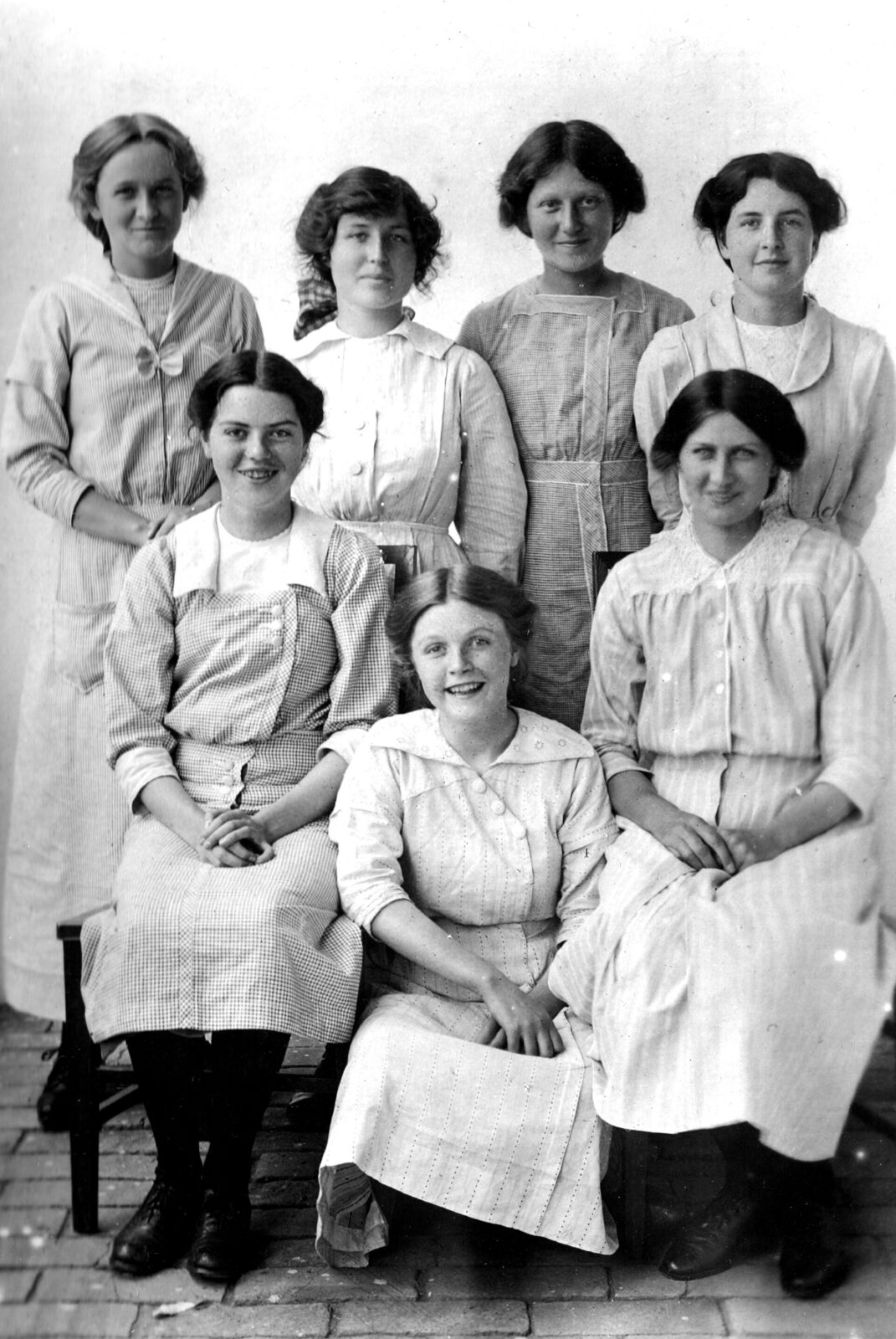
Plate 3. Older girls at the China Inland Mission Chefoo School, Shandong, about 1914, a boarding school opened in 1881 for the children of foreign missionaries and of the foreign business and diplomatic communities in China; the one historical image of mobile children as such, decades before anyone had a name for them. Edith Rinell, daughter of Swedish missionaries, sits in the middle row, right. Photo: unknown, circa 1914, from the album of Edith Johanna Rinell. Public domain, via Wikimedia Commons.
A few studies sit near the overlap. In London, 79 teenagers, half born abroad, gave the pattern "no gain without pain": higher open-mindedness and cultural empathy, lower emotional stability [91]. Two 2023 studies split: in 489 adults, TCKs had weaker ethnic identity than non-TCKs but more resilience [94], while 399 students in the UAE did better with integrated rather than compartmentalised identities [94]. A US master's thesis interviewed six non-white TCKs at one college, five of them biracial, and its author wrote that "a study dedicated to understanding the biracial identity of non-white TCKs would be beneficial" [60].
The gap, stated as a search result: this paper found no study that measures mixed-heritage children raised across cultures as such. Title and abstract searches on 2026-10-26 for "multiracial third culture kids", "mixed-race third culture kid identity", and four related queries returned no paper whose focus is both; Appendix C lists them so the search can be repeated [60]. "No study found" is the claim; "no study exists" is not. So nearly every finding in sections 5 to 9 was measured on one of the two comparison groups, and each finding says which. No study follows a child like these four from the first day of school to old age. The next four sections do it with what exists, one life stage at a time, and say at each stage which comparison group the evidence came from.
### 4.1 Whose lives this paper sees
The lives this paper can see are the ones somebody wrote down, and people get written down for being exceptional. The four anchors are a president, a national titleholder, a colony's reputed richest man and his family, and two Amerasians whose stories reached a memoir and a wire feature; most side stories are celebrities. The comparison literatures have the same tilt. Useem and Cottrell's adult TCKs came from families overseas "with the military, the State Department, business enterprises, religious organizations, and a miscellany of other sponsors", with "highly educated parents" and good overseas schools, and they volunteered [345]. The TCK label, one sociologist of international schools writes, "is usually applied to those who are relatively economically privileged", by a literature "unreflexive of its own American-centric approach" [323], and young people who fit the frame "do not want to be identified as being privileged" [80]. The wider term, cross-cultural kid, folds in children of immigrants, refugees and minorities (section 2.1) [264], and the research under it is thin. The mixed-race qualitative literature says the same of itself: a leading British study drew its 65 interviewees from universities and colleges and wrote that they "may have been insulated from the harshest manifestations of racism" [307]; a Birmingham study recruited a class-balanced sample because such studies "often report high proportions of middle class participants" [50]; even a study of Japanese-Filipino children with poorer mothers landed on private-school and university students, and its author calls class "often overlooked" [336]. No TCK study the paper found samples poor migrant-worker families.
What that does to every reading: the advantages of section 7 were measured on people with the schooling and the networks that turn a position into a seat; the costs of section 6 were measured on people a study could reach, so the worst-off are under-counted on both sides; and the stay-or-leave verdicts of section 12 lean on leavers who had somewhere to go. The paper's answer is a fifth anchor that no one wrote a memoir about: the children of marriage migrants in Korea and Taiwan, counted in national surveys and panels (Table 1.1; sections 5.4, 6.4 and 12). Where a finding below comes from a comfortable sample, the text says so; where the ordinary cohort gives a different number, it is printed beside it.
## 5. Development across the life course
Jakarta, about 1970. A nine-year-old boy waits in the library of the US embassy, where his mother works, and reads Life magazine. He finds a man whose skin has been chemically lightened, and learns that thousands of Black Americans had bought the treatment "in response to advertisements that promised happiness as a white person". "I felt my face and neck get hot." He says nothing to his mother [248]. Afterwards he began to notice that "there was nobody like me in the Sears, Roebuck Christmas catalog", and kept it to himself so as not to show her that her lessons had failed [248]. This is Barack Obama a year before the Punahou classroom of section 1, the earliest moment any anchor records about the look axis.
This section walks from the first months of life to old age. Figure 7 is the master figure: beneath the comparison-group evidence, an anchor band pins each scene in the four lives at the age it happened, and the empty stretches are gaps in the record ([Figure 7](https://truonghan.com/third-culture-kids/#fig-07-life-course)). Children react to look and speak years before they can think about either.
> [**Figure 7**: What the evidence covers, from birth to old age, and where the four lives sit. Studies of other children crowd into the first 25 years and stop at 45; the anchor band carries the four lives to 46, and only Robert Ho Tung's goes on, to 1956.]
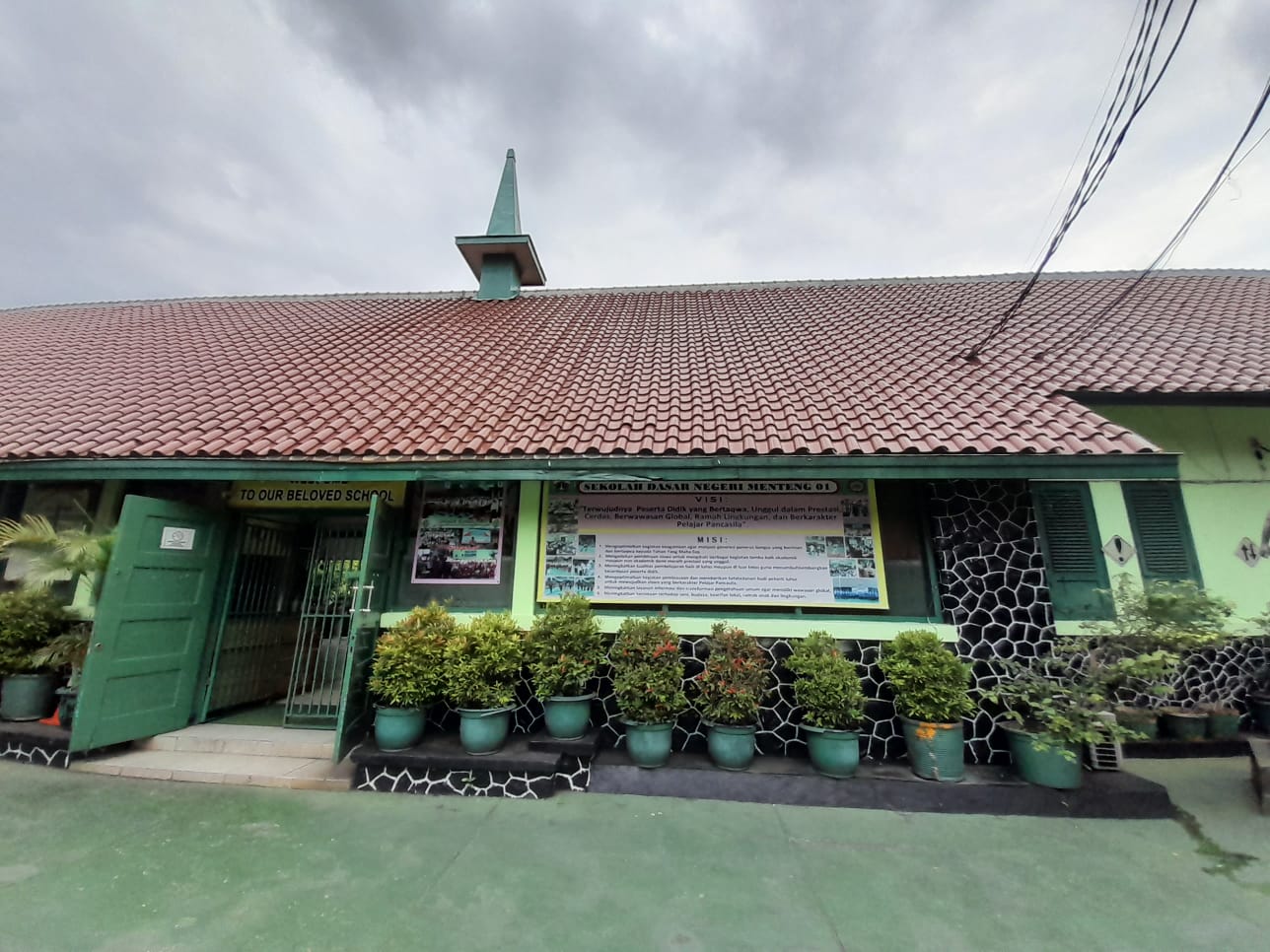
Plate 4. State Elementary School Menteng 01 (SDN Besuki), Jakarta, as it stands today; Obama attended it for less than a year, about 1970 to 1971, after an earlier school, Asisi. Photo: KemalWorld, 2024. CC0, via Wikimedia Commons [140].
### 5.1 Early childhood
No anchor has a scene before school age that touches difference; the earliest, Kien Nguyen's fifth birthday in 1972, records a roasting pig and nothing about his blond hair [243]. The evidence below is on infants in general.
Newborns show no preference for faces of their own group. Three-month-olds do, so the preference is learned from the faces around the crib [174].
Sound arrives next. At five to six months, 18 of 24 infants looked longer at a speaker with the local accent; at five, eight children "tended to choose" the local-accented child as a friend. The cells are tiny [180]. The child who sounds foreign loses friends before anyone asks where she is from.
The doll studies measure the look axis. In 1947 the Clarks tested 253 Black children aged three to seven; the share who said the brown doll "looks like you" rose from 36 percent at three to 87 percent at seven [68], while the share who chose the white doll to play with peaked at four, at 76 percent, and fell to 60 percent by seven ([Figure 8](https://truonghan.com/third-culture-kids/#fig-08-doll-by-age)) [68]. One caveat carries: a forced choice between two dolls is not self-esteem, and a 1995 re-test found Black preference more likely where children showed any [46].
> [**Figure 8**: The doll that looks like them, and the doll they want to play with. Choosing the brown doll as the one that looks like you rose from 36% at age 3 to 87% at 7; preferring the white doll to play with peaked at age 4.]
Sorting people by race comes later, and whether race is a category at all depends on place. Children can sort faces into racial groups between six and eight [258]. In 136 children, those in Massachusetts believed more firmly than those in Hawaii that race cannot change, and that belief explained their higher stereotyping [260]. The review that collects this work adds that multiracial children have been "almost entirely excluded" from it [258].
### 5.2 School age
All four anchors are on record at school, and all four were marked there. Obama entered first grade in Jakarta in 1968 under his stepfather's surname; later, at the Besuki school (Plate 4), a classmate remembers him "laughed at because of his funny pronunciation" during Koran readings, which are recited in Arabic, so the teasing says nothing about his Indonesian [140]; a biographer who interviewed classmates reports, in a passage read only as a snippet, that by the end of his first year they took him for Indonesian [210]. His mother (Plate 5) could not afford the International School, kept him in Indonesian schools, and woke him at four, five days a week, to teach English before school: "I was an American, she decided, and my true life lay elsewhere" [248]. At ten he landed in Honolulu to live with his grandparents, "I realized that I was to live with strangers", and walked into the Punahou classroom of section 1 [248]. That winter he told the boys that his father, due from Kenya, was a prince [248].
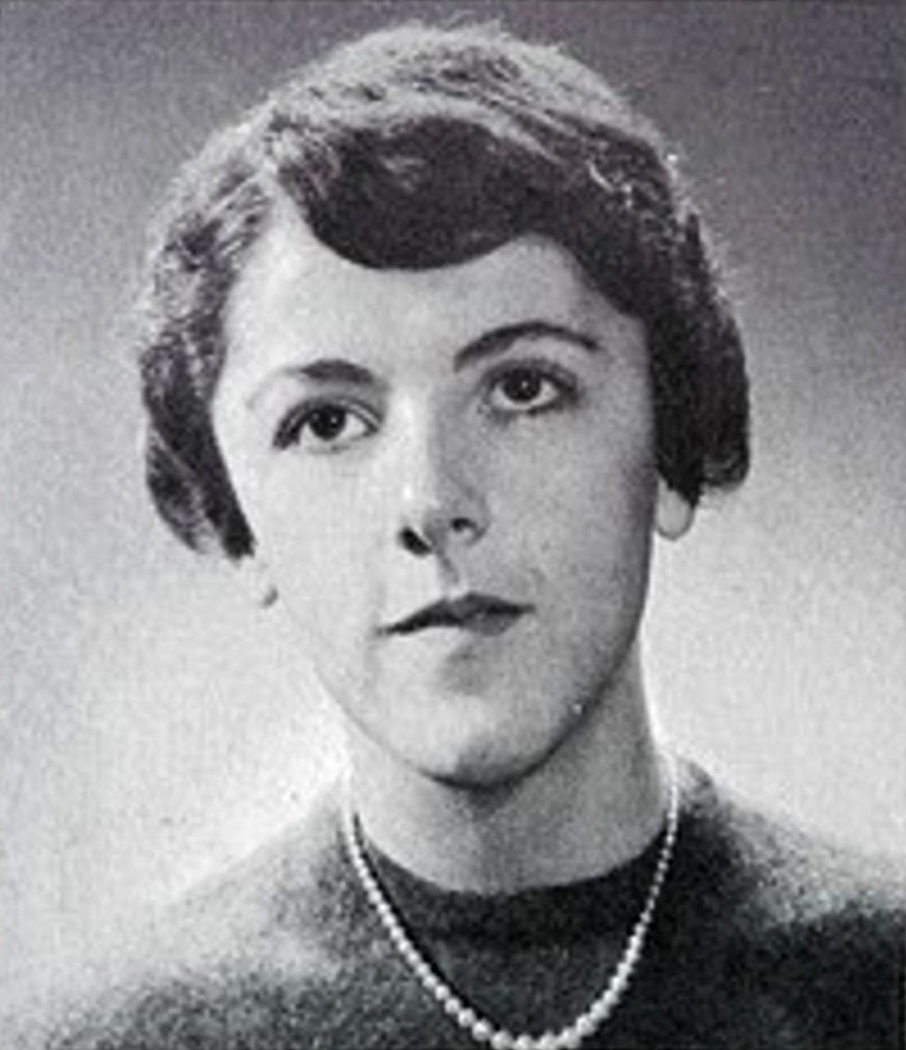
Plate 5. Stanley Ann Dunham, Obama's mother, in her 1960 high school yearbook; she raised him across Honolulu and Jakarta and taught him English before dawn. Photo: unknown, from the 1960 Mercer Island High School yearbook. Public domain, via Wikimedia Commons [248].
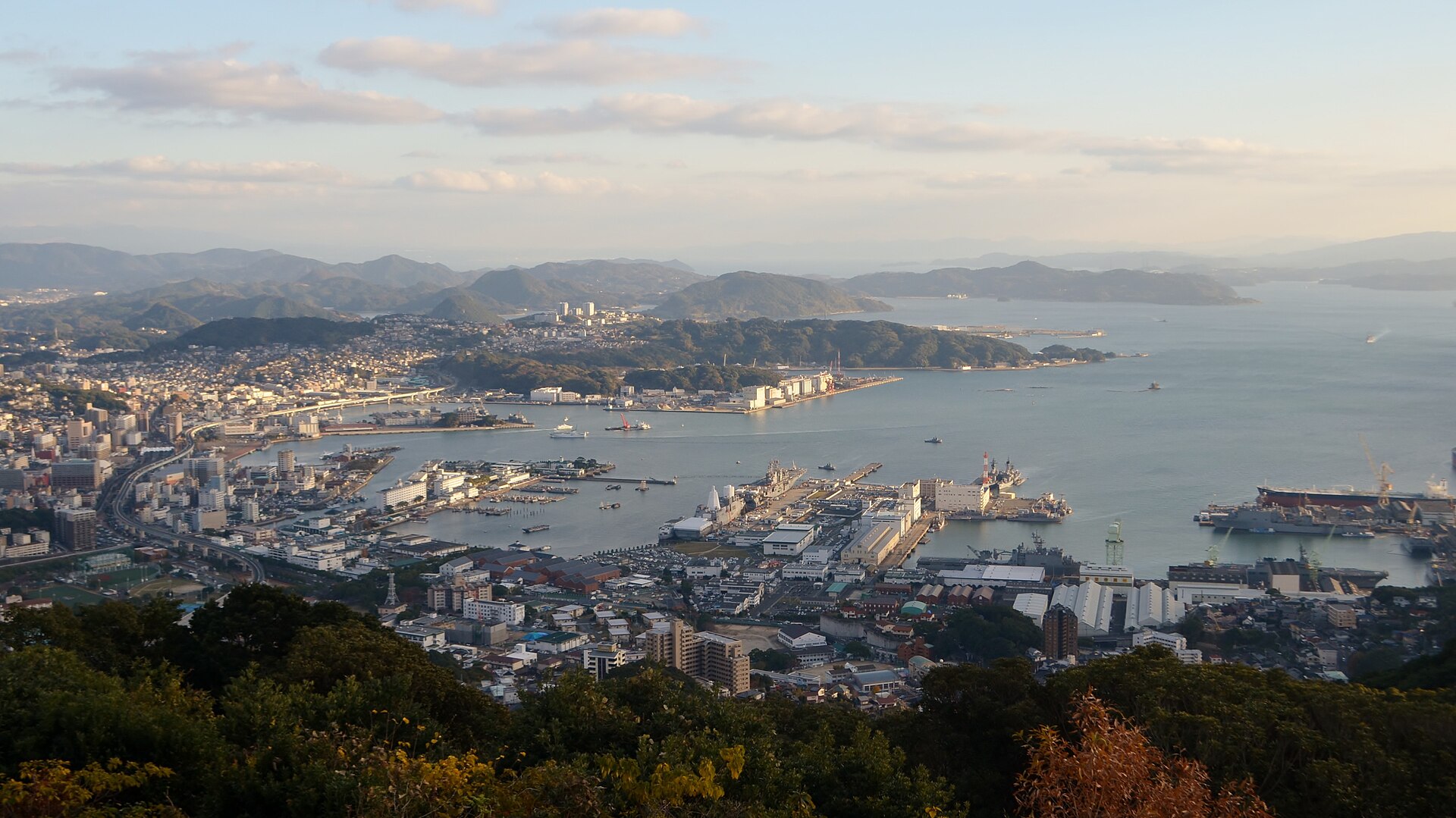
Ariana Miyamoto, at school in Sasebo (Plate 6), was called "kurombo", a slur for a dark-skinned person. When the teacher told the class to hold hands, children said, "Don't touch me", afraid her colour would rub off; a board eraser was thrown at her [92, 139, 298]. Most mixed children in Sasebo, she says, lived inside the US base; she lived outside it, where "everyone around me was a so-called 'pure Japanese'" [298]. Her coping: "In the end I think I made myself stop thinking about the words" [139, 298].
Plate 6. Sasebo, Nagasaki Prefecture, from the Yumihari-dake lookout, 2017: the town where Miyamoto grew up outside the naval base. No licensed photograph of her exists. Photo: Rekishi-JAPAN, 2017. CC BY-SA 4.0, via Wikimedia Commons [298].
Kien Nguyen was seven when Saigon fell in 1975. "Because her children were Amerasian", his mother was not allowed to work, and the family took refuge with relatives who, in one biographical entry's words, "abused them no less than did the government" [243]. Bi Thi Loan, given to her grandmother at two months because her mother's husband disliked the child, was pulling a plough at 12, and an uncle who had fought for the Viet Cong beat her head with a stick each time she failed [290]. Alex Oi, a Mexican-Japanese boy filmed at a Nagoya school in 2013, showed "physical symptoms of stress due to the teasing he receives from his classmates for being hafu" [321].
The school decides what the same child is. Among Japanese-Indonesian children, hāfu pupils were "deemed inferior" at the Japanese school in Indonesia and "superior" at the Indonesian one; the abstract gives no sample size [322]. Parents in Japan's 2016 foreign-resident survey named teasing "for name or nationality" as their top school worry, at 30.1 percent, a worry rather than a rate [150]. No survey measures bullying of hāfu children; Miyamoto's eraser and Alex's stomach are cases [82].
Side storySandra Laing, Piet Retief, 1966A school expelled a dark-skinned girl of ten or eleven, and the state then classified her twice without her parentage changing.
Sandra Laing was born in 1955 to white Afrikaner parents, Abraham and Sannie Laing, and raised as white with two brothers. Her skin was dark. After five years at an all-white boarding school in Piet Retief she was expelled, and two policemen escorted her home. She was ten by the Guardian's and the BBC's count, eleven by the Sunday Times'. Nine schools then refused her, the community punished the family, and her father appealed in vain against her reclassification as Coloured. In 1967 the law changed so that the child of two white parents could not belong to another racial group, and she was reclassified white. Blood tests proved she was her parents' child. At 15 or 16 she eloped with Petrus Zwane, a Black man, and her father threatened to shoot her if she returned. To keep her two children she needed to be classed Coloured, and her father refused his consent. She found her mother again in 2000 through a journalist; as of 2003 her brothers still shunned her [52]. The look axis, read by a school and then by a registrar, moved one child across a legal line twice. Her case sits in the Cape Coloured row of the library (Table 10.1).
Kikokushijo, the returnee children Japan has counted since 1977, are the one in-between group it does count: 10,000 to 13,000 a year from 1985 to 2000 [171]. Their public image swung from "educational orphans" to "symbols of internationalization", and many hid their years abroad [171].
In Pew's 2015 survey of 1,555 multiracial adults, 15 percent had been teased as children for being mixed, 30 percent among Asian-white backgrounds [262]. The largest school survey is Add Health, a US study that followed teenagers from 1994 into adulthood. In its first wave, 7.4 percent of 83,135 students chose more than one race; their odds of smoking were about twice those of single-race peers for Black and Asian mixed teens and 1.2 times for white, yet "most mixed-race adolescents are at low risk" [337]. Fryer and colleagues found Black-white teens in the middle on most measures and "stark outliers" on risky behaviour [114].
Korea now counts its mixed children in school. Students from multicultural families, the government's term for children with a foreign-born parent, rose from 46,954 (0.70 percent) in 2012 to 168,645 (3.19 percent) in 2022. By 2026 they were 210,838 (4.31 percent), while the school population fell ([Figure 9](https://truonghan.com/third-culture-kids/#fig-09-korea-multicultural-students)) [173].
> [**Figure 9**: Two school systems meeting children from elsewhere. South Korea's multicultural students rose from 46,954 to 210,838; Japan's school-age children abroad levelled near 49,463 while from 1985 returnees held between 10,000 and 13,313 a year.]
### 5.3 Adolescence
Obama at 12 or 13 stopped telling people that his mother was white, because he began to suspect that doing so was ingratiating himself to whites [248]. At 14, on a 1975 roll call, he told a teacher, "Just call me Barry" [361]. Of himself at about 15 he wrote, "I was trying to raise myself to be a black man in America, and beyond the given of my appearance, no one around me seemed to know exactly what that meant" [248]. One school friend, also mixed, remembers it differently: "He made everything out like it was all racial"; and Hawaii, where everyone was some kind of minority, is a weaker test of the look axis than Sasebo [361].
Miyamoto, in her mid-teens, went to live with her father in Jacksonville, Arkansas. In Japan people had said, "You're hafu, so why can't you speak it?"; in Arkansas friends said of course she could not, having grown up in Japan [298]. The same missing language cost her status at home and nothing abroad. Loan at 15 begged her mother to take her back, and her stepfather refused [290]. For the fifth anchor, adolescence brings a share of the mother's Korean reading and writing, usually behind the father: among ten Korean-born teenagers with immigrant mothers, four of them Vietnamese, language brokering for the mother was "an inevitable part of family assistance for all the participants", since eight mothers spoke Korean well and two read or wrote it well, though the father usually handled the official paperwork and the teens called their share minor [160].
In adolescence the label moves. Of Add Health's 20,743 Wave I students, aged 12 to 18, 5,548 (27 percent) were lost by Wave III, at 18 to 25; Doyle and Kao analyse the non-Hispanic remainder: single-race white and Black youth kept their label 96.3 percent of the time, Black-white youth 57.0 percent, Asian-white youth 53.1 percent, and Native American-white youth 18.6 percent ([Figure 10](https://truonghan.com/third-culture-kids/#fig-10-identity-stability)) [98]. About 12 percent of the same survey's teenagers gave different answers to near-identical questions about their race [98]. A looser count, from a national sample of 14- to 18-year-olds re-measured five years later, in which adding or dropping any one category counts as a switch, found youth who ever called themselves multiracial four times as likely to switch as to keep a consistent multiracial label [144]; it measures a different thing from Doyle and Kao's shares, and the two numbers do not combine. Interviewers recorded 45 percent of the Asian-white teenagers as white: the look axis measured by a stranger with a clipboard [98].
> [**Figure 10**: Single-race labels hold; mixed labels move. Six years on, 96% of single-race white and Black youth gave the same label; 18.6% of Native American-white youth did.]
The choice follows how the teenager thinks others read her face. Among 177 Black-white adults, identity followed "an actor's assumption of how others perceive his or her appearance", not skin colour [278]. In Japan the constraint runs both ways, as the 29 interviews of section 2.3 showed [252]. Fusae Miyako, in the film Hafu, is the invisible case none of the four anchors shows: she grew up in Kobe believing she was entirely Japanese and learned in her teens that a parent was Korean, a hidden immigrant [321]. In Pew's survey, 61 percent of adults with a mixed background do not call themselves multiracial [262]. A 27-year-old respondent: "Sometimes I just get tired of explaining who I am" [262]. The Amerasian cohort's teenagers were measured only as adults, on opposite sides of the Pacific; section 12 holds that comparison [198].
Side storyFusae Miyako, Kobe, in the film Hafu, 2013The invisible mixed face: she looks local and learned in her teens that her father was Korean.
By the film's own site, Fusae Miyako was born and raised in Kobe to a Korean father, who later became a naturalised Japanese citizen, and a Japanese mother. "No one can tell that Fusae (35) is hafu just by looking at her," the film's own site says. Until she was 15 she was raised to believe she was entirely Japanese. Then she found family documents that pointed to her Korean roots, confronted her mother, and found the discovery traumatic at the time. She began to study the differences between the two cultures. Twenty years on, at 35 when the film was made, she was still working out her place as a Korean-Japanese descendant. She helps organise the events of Mixed Roots Kansai, where, she says, the work helps younger people accept their mixed identities [321]. She is the hidden immigrant of Pollock and Van Reken's box, the one cell none of the four anchors occupies. Nothing in her face asked the question, and the answer still arrived.
### 5.4 Young adulthood
Kien Nguyen left Vietnam in 1985 at 17, after several failed attempts, under the Orderly Departure Program, with his mother, brother and sister: "I was the first kid to get on the plane." The family spent 22 days in Bangkok and three months in a camp on Bataan [349]. Miyamoto was crowned Miss Universe Japan on 12 March 2015, at 20, the first biracial winner, and placed in the top ten at the world final [92, 298]. Jean Gittins, born Ho Tung, at about 20 left university to marry Billy (Bill) Gittins in March 1929, over her father's objection to any daughter "marrying into an Eurasian family which did not subscribe to his view and adopt Chinese nationality" [127].
Obama's twenties are the one stretch between 18 and 30 that any anchor records in detail. At Occidental College, about 1980, a mixed classmate who refused the Black label made him "question my own racial credentials all over again" [248]. The same year friends began calling him Barack; his father had taken "Barry" in 1959 to fit in, and the son took the full name back as "an assertion of being comfortable with the fact that I was different" [361]. A friend said, "I thought your name was Barry", the sentence that had reached him at ten [248]. At Columbia, at 20 to 22, he understood himself as a black American, but "that understanding remained unanchored to place" [248].
Most in-between young adults get a move "home" instead. In Useem and Cottrell's survey of 680 adult American TCKs, read here in the authors' own 1993 newsletter articles, 81 percent held at least a bachelor's degree against 21 percent of Americans, and in a later article nine in ten of nearly 700 said they were "out of synch" with their age group for life; the sample volunteered, and came from what the authors call "elite communities", so section 7.8 weighs it [76, 77, 345].
The fifth anchor's young adulthood is measured in two national series, and it is ordinary. In Korea, 61.9 percent of multicultural-family youth were in higher education in 2024 against 74.9 percent of all Koreans, a gap of 13 points, down from 31 in 2021; part of the jump may be the survey's older age mix [226]. In Taiwan, adult children of new immigrants aged 18 to 40 showed no significant gap with the general population in college attendance or income in one self-selected survey, and family income decided who climbed [333]; the "ethnic dividends" of a Southeast Asian mother reached mostly those with a university place [190]. Harry Chan and Sean Hsu, 19, in Taipei (section 8), are two of them.
Reverse culture shock, the distress of returning to a country that is supposed to be home, has only small studies behind it: 785 Turkish returnee students, 18 percent with clinical depression against 11 percent of classmates who never left [120]; four Japanese returnees "polarized toward one language and culture" as teenagers [170]; and a life-history study in which returnees "scrape off" the overseas self or "graft" Japanese patterns on top of it [171]. Miyamoto's return from Arkansas is the anchor case, unmeasured [298].
Adult TCK samples show one pattern with two faces: weaker ethnic identity, more resilience and less comfort in close relationships in 489 adults [94]; cultural homelessness, the feeling of belonging to no culture, with lower self-esteem in 475 [145]; normal maturing of personality and well-being in 700 [1].
### 5.5 Adulthood
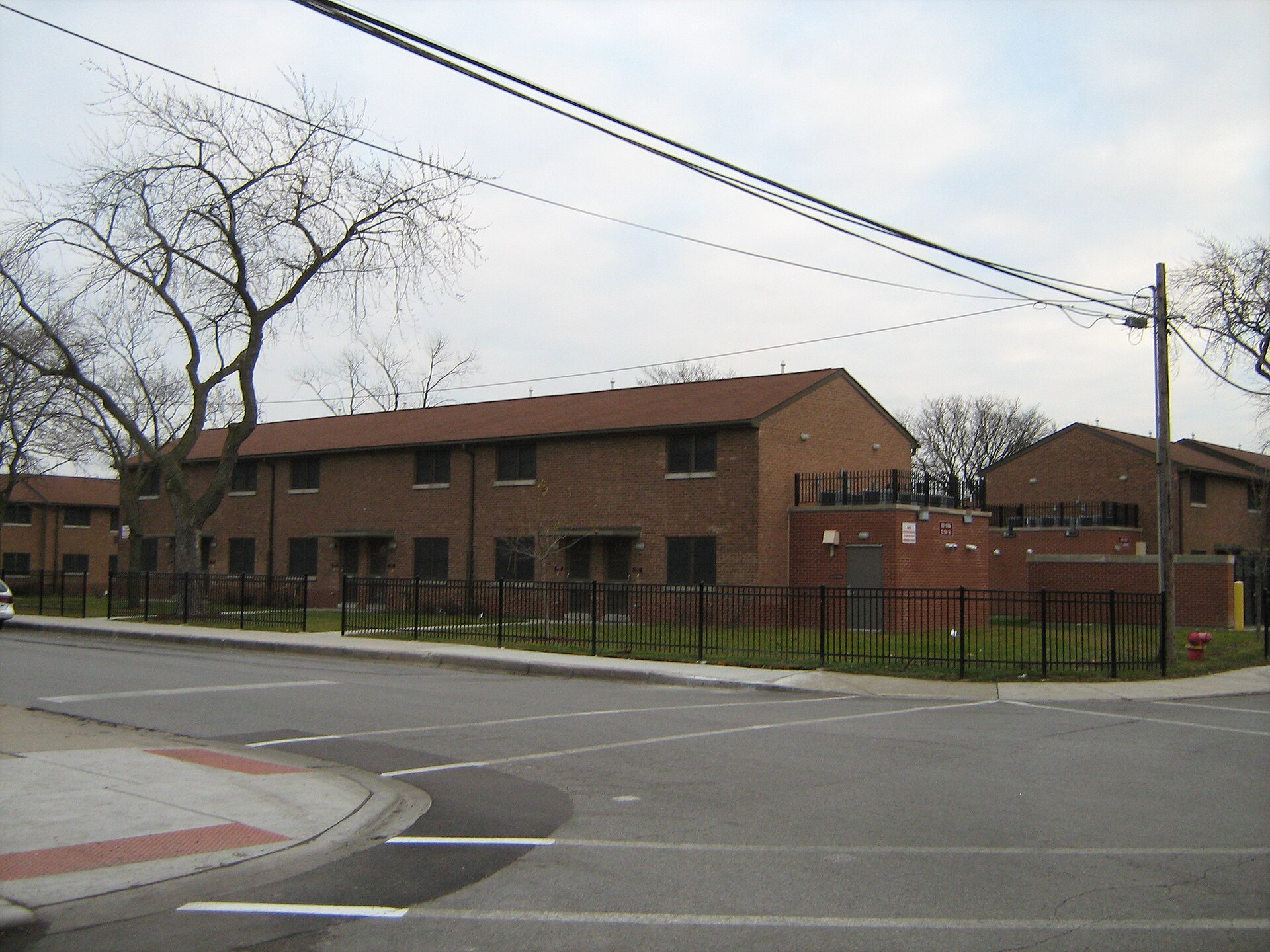
Jean Gittins at about 32, in 1941, sent her children to Melbourne. Elizabeth was ten and John five. The evacuation order of July 1940 had applied, she wrote, "only to those of 'pure' British descent", and her father's "claim to Chinese nationality would automatically rule out the possibility of my entry into Australia". The children went with family friends on their own passports: "Gittins was an English name and they looked foreign enough" [127]. Kien Nguyen at 31 took his dental degree in 1998; nightmares followed, a therapist told him to write everything down, and the diary became a memoir. By 38 he had given up his solo practice for writing: "I'm a writer, I love what I do, I find this is my calling" [349]. Loan at about 39 lived in a house inside a Saigon cemetery with her husband, four children and in-laws, ten people on about $38 a month, and was going back to school after fifth grade [290]. Obama in his mid-twenties, organising in Chicago (Plate 7), found that church women traded stories with him, and the stories "helped me bind my world together" [248]. At 46, in 2008, he opened a speech on race with "I am the son of a black man from Kenya and a white woman from Kansas" [247]. Miyamoto at 29 had two sons and lived in the United States [298].
Plate 7. Altgeld Gardens, the public housing project at "Chicago's southernmost edge" where Obama organised in the mid-1980s, photographed in 2009. Photo: Zol87, 2009. CC BY-SA 4.0, via Wikimedia Commons [248].
What adults pass on is mostly language. In 1,899 families with a minority-language parent, every child spoke the majority language, and the "one parent, one language" rule was neither necessary nor sufficient for the minority one [83]. In the United States, immigrant languages are nearly gone by the third generation, Asian ones faster than Spanish (section 9) [284]. Mixed parents also talk more than their parents did: 47 percent had discussed the mixed background with their children, against 32 percent who recalled their own parents doing so [262]. Miyamoto's sons are the one next generation on record in a parent's words: on American forms she ticks Black and Asian for them, and at a kindergarten open day in Japan one was greeted with "a foreigner has come" [298].
For the Amerasians who reached the United States as young adults, adulthood meant low-paid work, and Kien, a dentist from a wealthy family, is not typical. In a 1994 GAO sample of 100, 60 percent were employed [343]; of 13,060 Amerasians processed by March 1992, 7 percent had no schooling and 65 percent some primary school [343].
### 5.6 Old age
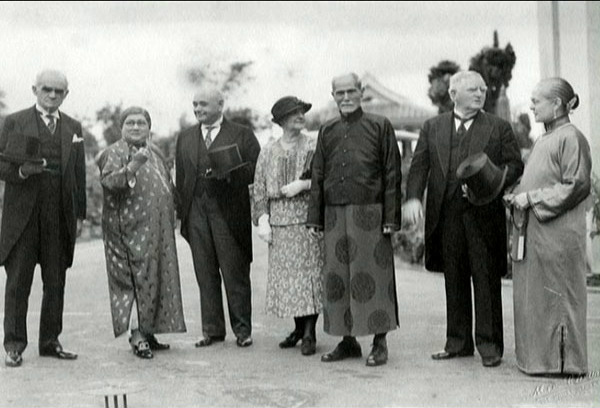
The only anchor old age on record is a rich man's. Robert Ho Tung at 72, in about 1935, received the US vice-president at Ho Tung Gardens, in Chinese dress (Plate 8). He spent the Japanese occupation mostly in Macau, and his loyalties came under question afterwards [199]. His daughter Irene lived in his household for his last ten years [58]. He was knighted a second time in 1955, at 92, and died in 1956 [11]. No card follows the other anchors further.
Plate 8. Sir Robert Ho Tung, about 72, third from the right in Chinese dress, receives US Vice-President John Nance Garner at Ho Tung Gardens, about 1935; the Commons description names Lady Clara and Lady Margaret in the group. Photo: unknown, South China Morning Post archives. Public domain, via Wikimedia Commons [127, 202].
No study follows mixed-heritage TCKs into old age. Figure 7 goes empty after 45 and after 1956 for lack of data, not of people. The nearest evidence comes from adult TCKs. The Useem and Cottrell respondents ran to age 87, and a majority, "including those over 65", still reported re-entry difficulty [78, 345]. Four lives, one pattern: at every age somebody asked what they were. Section 6 prices the question.
## 6. Challenges
Tokyo, March 2015. Ariana Miyamoto, 20, has held the crown for a week. A post in Japanese circulates online: "Even though she is Miss Universe Japan, her face is foreign no matter how you look at it!" Others write that Japan should be represented by "a pure blood". She answers: "But I am a Japanese" [92, 221]. Two months later she tells AFP she had expected it, and that it hurt. "I'm Japanese." "I stand up and bow when I answer the phone" [143]. She speaks unaccented Japanese; what fails the test is the face [221]. The cost of that test lands on the child, and from both sides.
### 6.1 "What are you?": invalidation and forced choice
Identity invalidation means that others deny the identity a person claims. Miyamoto's "No, you can't be" is its plainest form [360]. Obama describes the subtler one: people who learn his background make "split-second adjustments", and "They no longer know who I am" [248]. Forced choice means a form, or a person, that allows one box. Invalidation has three measurable forms, tested in 497 multiracial adults: behaviour ("you do not act Asian"), phenotype ("you do not look Black"), and discrimination aimed at an identity the person does not claim [110]. In the lab, denial raised self-reported stress in 126 bicultural and 119 biracial participants, and the bicultural group recovered more slowly in cortisol, the stress hormone; that design is causal [6]. In 317 multiracial adults, frequent forced-choice dilemmas predicted more depressive symptoms through lost identity autonomy. Identity autonomy means feeling free to identify as you like [287].
The harm is specific. In 193 multiracial college students, discrimination aimed at being mixed predicted distress (beta = 0.26), while general discrimination did not [93]. For a child like Miyamoto, the measured harm is in the sentence "you cannot be".
### 6.2 Mental health: the findings disagree, and the paper says why
Read the large surveys and mixed teenagers are at risk. Read the matched studies and they are not ([Figure 11](https://truonghan.com/third-culture-kids/#fig-11-mental-health-ledger)).
The risk side begins with Udry's 2003 Add Health paper. Teenagers who named more than one race had higher odds on most items in the printed tables, which carry no controls, yet "most mixed-race adolescents are at low risk" [337]. The authors also re-ran the analysis with controls for age, sex, vocabulary score, grades, family structure and parents' education, and report that very few odds ratios crossed below 1, though many changed in significance; the controlled tables were not printed, and income was not among the controls [337]. For White-Asian teenagers, the group nearest this paper's case, the excess was modest and uneven: 1.50 for fair or poor health and 1.58 for sleep problems against white teenagers, with several items not significant [337]. In four Seattle middle schools in 1997, 50.1 percent of the 454 multiracial pupils had ever smoked, against 32.8 percent of white pupils; 55 percent of the multiracial pupils were low-income against 11 percent of the white ones, and the higher risk held in models with age, gender and low income controlled [64]. A systematic review of 22 studies from 2016 to 2022 found that multiracial people "tended to have worse mental health, with notable exceptions", and reported no pooled effect [250].
The no-gap side uses the same or better data. Cooney and Radina, also in Add Health, found differences on fewer than half the measures [75]. Shih and Sanchez's review (section 4) found maladjustment only in clinical samples [295]. In the UK Millennium Cohort of 16,330 children, mixed three-year-olds had fewer behaviour problems than non-mixed children of the same minority group, 8.9 against 13.1 for Pakistani-mixed children on the Strengths and Difficulties Questionnaire, though some mixed groups' trajectories rose after three [375]. In a matched sample of 309 multiethnic and 508 monoethnic US teenagers, the multiethnic group had slightly fewer symptoms [176], and across 47,491 teenagers in two national surveys, biracial substance use often sat between the two parent groups [328].
> [**Figure 11**: Mental health: large surveys find higher risk, matched and cohort studies find little gap. Most odds ratios in two large US surveys sit above 1; matched, cohort and review studies find no gap or a smaller one.]
One case sits beside these rates and is not one of them. Miyamoto entered the pageant after a close friend, half Japanese and half white, died by suicide; the BBC wrote that he killed himself "in part" because he could not face being treated as an outsider, and in her words, "Japanese people didn't accept him and because he didn't speak English he wasn't like a foreigner" [139, 360]. It is one account of one death.
The competing explanation is not mixedness but the household and the school around the child: family structure, father absence, poverty, context. In CILS, in 1998 the largest study of its kind, intact families did "much better" and high-conflict broken ones worst, whatever the nationality [282]; the New Orleans authors tie Vietnamese delinquency to families split by war and resettlement [374]; and inside the multiracial group, household dysfunction predicts depression and anxiety, with standardised coefficients of 0.50 to 0.61 in 1,231 teenagers [357]. The Amerasian record is soaked in both: Loan given away at two months, Kien's family refused work (sections 5 and 6.4); and in the Amerasian case the household hardship was itself imposed for the children's mixedness, Kien's mother barred from work because her children were Amerasian, so the two readings overlap [243]. The studies above control for these unevenly. Udry reports that with family structure and parents' education held constant very few odds ratios fell below 1; the controlled tables were not printed, income was not among the controls, and his White-Asian teenagers had more college-educated parents than white teenagers and fewer two-parent homes, 73.5 against 78.4 percent [337]. The Seattle study held income but not family structure [64]. The two direct tests of the poverty reading disagree: in the UK cohort, adjusting for household income narrowed the mixed children's advantage, with family structure not held [375]; in the United States the multiracial excess in depression and drug use appeared only in high-income families [134]. Context changes the gap too: in poor inner-city neighbourhoods African American teenagers took fewer risks than white or mixed-race ones, and in one Alaskan city mixed-race students carried fewer protective assets [40, 119]. No study found matches mixed-heritage teenagers with single-race teenagers on father absence.
The paper's reading is the authors' synthesis, not a tested result: where a gap shows, it tracks invalidation and discrimination more than mixed heritage itself, and the household explains part of what remains. Against the household reading: the odds stayed above 1 in Udry's unprinted controlled re-run, and the US excess appears in high-income families where poverty cannot carry it. For it: the UK gap moved with income, household dysfunction predicts symptoms inside the multiracial group, and no study controls for household and discrimination at once. The studies that find a gap are large and cross-sectional; the studies that match on background or follow a cohort find no gap or a small one in the other direction [375]. The one study that separates the two kinds of discrimination (section 6.1) points the same way [93].
### 6.3 Belonging, restlessness, grief
Obama and Coretta kept apart in the Punahou playground "as if direct contact would only remind us more keenly of our isolation" [248]. The TCK literature measures that cost under another name: a thin sense of home. In 19 interviews with third culture adults, 6 said they belonged to no culture, and 15 called the life mainly positive; one said, "I feel like a tourist when I go to my home country" [232]. The London teenagers of section 4 showed more open-mindedness and empathy and less emotional stability [91]; the 489 adults, more resilience and less comfort with closeness [94]. Nearly half of 696 adult American TCKs "do not feel central to any group" [78]. Obama at Columbia named it from inside: a self "unanchored to place" [248].
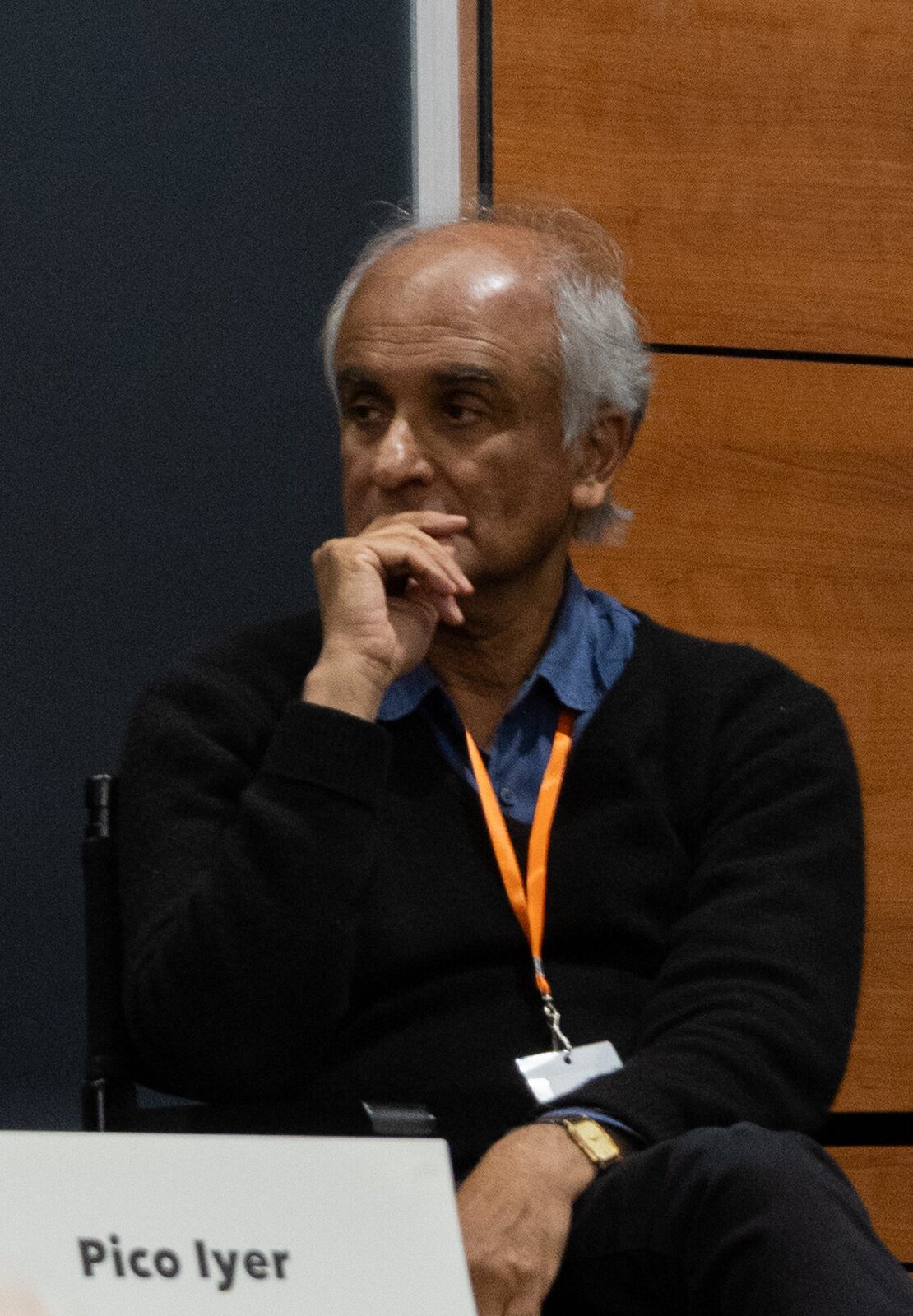
Side storyPico Iyer, Oxford, California and Japan, 1957 to 2013A plain third culture kid who calls belonging nowhere "a terrific emancipation".
Pico Iyer (Plate 9) was born in Oxford in 1957 to Indian parents; the family moved to California when he was seven, and he was schooled in England and the United States. He is the comparison group, a mobile child without mixed heritage, and his account of belonging is a sunny one. Of India he told a 2013 audience, "I've never lived one day of my life there", and said he could not speak "even one word of its more than 22,000 dialects". In England he was "the only kid in all my classes who didn't begin to look like the classic English heroes represented in our textbooks". In the United States he carried a "permanent alien" card, "this funny little pink card with green lines running through my face". In Japan, where he had lived as much as he could for the previous 25 years, he was on a tourist visa. He calls being part of many places and wholly of none "a terrific emancipation" [246]. Of the 19 interviewees above, 6 belonged to no culture and 15 called the life mainly positive; Iyer's account sits in both answers, and he has written books from the position.
Plate 9. Pico Iyer at the LA Book Fest, Los Angeles, 2025. Photo: Bea Phi, 2025. CC BY-SA 4.0, via Wikimedia Commons.
The loss has a name in the literature but no count. Forty-three TCKs described losses of persons, places, pets, and possessions, and the loss of a self. Others did not recognise the grief, so the literature calls it disenfranchised grief [125]. Ruth Van Reken, co-author of the field's main book, wrote down her 1958 departure from Nigeria as the child she had been: "It's sort of like a death, to lose your whole world in one moment" [348]. The child literature behind all this is 14 studies, none longitudinal [164].
Two claims need deflating. Code-switching between cultural frames is a measured skill (section 3.6), and no measured "code-switching fatigue" was found [24, 147]. The "migratory instinct" is a book term with no survey behind it [264]; Cottrell's own 604-person data say most respondents "experience some stress due to conflicting desires for stability and mobility", a tension, not a need to keep moving [77].
### 6.4 Rejected from both sides: Korea, Japan, Vietnam, Thailand
Korea first (Plate 10), through the one visitor who learned the word. Hines Ward, born in Seoul to a Korean mother and an African American soldier and raised in Atlanta, went back in 2006 and learned that mixed-race Koreans were called "twigi" and that the army took only "pure-blood Koreans" [15]. Korea measures the cost in national surveys. In the 2015 Korea Youth Risk Behavior Survey, 795 multicultural teenagers met school violence at 10 percent, against 1.9 percent of their peers [192]. The three-yearly National Survey of Multicultural Families shows discrimination among children rising from 6.9 percent (2015) to 9.2 percent (2018), then falling to 2.1 percent (2021) ([Figure 12](https://truonghan.com/third-culture-kids/#fig-12-korea-multicultural-survey)); the drop may reflect a changed question or sample [227]. The higher-education gap in 2021 was 31 points: 40.5 percent against 71.5 percent [227]. By the 2024 round it was 13: 61.9 percent of multicultural-family youth in higher education against 74.9, a jump the survey's older age mix may partly explain [226]. High-school dropout rose from 1.36 percent (2020) to 2.22 percent (2023), above the national 2.0 [193], and in 2021 it ran above the national rate at every school level, which the Ministry of Education blamed on income [103]. These are the fifth anchor's families: about one household in three earned under 3 million won a month in 2024, down from half in 2021, with no national comparison published, and the Ministry of Education says they tend to low incomes [103, 226]. Inside the group the mother's origin and schooling matter more than the mix. Chronic bullying lowered life satisfaction cumulatively for children of Southeast Asian mothers and for a shorter time for those of Chinese or Japanese mothers, in a panel of 1,375 [255]; the mother's education predicted teenage depression where her birthplace did not, in 1,147 [121]; and among 586 fifth-graders with Vietnamese mothers, life satisfaction tracked self-esteem, stress and parental support rather than the family's rated wealth [63].
Side storyA 14-year-old with a Vietnamese mother, Korea, 2022The ordinary bridge: a girl who helps with the family's Korean, and with the homework no one else at home can.
In a 2022 interview study of ten Korean-born adolescents with immigrant mothers, four of them Vietnamese, every participant helped the mother with written Korean, most often when the father was out, and some also tutored a younger sibling. Participant 6, a 14-year-old girl whose Vietnamese mother reads Korean poorly and whose father finished high school, is asked to help her younger brother with his schoolwork. "Honestly, no one in our house is good at studying. My dad only finished high school, and my mom doesn't speak Korean well. So if not me, then who?" The study records that the teenagers found such tasks unfair and stressful. Eight of the ten rated their mother's spoken Korean high, two her reading and two her writing [160]. The families were reached through multicultural centres, so these are households that find services. She is the bridge of section 7.7 at fourteen, unpaid: the position Ho Tung was paid for, carried as housework, and the fifth anchor's ordinary case.
> [**Figure 12**: South Korea: the costs, by the government's own counts. Discrimination and school violence rose to 2018 and fell in 2021, a fall the source cannot yet explain; dropout passed the national rate in 2023.]
Plate 10. Korea, 1980: two girls at St. Vincent's Home for Amerasian Children, Bupyeong. Photo: U.S. Department of Defense, Bupyeong, South Korea, 1980. Public domain, via the U.S. National Archives, the Digital Public Library of America and Wikimedia Commons.
Taiwan counts the same cohort as children of "new immigrants" (section 2.4) [225]. In a 10 percent sample of 162,219 tenth graders from 2012 to 2018, children of mainland Chinese mothers matched native pupils on grades, class rank and school type; children of Thai mothers did best; children of Vietnamese and Indonesian mothers did worst, and their families were poorer and more often single-parent, which the author reads as the cause [332]. A 2026 meta-analysis of 77 studies finds the gap fell from medium to small over 25 years and is negligible in junior and senior high [73]. One Vietnamese mother in a 2022 study recorded another child telling her son to "go back to Vietnam"; two others had been mocked in public as having been "bought" [57].
Japan has no mixed category, so its baseline is people read as foreign. The Ministry of Justice surveyed 4,252 foreign residents in 2016: 39.3 percent of house-hunters and 25.0 percent of job-seekers had been refused for being foreign, and 29.8 percent had been insulted [150]. Hāfu bullying stays case literature (section 5.2): one girl asked her foreign father to stay away from school [82]. Scholars call the frame behind Miyamoto's post, and behind the reply she quoted in section 2, the homogeneity discourse: the story that Japan has one people [178]. Inside the hāfu category the test is uneven: a mixed-race playwright says there would have been "less brouhaha" had Miyamoto been part white, an opinion no Japanese survey has tested [143]. Japan's ordinary count is children who need Japanese instruction: 69,123 in 2023, double the 2008 figure, with foreign nationals taking most of the growth and Japanese-national pupils, dual nationals and mixed children among them, more than doubling from 4,895 to 11,405 [222]. They drop out of high school at 8.5 percent against 1.1, go on to college at 46.6 against 75.0 percent, and 38.6 percent of those who take jobs hold non-regular ones against 3.1; the group mixes language, poverty and recent arrival, and is not a mixed-heritage count [222]. In the one cohort study of mixed parentage, children with one Japanese and one immigrant parent attended lower-ranked high schools than both native and immigrant children, East Asian parentage the exception; an immigrant mother brought more disadvantage than an immigrant father, a gap socioeconomic factors largely explain [159].
Vietnam's in-between children were the enemy's. Amerasians, the children of American fathers, were called "Lai", the word for mixed, instead of a name. One school refused a girl because "we don't know her roots" [198]. Loan put the reason in one line: "They see Amerasians as children of the enemy" [290]. In a 1994 GAO sample of 100, 71 percent reported harsh discrimination in Vietnam [343]. Thu Thuy Le, born in 1971 to a US soldier, stopped going to school at nine and "can only write my name" [290]. The 1987 Amerasian Homecoming Act opened a door (section 10.5); about 25,000 Amerasians and 60,000 relatives had left by 2009, within a consensus range of 21,000 to 30,000 and 55,000 to 70,000, and one second-hand estimate puts suicide attempts at 14 percent [175]. The children of Korean soldiers carry their own word, lai dai han; Tran Van Ty "was beaten up regularly on his way to school for having a South Korean father" [330].
Outside Asia the ordinary mixed child is not a success story on average either. In England in 2025/26, mixed pupils on free school meals scored 37.4 Attainment 8 points against 32.0 for poor White pupils, but the Mixed White and Black Caribbean group sat at 32.3, level with poor White British pupils, and reached university at 21.8 percent against 34.1 for Mixed White and Asian pupils and 16.9 for poor White British pupils; where the White and Black Caribbean group trails is outside free school meals, 45.0 against 48.8 Attainment 8 points and 38.9 against 42.1 percent at university. The mixed advantage of section 10.9 is a White-and-Asian result [87, 89]. The US adult children of immigrants, mixed or not, in 2010 to 2012 data, are ordinary: a median household income level with the national figure, 36 percent with a degree, 10 percent without a high-school diploma [263].
Thailand is the region's one acceptance story, and it is thin: a 1996 AP feature says luk khrueng went from "society's outcasts" to "fashionable and hip" in twenty years, and ties the change to class [362]. The same position that draws the question also sits between two markets. Section 7 asks what that is worth, and starts with the man who made the most of it.
## 7. Advantages, with replication status
Hong Kong, 1880, by one account. Robert Ho Tung, 17, raised as Chinese by a mother whose Dutch partner had left when his business failed, joins Jardine Matheson, the largest British trading house in the colony, in its compradore department: the bilingual broker's post between a British firm and its Chinese market [325]. By thirty he is a millionaire; later he was "generally believed to be the wealthiest man in Hong Kong" [364]. He looked European, in one historian's words, sounded Chinese, and had chosen to live as Chinese; the position between two markets was the one the colony paid for [127, 202]. Nine edges have been claimed for people like him. For each, the text says which population the study measured and whether the result survived a second look, and ends in a one-line verdict. Figure 13 ledgers the four edges with meta-analyses ([Figure 13](https://truonghan.com/third-culture-kids/#fig-13-replication-ledger)).
Plate 11. Sir Robert Ho Tung, about 1910 to 1920, three decades after he joined the compradore department at Jardine Matheson. Portrait of Sir Robert Ho Tung, c. 1910-1920. Photographer unknown. Public domain (Hong Kong), via Wikimedia Commons.
> [**Figure 13**: Which advantages replicate. Each claimed edge with its pooled effect, or the note that none is printed, its studies and people, and a replication status.]
### 7.1 Bicultural adjustment
Adjustment means psychological well-being plus getting along in daily life. The 2013 meta-analysis of section 3.1 found "a significant, strong, and positive association" between the two [242]. In 2021 Bierwiaczonek and Kunst reanalysed the same 83 studies and added 19 longitudinal ones with 6,791 people: the link "is much weaker than previously assumed", and the longitudinal evidence "is minuscule at best" [34]. A 2023 follow-up put the true effect of integration at negative "almost 30% of the time" [35]. The counter-finding: multiracial adults who changed their racial label across settings reported lower well-being, unless they tolerated inconsistency in the self [288].
Side storyNaomi Osaka, New York and Japan, 2018 to 2024A present-day Japanese case beside Miyamoto: told her "black card" was revoked, she called her two heritages her strength.
Naomi Osaka was born in Osaka to a Japanese mother and a Haitian father and raised in the United States. At the 2018 US Open (Plate 12) she told reporters that she grew up in a Haitian household in New York, living with her grandmother. Her mother told the Wall Street Journal that year that the girls "have always felt Japanese". Years after she chose to play for Japan, she was told online that her "black card" had been revoked; she answered that people "really don't know the difference between nationality and race". In 2024 she told USA TODAY Sports that her competitiveness comes from her Haitian side, and that "Being of Japanese and Haitian heritage is my source of strength" [112]. Set beside the counter-finding above, she is a person who kept two labels at once and was asked by the public, not by herself, to drop one. The measured harm in section 6.1 goes with being denied the choice. She refused the denial in public, as Miyamoto did in 2015, and no study has measured what that costs or saves.
Plate 12. Naomi Osaka after winning the 2018 US Open, New York, 8 September 2018. Photo: Azilko, 2018. CC BY-SA 4.0, via Wikimedia Commons.
Verdict: direction positive, size contested, cause unproven.
### 7.2 Integrative complexity
Integrative complexity is the habit of weighing several viewpoints and linking them. Tadmor and Tetlock proposed in 2006 that life under two cultures forces the habit, with no data [319]. Bicultural professionals who had lived abroad "achieved higher promotion rates and more positive reputations", with complexity as the mediator, in observational work from one research network [318].
Verdict: one lab network, observational, no independent replication found.
### 7.3 Creativity
Five studies in 2009 found that living abroad, but not travelling abroad, went with creative performance; these are adults who moved, not children born in between [207].
One study reaches mixed-heritage people, and it cuts both ways. Writing about their racial identity raised multiracial people's creativity and did nothing for monoracial people; but reminding anyone of their own multiple identities worked too, so the effect is a mind-set, not ancestry [117]. An independent lab, n = 596 and 174, found multilingualism and deep immersion abroad the most robust predictors [115].
Verdict: one of the two best-supported edges, with brokerage (7.7), but it is a mind-set and a context effect, not a trait of mixed people; the one study on mixed people shows the mind-set can be switched on in anyone.
### 7.4 Cultural intelligence
Cultural intelligence (CQ) is the ability to work well across cultures, built by Earley and Ang from three facets and later four [102]. A 70-study meta-analysis finds "incremental validity" beyond personality [291]; a review of 15 papers finds the link from international experience to CQ inconsistent [223].
Verdict: a real and measurable construct, mostly self-report, partly downstream of personality; growing up abroad does not reliably raise it.
### 7.5 The bilingual cognitive advantage
This edge shrank most, and no study of it measured mixed or mobile children. Executive function is the mental control that ignores distraction, switches tasks and holds things in mind. In 2004 Bialystok and colleagues found that bilingual adults paid smaller costs on a test of ignoring a misleading cue [32]. Then the counts came in. Across 152 adult studies, "No evidence for a bilingual advantage remained after correcting for bias" [200], and about 23,000 children gave a standardised difference of .08 before and -.04 after bias adjustment [206]. The proponents now argue for cognitive reserve in old age, having conceded in 2017 that young-adult studies "largely fail to show these effects" [33]; on dementia the meta-analyses split [9, 235].
Verdict: the executive-function advantage is small or absent and should not be listed as a proven edge [200, 206]; the dementia question is split; the communication benefit is not in dispute.
### 7.6 Less essentialism, less stereotype threat
Essentialism is the belief that race is a fixed inner essence. Stereotype threat is the performance drop that follows a reminder of a negative stereotype. In four studies, Asian-white and Black-white multiracial people "were less susceptible to racial stereotypes than monoracial individuals" [296]. Teaching that race is socially constructed gave anyone the same buffer [296]. The developmental side is in section 5.1: Massachusetts children essentialising more than children in Hawaii, a two-place comparison [260].
Verdict: consistent small studies from two lab networks, no independent large replication.
### 7.7 The bridge: network brokerage
Brokerage is the position of a person whose contacts do not know each other. Burt called the gaps "structural holes". Among managers at one American firm, pay, good evaluations, promotions and good ideas were "disproportionately in the hands of people whose networks span structural holes" [47]. Burt says nothing about heritage; the link is this paper's inference.
The closest measurement is three studies of 1,196 Canadian employees [108]. Among 819 health-care workers, those with more cultural identities interpreted more often and scored higher on adaptability [108]; among 31 hotel staff, the multicultural ones were rated higher by supervisors [108]. The same people felt "significantly more overburdened with cultural translation work" ([Figure 14](https://truonghan.com/third-culture-kids/#fig-14-bridge-costs)) [108]. The cost has one face the anchors cannot show: a software developer whose role as his team's "bridge to India" took 70 percent of his time, on top of his job [108]. Untested: people who keep their identities apart may bridge more than people who integrate them [108].
> [**Figure 14**: The bridge has a toll. Multicultural employees score higher on the skills of a go-between, and on the burden that comes with them.]
The two anchors who bridged show the benefit and the bar together. Obama wrote of his Honolulu teens: "I learned to slip back and forth between my black and white worlds, understanding that each possessed its own language and customs and structures of meaning" [248]. The sentence answers a Black friend's "Speak for your own self", and the memoir goes on: "So why did such comments always set me on edge?" [248]. Ho Tung's bridge made him, by reputation, the richest man in the colony and still did not open the Hong Kong Club; he became the first chairman of the Chinese Club, founded in 1899 by Carroll's date, instead [364]. When he reached San Francisco in 1908 with two wives, the New York Times greeted him with the headline in Plate 13 [325].
Plate 13. "Two Wives, to Be Deported," The New York Times, 29 September 1908; Ho Tung was 45. Public domain, via Wikimedia Commons.
Verdict: brokerage advantage is well replicated for people who hold bridging positions; that mixed-heritage people hold them more often is an inference, and the cost arrives with the benefit.
### 7.8 Careers
The Amerasian cohort gives the two ends of one in-between career: Kien Nguyen, from a wealthy family, a dentist at 31; Loan, who stayed, on about $38 a month for a household of ten [290, 349]. The middle is in the group data: 60 percent employed at an average wage of $6.54 an hour in the GAO's 1994 sample [343]; three in four with fewer than eight years of school in a California survey of 275 [65]. Thirty years on, in the Homecoming wave as a whole (Amerasians, siblings and other refugee youth), those who had arrived at 14 to 17 earned about 11 percent less than US natives, and those who arrived at 18 to 21 about 24 percent less [175].
Useem and Cottrell surveyed American adult TCKs (ATCKs) in the early 1990s, the only adult-TCK dataset with attainment figures: 81 percent of 680 with at least a bachelor's degree against 21 percent of Americans [345]. The later 604-person report gives 98 percent with post-secondary education, and the authors' own explanation is "a culture of highly educated individuals" in "elite communities" [77]. The sample was self-selected, so the gap is largely selection [345]. Table 7.1 carries the rest, none of it with a comparison group. Military ATCKs had the least re-entry difficulty and missionary ATCKs the most [78].
Table 7.1. The Useem and Cottrell interim figures, 1993
| Measure | Value | n | Article |
|---|---|---|---|
| At least a bachelor's degree | 81 percent against 21 percent of Americans | 680 | May 1993 [345] |
| Want an international dimension in their lives | two-thirds | 680 | May 1993 [345] |
| "Out of synch" with their age group | 90 percent | nearly 700 | September 1993 [76] |
| Satisfied with how life has unfolded | three in four | 696 | November 1993 [78] |
| Feel central to no group | nearly half | 696 | November 1993 [78] |
Other career data are thin: a thesis finding that TCK schooling and identity shaped careers more than mixed parentage [299]; the eight Korean TCK students of section 2.3 [297]. Expatriate research gives the one solid negative. Across 66 studies adjustment drives expatriate outcomes [30], and across 30 studies four Big Five traits predicted performance while "openness was not" among them [231].
Verdict: careers data are selected and thirty years old; openness does not map onto assignment success.
### 7.9 Attractiveness
Low confidence. Across 1,205 faces, mixed-race faces drew "a small but highly significant" advantage, with a hybrid-vigour explanation that is untested [201]; Chinese raters showed no preference among composites [273].
Verdict: a perception, not a skill; small, uneven, and it sits beside exoticisation. Ho Tung chose a side and a club. Miyamoto chose a word. Section 8 asks when the edge is built, where it pays, when it fades and when it turns; section 9 asks what a family can choose on purpose, and section 14 grades it.
## 8. The edge across a life
Taipei, 2026. Harry Chan and Sean Hsu, both 19, both sons of Vietnamese mothers and Taiwanese fathers, have enrolled in the Vietnamese track of National Chengchi University's Department of Southeast Asian Languages and Cultures, a department mocked online as the "migrant worker department". Chan was born in Vietnam and grew up speaking Vietnamese with his mother and brother; he found he could understand it and not read it. Hsu's family spoke Mandarin at home, and he could manage little beyond greetings: "My mother was busy working and didn't teach me much about Vietnam's cultural or historical background." As children, both recall, speaking Vietnamese in public drew stares, and a market vendor "looked differently" at Chan and his mother. Now a vendor says "Wow, you can speak Vietnamese", and about half their cohort comes from immigrant families [189]. Two ordinary lives, one edge, bought at nineteen with the literacy a childhood had not supplied. This section asks when the edge is built, where it pays, when it fades, and when it turns on its holder, and grades each answer by the evidence, which is thinner than the question deserves.
### 8.1 Building it
The host language is bought by age at arrival, and it buys schooling. Among immigrants who reached the United States as children, each step up a four-point English scale raised wages by about a third, 33 percent for "well" and 67 percent for "very well" against "poorly", with arrival at 11 or younger as the instrument; controlling for schooling cut the effect by a factor of three or more, so schooling carries most of it [38]. The chance of dropping out of high school rises with each year of arrival after eight [22]. The window for native-level grammar stayed open to about 17.4 in one test of 669,498 English speakers, later than the old puberty rule, though a reanalysis the paper did not read argues for a steady decline [136]. The same early arrival that gives the host language pulls the child toward the host network: better English from early arrival raised intermarriage and divorce and lowered fertility and, for some, enclave residence [37], and in Sweden each five years' later arrival added 12 points to the chance of an immigrant spouse and 2 points to the immigrant share of neighbours and coworkers, with employment 6 points lower for ten years' delay [14]. A bridge needs two live networks. Early arrival secures the host one; the heritage one survives only if the family and the community keep it alive (section 9).
A second language pays little by itself. Among US college graduates it earned a 2 to 3 percent wage premium [286]; in a national adult-literacy sample bilinguals' higher pay "largely reflects" their higher schooling, and the premium was not significant once human capital was held constant [113]. What pays is being strong in both. In two longitudinal samples, balanced bilinguals among children of immigrants earned more as young adults than English-dominant peers from the same minority groups, and the cost of complete linguistic assimilation was put at $2,100 to $3,300 a year after controls [3]; in Southern California, fluent bilingualism lowered dropout and raised job status and earnings after controls [283]. Whether the premium needs literacy in both languages is untested in the studies found: none isolates reading and writing from speech, and heritage literacy is the part that dies first (section 9) [284]. Chan could speak Vietnamese and not read it, the usual state of a second generation; the department is where he bought the rest.
The two identities pay when they fit together. In three studies of multiracial US adults, switching identity by setting went with lower well-being (section 3.6) [288]; people high in bicultural identity integration shift frames with the cue and people low in it shift against it (section 3.6) [24]; and among people who had lived abroad, those who identified with both cultures were promoted more than those who picked one, in observational data [318].
### 8.2 Where it pays
The edge is a seat, not a trait, and the seat is contextual. Brokerage pays whoever sits between contacts who do not know each other (section 7.7) [47]; Ho Tung's compradore post was that seat [364]. In teams, cultural diversity raised creativity (0.16, on five effect sizes from 160 teams) and satisfaction (0.15), raised task conflict (0.10), lowered social integration (minus 0.07), and left performance unchanged (0.02), across 108 studies and 10,632 teams; the cohesion loss appears in student samples and not in field studies of managers [310]. Those are teams of different cultures, not teams with one bicultural member, so the result reaches the in-between person by inference: the gains run through process, and process is what the bridge does. A university place can also make the seat. In Taiwan, 57 adult children of cross-border marriages said a bicultural identity had become "a likely option" for children of Southeast Asian mothers, with "ethnic dividends" mostly reaching university students with academic capital [190]. For eight Korean third culture kids, English was an edge and weak Korean a job barrier (section 14) [297]. The seat pays where someone needs the bridge.
### 8.3 When it fades
Three things erode it. The heritage language goes first: in Southern California, Chinese, Vietnamese and Korean last 1.5 to 2.0 generations (section 9) [284], and by the third generation 42 percent of Asian-origin children are not identified as Asian (section 11) [101]. Using it in an enclave costs the host language and income, independently of each other, in 1990 census data on adult men [62]. Scarcity goes next: in India, fluent English raised men's hourly wages 34 percent, but among young workers only the educated kept a premium, which the authors list as one sign of a supply of English speakers that "has expanded so much", a cross-section of cohorts rather than a time series [17]. Restlessness is the third, and it rests on small work: nine in ten adult TCKs said they were "out of synch" with their age group for life (section 5.4) [76], and the paper found no study that measures job-change rates. What does not fade, in the one longitudinal test, is the appearance premium: facial attractiveness still predicted men's earnings in their early 50s [292]. No study found tests whether the mixed-face rating advantage of section 7.9 pays in earnings or changes with age, so the paper prints no exotic premium.
### 8.4 When not to use it
The seat between two groups is exposed in four ways. First, the middleman-minority trap. The classic theory casts trading minorities as useful and resented at once, and its best-known case fails the test: American Jews had no sojourner outlook, did not shift into the intermediary positions the theory anticipates, and stayed a working-class group before the Second World War [59]; across 107 countries from 1984 to 2003 there was no worldwide effect of market-dominant minorities on ethnic violence, only in Sub-Saharan Africa [29]. The theory describes a niche, not every mixed person; the library's compradors and Chinese mestizos held it (section 10). Second, the clash. When the two countries fight, partial ancestry becomes full ancestry in the state's eyes. In 1942 the US Army incarcerated orphans "of Japanese ancestry" at Manzanar's Children's Village, 101 children by 1945; before the war the Shonien, one of three Japanese American orphanages in California, had taken in nineteen orphans of mixed heritage [86]; a priest's question about orphans of part Japanese descent drew the reported answer that if any "have one drop of Japanese blood in them they must all go to camp", and a blond six-year-old was taken from a "white" orphanage [48]. In Jakarta in May 1998 the joint fact-finding team interviewed 85 victims of sexual violence, 52 of them raped, in a report that files them under the rape of ethnic Chinese women; the death tolls disagree and the paper prints none [340]. In the United States, anti-Asian hate crimes reported to the FBI rose from 279 in 2020 to 746 in 2021, on incomplete reporting [335], and two in three of nearly 11,500 incidents reported to a community centre over two years were harassment rather than crimes [316]. The library's rule holds here (section 10.6): the premium a patron or a peace confers goes with it. Third, the cost of switching. Black professionals who adjusted themselves to fit in saw more career success and more burnout, in a survey of about 300 [214]; Black-white multiracial students at a mostly white university described "chronic codeswitching" to answer "too Black" and "too White" [366]; and Asian Americans, seen as less American and knowing it, answered identity denial by performing American knowledge, in five studies [61]. Fourth, tokenism: the costs of being one of few at work are documented for token women, and the paper read that literature only in summaries, so the transfer to ethnic mix is an analogy and nothing more [172, 369].
Side storyDennis Tojo, Los Angeles to Manzanar, 1942A blond six-year-old who did not know he had Japanese heritage, taken from a "white" orphanage to the camp's orphanage.
Dennis Tojo, also printed Togo and later Bambauer, lived his first six years in a Children's Home Society orphanage in Los Angeles without knowing he had Japanese heritage. In 1942 Army authorities removed him from the "white" orphanage and sent him to the Children's Village at Manzanar, the one orphanage inside the camps. The Wartime Civilian Control Administration's director, Colonel Karl Bendetsen, asked by a Maryknoll priest what would happen to orphans of partial Japanese descent, reportedly replied that if any "have one drop of Japanese blood in them they must all go to camp"; the National Park Service report that carries the line marks it second-hand and adds that it "was not rhetoric". Sixty-one children arrived by bus in June 1942, and 101 lived in the Village until September 1945. Dennis later gave an oral history for the park's project, and the report reproduces his identification card [48, 86]. Plate 14 shows the Village's superintendent, Harry Matsumoto, with some of its children in 1943; it is not a portrait of Dennis. He is the paper's clearest case of the edge turning: a child housed as white in peacetime, counted as the enemy's the year the two countries went to war.
Plate 14. Harry Matsumoto, superintendent of the Children's Village at Manzanar War Relocation Center, California, with some of its children, 1943. Photo: Ansel Adams, 1943. Public domain, Library of Congress (LC-DIG-ppprs-00362), via Wikimedia Commons.
### 8.5 The life cycle, graded
Table 8.1 grades the section's advice on the scale of Table 14.1: A means pooled or causal evidence in the right population; B means causal or replicated evidence in a nearby population (minority students, immigrants, bicultural adults); C means observational or small-sample evidence; D means expert opinion only. Nothing here was measured on mixed-heritage third culture kids, and two of the questions this section set have no evidence at all: no study found tests whether the mixed-face rating advantage pays or changes with age, and none tests whether heritage literacy, as against heritage speech, pays.
Table 8.1. The edge across a life, graded
| # | Stage | Recommendation | Grade | Basis | Sources |
|---|---|---|---|---|---|
| 1 | Building | Move before about 11 if the family moves at all; later arrival costs host language and schooling | B | instrumented census studies, replicated | [22, 38, 136] |
| 2 | Building | Keep both languages strong; a second language alone pays 2 to 3 percent or nothing after schooling | C | four single studies, one null; the gain is for balanced bilinguals | [3, 113, 283, 286] |
| 3 | Building | Teach heritage literacy as well as speech | D | no study tests the return to literacy; Table 14.1 row 4 grades its loss C | [284] |
| 4 | Building | Hold the two identities together rather than by turns | C | lab, cross-sectional and observational | [24, 288, 318] |
| 5 | Building | Keep two live networks: early arrival pulls toward the host one | C | Swedish sibling data and US census; the bridge reading is an inference | [14, 37] |
| 6a | Paying | Do not expect the edge in team performance | B | meta-analysis, 42 effect sizes from 7,184 teams, null | [310] |
| 6b | Paying | Expect it in bridging seats and in diverse teams' creativity | C | five effect sizes from 160 teams; brokerage theory | [47, 310] |
| 7 | Paying | Treat a premium conferred by a patron or a policy as revocable | C | the historical library's niches died with their patrons | [81] |
| 8 | Fading | Expect the heritage language to go in about two generations unless both parents keep it | C | two single studies; Table 14.1 row 3 grades the same advice C | [83, 284] |
| 9 | Fading | Expect the premium to shrink as speakers multiply | C | one Indian cross-section of cohorts | [17] |
| 10 | Fading | Do not count on an exotic premium, early or late | D | no study tests whether the mixed-face rating advantage pays or changes with age; the general appearance premium does not fade | [201, 292] |
| 11 | Turning | In a clash between the two countries, expect to be counted as the other side | C | historical cases; incomplete hate-crime counts | [48, 86, 335] |
| 12 | Turning | Code-switch knowing the cost, and name the load | C | one survey, one qualitative study, five lab studies; none on mixed Asians | [61, 214, 366] |
The grades say what the evidence can say: the edge is real where someone needs a bridge, it is built in childhood by arrival and by two kept languages, it thins with the heritage language and with the supply of people who can do the same, and in a clash it is a liability first. What a family can choose on purpose comes next.
## 9. Embracing it: what the evidence says works
Tokyo, 2015. Ariana Miyamoto, 20, had entered the pageant after her friend's death, and she said so [139]. She kept the title through the posts saying it belonged to a "pure" Japanese, and she took the word "hāfu" because the other word was refused her [143, 360]. She said she did not need to learn the tea ceremony or be better at calligraphy "just because I look different": "I don't feel like I need to compensate" [219]. "When I was small I stood out and always felt I had to fit in with everyone," she told a wire reporter; "now I say what I feel" [143]. That is identity autonomy, the freedom to name oneself, claimed in public by a woman who had spent her school years in Sasebo making herself stop thinking about the words [139, 298]. This section asks what a family, a school or a person can do on purpose.
One case shows the speak axis doing the work the look axis refuses, more cleanly than any anchor: Trevor Noah, born in South Africa to a Black mother and a white father, learned as a boy that "if I spoke like you, I was you" [244]. Obama's return to his full name in his late teens or early twenties (his sister dates it to Christmas 1980), "not a racial assertion" but a statement that he no longer needed to fit in, is the same move on the think axis [361].
Side storyTrevor Noah, South Africa, 1980s and 1990sThe chameleon: a child whose language changed how people read his colour.
Trevor Noah (Plate 15) was born in South Africa to a Black mother and a white father; his memoir's title, Born a Crime, names what their relationship was under the law of the time. In its fourth chapter, "Chameleon", he describes a group of Zulu-speaking men who relaxed once they heard him speak their language. He drew a lesson from the moment: "Maybe I didn't look like you, but if I spoke like you, I was you." If someone addressed him in Tswana, he answered in Tswana. He became, in his own word, a chameleon, able to change how people read his colour by changing his language, and the habit became his trade as a writer and performer [244]. The paper's three axes meet in his sentence. The look axis asked the question, and the speak axis answered it, which is what the speak axis of section 2.3 is for. No anchor shows the move this cleanly: Obama's "slip back and forth" (section 7.7) crosses the think axis, and Miyamoto's unaccented Japanese could not pass the test her face failed (section 6).
Plate 15. Trevor Noah on stage in Cincinnati, Ohio, 1 February 2019. Photo: Hayden Schiff, 2019. CC BY 2.0, via Wikimedia Commons.
**Parents' heritage talk.** Ethnic-racial socialization is what parents tell children about their heritage and about bias. Across 102 studies and 27,221 participants, such talk was "positively, albeit modestly" linked to self-perception, relationships and internalising behaviour, and not significantly to externalising behaviour [353]. The samples were children of colour; mixed-heritage children are not reported separately. Obama's mother taught him pride in being Black where he saw nobody like himself, and he kept his doubts from her; no study tests that case [248].
**Heritage language.** Among 414 ninth graders of Asian and Latin American background, proficiency in the heritage language, not the habit of using it, went with closer parents and a stronger ethnic identity [251]. The arrow may run the other way: in over 620 teenagers followed for two years, closeness predicted later language use and not the reverse [331]. An 18-study meta-analysis finds a moderate correlation between heritage-language skill and ethnic identity [234]. The language itself does not last. In Southern California, Chinese, Vietnamese and Korean mother tongues have a life expectancy of 1.5 to 2.0 generations, against 3.08 for Spanish [284], and even Spanish falls to 17 percent fluent speakers by the third generation [284]. In the Children of Immigrants Longitudinal Study, at age 24, 34.8 percent of the Asian-language group spoke the language very well and 7.5 percent wrote it very well; the 2.5 cohort, with one US-born parent, the nearest proxy for a mixed home, spoke very well at 22.1 percent ([Figure 15](https://truonghan.com/third-culture-kids/#fig-15-language-life-expectancy)) [284]. The Amerasian cohort had no father's language to keep and arrived with 7 percent unschooled, so these series describe their host community, not them [343].
> [**Figure 15**: A mother tongue lasts two generations, less in a mixed home. Life expectancy of immigrant languages, and fluency by how many parents were born abroad.]
What keeps a language alive is input. The 1,899 families of section 5.5 succeeded most often where both parents used the minority language [83]. One Vietnamese weekend school was linked to some language skill and "had little impact on integrated cultural identity" [209]. The best school evidence is a lottery study: children who won a dual-language immersion place read 7 to 9 months ahead in English by grades 5 and 8, with no identity outcome measured [313]. Pew reports that 72 percent of Vietnamese Americans speak Vietnamese at home (Plate 16) [152].
Plate 16. The Westminster School District's Vietnamese-English bilingual programme at the Tet parade, Westminster, California, 22 January 2023. Photo: DHN, 2023. CC BY-SA 4.0, via Wikimedia Commons.
**Identity autonomy.** Let people name themselves. Section 6.1 gave the harm side [287]. The other side holds: among 182 mixed-heritage high schoolers, those who claimed several groups reported "equal or higher" well-being [36]. Root's Bill of Rights (section 3.5), a charter rather than a study, claims the right "To have loyalties and identification with more than one group of people" [280]. In 399 TCK students in the UAE, integration went with higher well-being, in cross-sectional data [94]. The one randomised trial, in a general rather than mixed-heritage sample: 215 ninth graders assigned to a short identity-exploration course showed higher self-esteem, lower depressive symptoms and better grades a year later [338].
**Stories people tell.** People whose life stories find meaning in hardship and feature agency "tend to enjoy higher levels of mental health, well-being, and maturity" [212]. All of it is correlational and none of it is on in-between people. The stories exist anyway: Kien Nguyen wrote his memoir on a therapist's instruction [349], and a Vietnamese Amerasian who returned in 1996 wrote, "I felt I had finally come home" [198]. Japan's returnee children went from "educational orphans" to "symbols of Japan's internationalization" (section 5.2), a shift in the watchers more than in the children [171].
**Peers like you.** Families in Global Transition began at Ruth Van Reken's kitchen table in 1997 and held its first conference for 85 people in 1998 [105]. A systematic review of 14 TCK studies found that close friendships buffer adjustment and reviewed no programme evaluations [164]. Six adult TCKs wanted friends with migrant backgrounds [187]. Miyamoto's generation built its own: Edward Sumoto, Venezuelan-Japanese and raised in Kobe, founded Mixed Roots Kansai [321]. No study shows that any of these groups improves an outcome.
**Transition practice.** RAFT (Reconciliation, Affirmation, Farewells, Think destination) is widely taught in international schools and tested nowhere; it is expert opinion [264]. Everything so far is one life or one generation. Jean Gittins, in 1941, had to decide for the next one.
## 10. History as natural experiments: the coded case library
Hong Kong, February 1942. The colony surrendered on Christmas Day. Dr Jean Gittins, 33, born Ho Tung, daughter of the man reputed to be its richest, is free: Eurasians are not interned, and she holds two nationalities [364]. If she claims the Chinese one she can "return to the family home and remain free". She asks herself: "Could I on moral grounds now use my Chinese nationality merely to escape internment?" At a bank she tests the claim, "in name and appearance I was a foreigner", and the Japanese finance controller takes her word. On 21 February she walks into Stanley camp with the British (Plate 20), hoping for an exchange that would take her to her children in Melbourne [127]. Her husband Bill is a prisoner of war; his all-Eurasian volunteer company lost all its officers and 70 percent of its men [199]. One historian adds a detail her memoir does not: that a doctor advised her to appear as "Miss Jean Gittins" on the hospital staff list, with "Hotung" dropped [199]. Either way, the second generation of the Ho Tung line chose its label under a regime shock, and two of the third had already left for Melbourne. That is the pattern this section tests on 28 groups.
### 10.1 Method
The library has 32 rows (Appendix A, Table A1): 28 mixed-heritage groups with a social history, plus four deep-history rows on ancient admixture that enter no count. Each group carries five codes, written from the sources alone: a bridge role (did the group work as go-betweens for rulers and ruled?), legal security at the group's height, a regime shock with its main year, majority acceptance as the sources describe it, and a coping mode, the dominant response across generations: niche, pass, merge, people, leave, or mixed. A sixth variable, the third-generation outcome, is free text collapsed into four classes: dispersed, absorbed, persists as a named group, or untraceable (Appendix A.2). The groups were chosen in an afternoon, Asia first; famous cases are over-represented; 22 rows carry a weak code; and with n = 28 the paper runs no test (Appendix A.1).
### 10.2 The library at a glance
> [**Figure 16**: Twenty-eight mixed groups, coded. Where the case library's groups lived, by the way each group coped.]
> [**Figure 17**: Ten of 25 shocks fall in 1941 to 1961. Each coded group from its origin to the change of rulers or policy that tested it.]
The map is dense in Asia by design ([Figure 16](https://truonghan.com/third-culture-kids/#fig-16-case-map)). The timeline shows one thing the paper did not plan ([Figure 17](https://truonghan.com/third-culture-kids/#fig-17-case-timeline)): ten of the 25 dated shocks fall in the twenty years from 1941 to 1961, eight of them in Asia, from the Japanese conquest to the end of empire, and the Hong Kong surrender, behind Jean Gittins's camp gate, is the first entry (Table A1). Seven groups have a count that can be drawn over time ([Figure A1](https://truonghan.com/third-culture-kids/#fig-A1-group-sizes), Appendix A; section 10.8).
Before the first colonial row, every present population was already a mixture: about 15 percent Jomon ancestry in present-day Japanese [74]; the Kinh today closest to Hmong-Mien and Tai-Kadai groups, with no Hoabinhian signal [203].
### 10.3 One family through the codes
The Ho Tung line is the one group the library can follow person by person.
Bridge role: yes. Robert's compradore post at Jardine Matheson, section 7's opener, was the go-between job the codes name [364]. Legal security: partial. He held dual Chinese and British status [199]. He was the first non-European allowed to live on the Peak, despite a 1904 ordinance meant to keep Chinese off it, through "an English friend" who bought houses for him; the Hong Kong Club still barred him [11, 58, 364]. Majority acceptance: low, on both sides. In 1901 the Registrar General remarked that most Eurasians dressed and lived as Chinese and would call themselves Chinese; "Eurasian" was a reproach, and Cantonese had its own slurs [199]. The census count of section 2.4 fell to 42 in 1911 and rose to 837 in 1931, a jump one historian reads as a generation born to marriages rather than cohabitations [199]. Irene Cheng, writing in 1976: "the majority therefore identified themselves with the Chinese and tried in every way to be as 'Chinese' as possible" [58].
Coping mode: mixed, and visible inside one family. Robert chose Chinese. A cemetery historian and his daughter Jean both describe it as a choice: "In spite of his pale skin, blue eyes and red hair, Sir Robert Hotung chose to live the life of a Chinese gentleman"; he and "others who thought likewise threw in their lot wholeheartedly with the Chinese" [127, 202]. China's rule by the father would have made him European; the American rule, by the non-white parent, would have made him Chinese; he chose Chinese [230]. His children married into the Eurasian web and out of it [58, 199]. Jean sent her children out on their own passports, with an English surname, and then declined to claim Chinese nationality for herself; others swapped European surnames for Chinese ones to stay out of the defence force [199], and in July 1940 some Eurasian evacuees "not of pure British descent" were "weeded out" at Manila [199].
Plate 17. Sir Robert Ho Tung with his two wives and his son's family, Hong Kong, about 1930: three generations in one frame. Photo: unknown, c. 1930. Public domain, via Wikimedia Commons.Plate 18. Robert Ho Tung (seated, centre), Ho Fook (standing, left) and Ho Kum (seated, right), early 1920s. Photo: unknown, early 1920s. Public domain, via Wikimedia Commons.
Regime shock: 1941. Under Japan the Eurasians were "Third Nationals". Sir Robert Kotewall dropped his British title and took the name Lu Kuk Wo (Plate 19); M. K. Lo, Robert's son-in-law, was held in solitary confinement until he agreed to join the new government [199]. Robert spent the occupation in Macau (section 5.6) [199].
Plate 19. Sir Robert Kotewall, Hong Kong Eurasian member of the Executive Council; after the surrender of December 1941 he dropped his British title and took the name Lu Kuk Wo. Photo: unknown, before 1949. Public domain, via Wikimedia Commons.Plate 20. A room "normally occupied by seven" at Stanley Civil Internment Camp, Hong Kong, photographed after liberation in 1945; Jean Gittins entered the camp on 21 February 1942 and stayed three and a half years. Neither person shown is Jean. Photo: Royal Navy official photographer, 1945 (IWM A 30548). Public domain, via Wikimedia Commons [127].
Third generation: dispersed, and this line documents it. "Oddly enough," Irene Cheng wrote in 1976 of Clara's eighteen grandchildren, "none of the eighteen grandchildren married Eurasians"; the endogamous web describes her own generation, not her children's [58, 199]. After 1949 most Eurasians left China, and the 1967 riots "marked the first wave of Eurasian ... diaspora from Hong Kong to the US, UK, Canada and Australia" [199]. Jean later lived in Melbourne [127]. Of the grandchildren, Sir Joseph Hotung died in London in 2021; his obituary does not say how he described his heritage [305]. The heritage board lists a general, a philanthropist and a casino magnate's grandfather among the descendants [11].
### 10.4 Five coping modes, one group each
Five groups stand for five of the six modes, one paragraph each; Table 10.1 carries the rest.
**Leave: the Sri Lankan Burghers.** The census counted 46,000 Burghers and Eurasians in 1953 and 37,100 in 2012, and their share fell from 0.65 percent in 1881 to 0.18 percent in 2012 [309]. The law defined them through the father's line from 1883 [236]. Their niche was English, and the Sinhala-only Act of 1956 changed the language of the state: "We were ruined by the Sinhala-only Act, because by then English had become our mother tongue," the president of the Dutch Burgher Union said in 1988 [81].
**Mixed: the Anglo-Indians.** The last census to count them separately, in 1931, found 138,895; estimates for 1947 run from 200,000 (Blunt) to 300,000 to 400,000 (community leaders), since claiming to be British was a way out of prejudice [31, 39, 233, 367]. India's constitution let the President nominate two Anglo-Indians to parliament; in 2011 a census with no Anglo-Indian column recorded 296 of them, and the nominations lapsed in 2020 [31, 367]. On 15 August 1947 a troopship reached Fremantle with more than 700 Anglo-Indians aboard; about a third of the community had left by the 1970s [39].
**Merge: the Chinese mestizos of the Philippines.** Spain taxed the mestizos de sangley, children of Chinese fathers and local mothers, at double the indio tribute [359]. Wickberg puts them near 120,000 in 1810 and near 240,000 by mid-century [359]. The niche was conversion, marriage, money-lending and land [359]. The category was legal, so it could be changed: Jose Rizal's family was re-registered as indio, though by ancestry he was a fifth-generation Chinese mestizo. By the late 1800s the mestizos "increasingly identified themselves with the indios in a new kind of 'Filipino' cultural and national consensus". The group did not vanish. Its name did [359].
Side storyJose Rizal, 1861 to 1896By one historian's reckoning a fifth-generation Chinese mestizo, registered as indio, who used a surname of his own at school and became the hero of the nation that absorbed his group.
Jose Rizal's paternal ancestor Lam-co, a Chinese man from the Chinchew district of Fujian, was baptised in the Parian church of San Gabriel in June 1697. He was 35, and took the name Domingo. The family took the surname Mercado. "Sangley, Mercado and Merchant mean much the same", his 1913 biographer Austin Craig wrote; the name kept the Chinese line in view while avoiding its prejudice. On his mother's side his great-grandmother came from the Florentina family of Chinese mestizos of Bulacan. After an 1849 decree that every Filipino take a surname, Rizal alone used "Rizal" at school while the family stayed Mercado (Plate 21) [79]. The tax register classed the family as indio [359]. Craig: "He was a typical Filipino, for few persons in this land of mixed blood could boast a greater mixture than his." He was executed in 1896. Craig wrote that his life prepared "the union of the various disunited Chinese mestizos, Spanish mestizos, and half a hundred dialectically distinguished 'Indians' into the united people of the Philippines" [79]. Merge, in the library's code, has a face here. The category changed on paper and the name at school, and the man who carried both became the symbol of the people that absorbed his group.
Plate 21. Jose Rizal in the 1890s; by one historian's reckoning a fifth-generation Chinese mestizo, by the tax register an indio. Photo: unknown, 1890s. Public domain, via Wikimedia Commons.
**People: the Canadian Metis.** The census counted 204,115 Metis in 1996 and 624,220 in 2021, and Statistics Canada's own reading is that most of the rise is people reporting their identity differently, not births [312]. In 1982 the Constitution named "the Indian, Inuit and Métis peoples of Canada" and defined none of them; in R v Powley (2003) the Supreme Court set three "indicia" of Metis identity: self-identification, ancestral connection, and community acceptance [72].
**Pass: the United States and the one-drop rule.** Virginia made a "mulatto" (1785) anyone with one-fourth or more "negro blood", moved the line to one-sixteenth in 1910, and in 1924 defined a white person as one with "no trace whatsoever" of other blood [205]. Thirty states banned interracial marriage at the peak from 1913 to 1947; sixteen still did when Loving v. Virginia struck the bans down in 1967 [205]. Homer Plessy, "seven-eighths Caucasian and one-eighth African blood" in the Court's words, said in his petition that the mixture "was not discernible in him" [205]. Jean Gittins's children passed, on their own passports, under the same logic in reverse [127].
Table 10.1 carries the other coded groups in one line each. The Can Tho children at its foot are a present-day case the library did not code.
Table 10.1. The remaining coded groups, with the one number the sources support
| Group | Place and span | A count | Status and shock | Third generation | Sources |
|---|---|---|---|---|---|
| Macanese | Macau, Hong Kong, Shanghai; 1557 to 1999 | 8,106 of Portuguese ethnicity in Macau (2011) | interpreters, clerks and compradors under Portugal; handover 1999 | Patua creole under 50 speakers | [49, 195, 311] |
| Kristang | Malacca, from 1511 | about 800 speakers (2010) | gathered into a settlement in 1933 on a French priest's initiative; no full bumiputera status as of 2005 | a settlement of about 750 residents (2002); fluent speakers mostly over 40 | [19, 20] |
| Anglo-Burmese | Burma, 19th century to 1948 | 19,200 (1931); 22,080 (1941) | three reserved seats under the 1935 Act; about half of Rangoon's community held Burmese nationality in 1949; stayed out of nationalist politics | Perth society dissolved by 2014; later generations identify with the host country | [241] |
| Indos | Dutch East Indies, 1600s to 1957 | 246,000 "Europeans" (1930); 254,000 left 1946 to 1967; 582,000 Indo-Dutch by 2001 | European legal status; Japanese occupation 1942; Dutch citizens ordered out 5 December 1957 | more mixed marriage assumed in the one demographic reconstruction; repatriates housed at Westerbork; Tjalie Robinson, "neither fish nor fowl" | [12, 23, 347] |
| Indochina metis | French Indochina, 1890 to 1954 | about 4,500 children in FOEFI's care 1947 to 1976 | nationality followed a father who recognised the child; the 1928 decree; Geneva 1954 | raised in French institutions; later fates not in the sources read | [85] |
| Peranakan | Straits Settlements and Java; 15th century? to 1957 | Baba Malay about 2,000 or 1,000 speakers, by the same linguist | British subjects, "the King's Chinese"; independence | counted and taught as Chinese in Singapore; marry into other Chinese groups | [195, 196, 306] |
| Thai luk khrueng | Thailand, 1960s | no printable count | no shock coded | "fashionable and hip" by 1996 in one wire feature that ties the change to class | [362] |
| New Spain castas | Mexico, 16th century to 1821 | mulattoes 7.11 percent (1742) and 8.09 percent (1810); mestizos 13.78 percent (1810) | legal, fiscal and fluid: "racial mobility was the order of the day"; independence | the 1930 census stopped counting race; Navarrete's series runs 23, 43, 59 percent mestizo (1808 to 1921), source unnamed; Afro-Mexicans 1.2 percent (2015), 2.0 percent (2020) | [55, 154, 238] |
| Mexican mestizaje | Mexico, from 1925 (La raza cósmica) | the 1930 census stopped counting race | state ideology; mestizo became the national default | Afro-Mexicans counted in the 2015 survey and the 2020 census | [154, 238, 300] |
| Brazilian pardos | Brazil, colonial period onward | 42.45 percent (1991) to 45.34 percent (2022), the largest group in 2022 | no shock coded | Lacerda's 1911 extinction forecast failed | [155, 188] |
| Cape Coloured | South Africa; state category from 1950 | 8.6 percent (1904) to 8.2 percent (2022) on consistent boundaries | defined by subtraction in 1950, "not a white person nor a native", with the classifiers' tests | District Six, about 60,000 removed; Sandra Laing reclassified white in 1967 after a change in the law | [28, 52, 267] |
| Louisiana free people of colour | Louisiana, 1722 to 1865 | 29 percent of New Orleans (1810) | middle tier squeezed from 1806 | Plessy, 1896 | [205, 240] |
| Rhineland children and Afro-Germans | Germany, 1920s | 385 sterilised in 1937, about 400 in all, of a cohort near 800 | Nuremberg Laws 1935; sterilisations 1937 | no ethnic count today | [356] |
| Krio | Sierra Leone, from 1787 | 400 Black Poor (1787), 1,196 Nova Scotians (1792), more than 500 Maroons (1800), 92,230 liberated Africans (1808 to 1862) | clergy, clerks, lawyers; independence 1961 | 1.2 percent Creole today; Krio a first language for 10 percent and understood by 95 percent | [132, 167] |
| Cape Verdeans | Cape Verde, from the 1460s | 181,740 (1940) to 149,984 (1950), a fall of 17.5 percent | Portuguese colony; independence 1975 | "about one quarter" dead in two 1940s famines; 80,000 shipped to São Tomé; a diaspora larger than the 500,000 residents | [51, 156] |
| Stolen Generations | Australia, 1910 to 1970 | "between one in three and one in ten" Indigenous children removed; 10 percent of adults in the 1994 ABS survey | the 1937 absorption resolution for natives "not of the full blood" | apology 2008, compensation ruled out; Molly Craig's walk home in 1931 | [149, 257, 317] |
| Garifuna | St Vincent to Central America, 1797 | 2,026 landed on Roatán on 11 April 1797 (12 April in one account), of 2,248 embarked; about 400,000 today as a ceiling | deported by Britain after the Carib War | UNESCO proclamation 2001, inscription 2008; the language is taught in one village | [4, 129, 339] |
| Susa weddings | Persian Empire, 324 BC | over 10,000 registered soldier marriages | Alexander's death 323 BC | the claim that most officers dropped Persian wives lacks ancient support | [13] |
| Minh Huong | Hội An and southern Vietnam, 17th to 19th century | no printable count | a merchant-bureaucratic class whose status eroded in the 19th century | identity "all but disappeared" | [358] |
| Can Tho children (not coded) | Mekong Delta, 2015 to 2018 | 206 children in 45 families, 136 holding only a foreign passport | no household registration; schooling at local officials' discretion | too new to tell | [182] |
Plate 22. Ignacio Maria Barreda's casta painting of 1777: sixteen family groups, each captioned with the child's category, the one image in this paper of category-making itself. Painting: Ignacio Maria Barreda, 1777. Public domain, via Wikimedia Commons.
### 10.5 Children of soldiers
The Amerasian cohort's door was built by a photograph: a 1985 picture of Le Van Minh, an abandoned Amerasian boy with polio, set off a petition, and the congressman who flew to Vietnam in 1987 found dozens of Amerasians camped in a church, saying, "I want to go to the land of my father" [175]. The Amerasian Homecoming Act of 1987 followed. It covered children born in Vietnam from 1962 to 1975 and fathered by a US citizen, and asked for a face-to-face interview; the 1982 Act of section 2.2 had named "physical appearance" [268]. The GAO funnel runs 131,814 signed up by August 1993, 77,577 approved, 68,558 arrived, most of them relatives; approvals rested partly on appearance in practice ([Figure 18](https://truonghan.com/third-culture-kids/#fig-18-amerasian-funnel)) [343]. Kien Nguyen left two years before the Act, under the Orderly Departure Program [349].
> [**Figure 18**: The Amerasian door. How many Vietnamese Amerasian applicants, with their families, made it through each stage, and when they arrived.]
The cousin cohorts had no such door. Japan's occupation-era children, the konketsuji, numbered about 5,000 in two 1952 surveys, against an earlier guess of 150,000 [334]. Miki Sawada opened a home for them at Oiso in 1948, and the exit was American law: the acts of 1952 and 1953 opened adoption [104, 334]. Korea's Amerasians were never counted; estimates in 1981 ran from 1,500 to 10,000 [270]. Those who stayed were filed in welfare reports as "social handicaps" [363]; Insooni, born in 1957 to a Korean mother and an American soldier, became one of Korea's best-known singers [261].
Side storyMiki Sawada and the Elizabeth Saunders Home, Oiso, 1948The Mitsubishi founder's granddaughter, who sold her property to house the occupation's children.
Miki Sawada (Plate 23) was born on 19 September 1901, the daughter of Hisaya Iwasaki, eldest son of the founder of Mitsubishi. A founding committee met at St Luke's International Hospital in Tokyo on 1 October 1947. It named the planned home for Elizabeth Saunders, an English Anglican who had died the year before and left US$170 to Anglican social work. The Home opened on 1 February 1948, with Sawada as its first director and two children; it stands on the Iwasaki family's former villa at Oiso. She sold her remaining property to run it, became the first chair of its corporation in 1953, and opened a school the same year. Wikipedia, citing her autobiography, tells of a Black baby's body falling from a train rack onto her lap in Gifu in early 1947, the moment that moved her. The paper could not confirm the scene outside her own telling. She died in Palma, Mallorca, on 12 May 1980 [104]. The children's exit was the one the cousin cohorts had: American adoption law, from 1952 [334]. Of the roughly 5,000 children the 1952 surveys counted [334], the sources read trace none into adulthood.
Plate 23. Miki Sawada in 1952, four years after she opened the Elizabeth Saunders Home at Oiso. Photo: Asahi Shimbun, 1952. Public domain, via Wikimedia Commons.
The Vietnamese leavers are the one cohort with outcome data at a few years and at thirty. Before they left, 161 Amerasian youth were measured in Vietnam and 95 again in a Philippine camp: more risk factors at home meant more symptoms abroad, and a sample of 147 replicated the line [217, 354]. A few years after arrival, 140 Amerasians carried more trauma and distress than their 71 non-Amerasian siblings yet adapted as well as other Vietnamese immigrants of their age [216]. Thirty years on, those of the Homecoming wave, Amerasians, siblings and other refugee youth together, who had arrived at 14 to 17 matched US natives on college completion, while those who arrived at 18 to 21 kept a gap; an estimated 400 to 500 Amerasians never left [175, 198]. Loan, when interviewed, was one of them.
### 10.6 Five patterns
The five cross-tabs behind this section are printed in Appendix A as Tables A2 to A6, each a table of names.
> [**Figure 19**: Status did not decide who stayed. Two cross-tabs of the case library, with the groups named in their cells.]
Five patterns are worth printing, each with its count and its limit ([Figure 19](https://truonghan.com/third-culture-kids/#fig-19-coping-crosstabs)). None is a cause, and the last two are true by selection: they describe how the library was built, not what happened to mixed groups in general.
First, absorption beat persistence. "Mixed" is the modal coping mode (12 of 28), and absorption into a majority or a parent group beats persistence as a named group, 9 against 5. A mixed-heritage group more often became part of someone else's nation than its own: the Chinese mestizos came to identify with the indios and then as Filipinos, the Minh Huong "all but disappeared", the castas became mestizos, the pardos became Brazil's largest category [155, 238, 358, 359]. The five groups that persist as named groups (Metis, Krio, Garifuna, Cape Coloured, Kristang) each had a territory, a language, or a state category to hold the boundary, which is Barth's point (section 11) [18]. The limits: five cases cannot test it, and 9 is an upper count, since two pairs of rows describe overlapping populations (the two Mexico rows, the two US Black-white rows) and the pardos hold a state category of their own.
Second, being the bridge did not decide the third generation. Dispersal (9 of 28), absorption (9) and persistence as a named group (5) each occur under every bridge code (Table A3). The limit is that the four classes are one reader's coding of free text, and 5 groups could not be traced.
Third, the go-between niche and the legal shield went together. Eight of 10 bridge groups had a secure legal status; 5 of 10 non-bridge groups had none (Table A6). In the analyst's reading, both came from the same patron, a colonial state that used a group as clerks and interpreters and wrote it into law; Ho Tung's Peak exemption was a family privilege inside a "partial" code, not the group's. The limit is that 6 of the 8 codes in the top-left cell are weak.
Fourth, true by selection: this is a decolonisation library. Twenty-five of 28 groups met a change of rulers or state policy, and 10 of the 25 dated shocks fall between 1941 and 1961 (Table A2; years in Table A1 and [Figure 17](https://truonghan.com/third-culture-kids/#fig-17-case-timeline)). The workers chose groups that had a shock, so the count describes the library and says nothing about what shocks do.
Fifth, true by selection: every group that left had a door. All five "leave" groups had a receiving state with a legal route into it: Burghers, Anglo-Burmese, Indochina metis, Vietnamese Amerasians under the 1987 Act, Japanese konketsuji under the laws of 1952 and 1953. A group coded "leave" could hardly have left without one, so the pattern is close to a definition, and the informative question, whether a group with a door and no shock left, or a group with a shock and no door stayed, cannot be asked of 28 rows in which only three lack a shock (Table A2). The konketsuji code is the weakest of the five and now carries the weak mark (Table A1): the sources count about 5,000 children in 1952, record adoption abroad under the US laws of 1952 and 1953 as the exit, with a 1954 magazine report of 300 American couples adopting Japanese orphans, mixed or not, and no total, and trace none into adulthood, so "leave" there means that the recorded exit ran abroad, not that most of the cohort went; for the same reason its third-generation class is untraced, not dispersed [334]. Legal security at home did not predict staying (Table A4). The limit is five cases.
One table is printed and not counted: acceptance against coping (Table A5), because the same reader coded both from the same texts.
The historical ledger, in two sentences. The pro was a niche with a legal shield: compradors, clerks and interpreters whose status a patron state wrote into law. The con was that the niche and the shield died with the patron, and what followed ran from a changed state language and an exodus to removal, sterilisation and a camp gate [81, 199, 356].
### 10.7 Outside the colonial coast: a test of the pattern
Most of the 28 rows share a setting: a colonial or occupying state, a foreign father, a local mother, and a law that named the child. A seventh research pass asked which steps of the library's sequence, a niche under one regime, a shock, then leave, merge, pass or persist, appear where that setting is absent, in seven more cases coded on the same five variables. Four (Koryo-saram, Zainichi, Nikkei, Joseonjok) are co-ethnic diasporas, not mixed-heritage groups: they test the sequence, not the mixed child. They are an out-of-sample check, read against the 28 and never added to their counts (Table 10.2).
Table 10.2. Seven cases coded outside the library, read against the pattern
| Group | Niche | Shock (year) | What followed | Coping; steps shown | Sources |
|---|---|---|---|---|---|
| Russian-Kazakh families and Russified Kazakhs | partial?: the Russian-speaking city; 14.4 to 21.5 percent of families mixed, 1959 to 1979; a Kazakh husband and Russian wife in 81 percent of Kazakh-Russian couples, 55 percent of their children recorded Russian | y (1991): the end of the Union; then Kazakh the state language, Russian "officially used on equal grounds", a duty on every citizen to learn Kazakh | more than 2 million left 1991 to 2000, 55 percent Russian and 20 percent German in 1999; Kazakhs 40 to 70 percent of the population 1989 to 2021; 39 percent of couples mixed in 2009 (a different measure) | mixed; niche, shock, exit: every step | [45, 107, 184, 208, 272, 351] |
| Koryo-saram | partial?: deported in 1937, about 100,000 to Kazakhstan and 74,000 to Uzbekistan; university graduates about twice the general share by the 1970s | y (1937; 1991) | Korean as mother tongue 68.6 percent (1970) to 49.4 (1989); intermarriage over 40 percent in the 1990s, by one estimate; kept out of Korea's kin law until 2004, admitted as workers from 2007; about 19,600 from Uzbekistan on kin visas in 2015 | mixed; niche, shock, exit: every step, and "return" gives no safe status | [45, 161, 177, 294, 329] |
| Kazakhstan Germans | n? | y (1991) | about 927,000 arrivals in Germany from Kazakhstan 1992 to 2012; by 2004 only 19 percent recognised in their own right, the rest spouses and descendants | leave; shock and exit, no niche carded | [365] |
| Zainichi Koreans | n | y (1952): the peace treaty stripped Japanese nationality | about 2 million in 1945, 535,000 in 1952; naturalisation 232 in 1952, about 10,000 a year from the mid-1990s, more than 275,000 by 2003; over 80 percent of marriages to Japanese since 1988, many of them, the authors suspect, by people already naturalised; children of mixed couples Japanese at birth from 1985; deaths over births from 1993 | mixed; shock and exit by passing and merging, no niche | [153, 245] |
| Nikkei Brazilians in Japan | n: factory labour | y? (2009): a financial crisis, not a regime | 1,955 (1985) to 254,394 (2000) after the 1990 descendant visa, as Brazil's inflation reached 1,769 percent; 20,649 took a paid exit in 2009 to 2010, 92.5 percent of them Brazilian; more than half of those who stayed held permanent residence by 2020; 210,014 at the end of 2025; 9,851 pupils with Portuguese as mother tongue needed Japanese teaching in 2018 | mixed; a visa and an exit, no niche and no regime shock | [142, 153, 179, 211, 368] |
| Joseonjok in South Korea | n? | y? (2007): a work visa for co-ethnics | 236,854 (2006) to 708,082 (2018); work visas 267,768 to 79,821 and residence visas 208,312 to 390,862, 2014 to 2024; defined as foreigners and ranked by visa below Korean Americans | mixed?; a visa and sorting, no niche and no regime shock | [161, 183, 294] |
| Black Amerasians in Korea, Japan and Vietnam | n | ? (no shock carded) | 13 percent of Korean adoptees to US families 1950 to 1966 were Black Amerasians, so many stayed in orphanages and camptowns; in Vietnam the sharpest stigma fell on children with Black fathers | leave?; exit by adoption, with a skin-colour ladder; no niche or shock carded | [194, 198] |
Kazakhstan shows every step. The niche was the Russian-speaking city. In 1989 the census had more than 98 percent of Kazakhs naming Kazakh as mother tongue, while a leading Kazakh scholar put the share who knew it poorly or not at all near 40 percent [107]. The shock of 1991 was the end of the Union, and the new state's lever was language [107, 272]. Russians and Germans then left by the million, and by 2004 four in five of those Germany admitted came as spouses, descendants or other relatives [45, 365]. In 2022 focus groups some older Kazakhs called poor Kazakh shameful, Russian remained the route up, and participants of mixed origin tended to define themselves by job or family rather than by nation. A Shymkent entrepreneur, Russian on her papers, would rather call herself "a citizen of Kazakhstan" [157].
The Koryo-saram show every step too: deported, then an educated niche, then Russian as first language inside one generation and marriage out [177, 329]. In Korea they look local and speak Russian, the hidden-immigrant cell, and the homeland admits them as low-wage workers: "Chinese think that I am Chinese, Uzbeks that I am Uzbek, only Hanguks (South Koreans) never think that I am one of them" [161, 294, 370]. The Zainichi show shock and exit without a niche, passing and merging at the scale of a community. A treaty stripped their nationality, and naturalisation, marriage to Japanese and a 1985 nationality law drained the category with little emigration [153, 245].
Side storyKang Sangjung, Kumamoto, 1950A second-generation Korean in Japan who lived under a "public name" until he came of age.
Kang Sangjung was registered as born on 12 August 1950 in a Korean settlement near Kumamoto station, in the middle of the Korean War. He grew up with two names. "My Korean name is Kang Sangjung. My Japanese name is Nagano Tetsuo," he writes in his memoir. The second was his tsumei, or "public name", "and it is the name under which I lived until I came of age." He switched to Sangjung in his twenties. He does not call the Japanese name a false one to be thrown away; it is, he says, "an inescapable symbol" of who he is. Postwar neighbours called Koreans "third country people" and blamed them for black-market crime. He became a professor at the University of Tokyo [169]. The Japanese occupation of Hong Kong filed Jean Gittins's community as "Third Nationals" (section 10.3) [199]; a few years later, postwar Japan gave a near word to the Koreans who stayed. The staff list on which, in one historian's account, "Hotung" became "Gittins" was one name for one woman [199]. Kang's public name was the same move, kept until he was old enough to choose, inside a community of half a million [153, 245].
The Nikkei Brazilians and the Joseonjok show neither the niche nor the regime shock. Both were pulled in by a visa for descendants, as factory labour (Plate 24) [142, 294, 368]. The speak axis was wide open: at the start of the return more than half of Japanese Brazilians could not read Japanese [179, 368]. One observation cuts against the look axis: a dekasegi who looked wholly Japanese described a "problem of similarity", while a cited study found that those of mixed descent, from whom nobody expected the norms, reported smoother relations [179].
Plate 24. The Brazilian Plaza in Oizumi, Gunma prefecture, 1 May 2010: Portuguese and Japanese signs in a town with a large Brazilian community. Photo: Abasaa, 2010. Public domain, via Wikimedia Commons.
Black Amerasians add a ladder by skin colour inside a group the library holds; Loan's cohort is where its sources place the sharpest stigma [194, 198]. The tally by steps: two show the full sequence (Kazakhstan, the Koryo-saram); two a shock and an exit without a niche (the Germans, the Zainichi); one an exit with no niche or shock carded (the Black Amerasians); two a visa and no niche or regime shock (the Nikkei, the Joseonjok). The limits are sharper than the library's: few sources per row, most of them secondary, nationality counts that hide mixed people inside the categories, and no third-generation data for any of the seven. The 28-case counts of section 10.6 stand unchanged.
### 10.8 What the library cannot say
The library supports no causal claim, for the reasons section 10.1 gave, and its codes capture look and speak better than think. The size question, asked of history, gets the answer section 2.5 gave for the present: a definition, not a count ([Figure A1](https://truonghan.com/third-culture-kids/#fig-A1-group-sizes)). Anglo-Indians run from 296 in the 2011 census to 400,000 in community claims [31], and Hong Kong's 42 Eurasians in 1911 against 837 in 1931 is a count of who was willing to tick the box [199].
### 10.9 Euro-Asians then and now
Set the 837 Hong Kong residents willing to tick "Eurasian" in 1931 against the 66,732 who ticked "Mixed" in 2021, 63 percent of them born in the city, and the question is whether the second group is the first one's heir [53, 199]. Singapore holds the same question in one Association, which widened its definition to anyone of Asian and European heritage and, one member says, recruits "New Eurasians"; some old members resist: "Pure Eurasians no more," said one 62-year-old [277]. The Euro-Asian of the present has no patron. Daniel Henney, son of a white American father and a Korean adoptee mother, grew up in Michigan leaning "heavily to my white side" and now calls himself "a Korean actor who works in Hollywood" [303].
Side storyMerle Oberon, Bombay to Hobart, 1911 to 1979The daughter of an Anglo-Indian mother, who passed into stardom on a Tasmanian birth story and never put it down in public.
Merle Oberon (Plate 25) was born Estelle Merle O'Brien Thompson in Bombay in 1911. Her grandmother raised her as her own and told her that her teenage mother was her half-sister. At a good Calcutta girls' school, where she held a scholarship, classmates drove her out with overt racism. When the producer Alexander Korda took her up, a Tasmanian birth was chosen for her. It was picked, in the film-maker Maree Delofski's words, "because it was so far from the US and Europe and generally considered to be 'British' to its core". She also said her birth records had burned in a fire. In 1965 she cut short an Australian trip when journalists pressed her about her background. In 1978 she attended a "welcome home" reception in Hobart; the accounts of what she said there conflict. Her biographer Mayukh Sen has her telling a driver, "I was actually born in India." She died in 1979, never having admitted it in public. Sen describes her mother as half-Sinhalese and half-white, and Anglo-Indian by her own account [21]. Table 10.3 has a cell for this: "claimed British or European where it paid". Oberon is what the claim cost one person to keep for a working life, and the school in Calcutta is where the paying began.
Plate 25. Merle Oberon in 1937; born in Bombay, she gave Tasmania as her birthplace in public from her rise under Korda. Photo: Robert Coburn, 1937. Public domain, via Wikimedia Commons.Plate 26. Daniel Henney at a photocall, 14 May 2024. Photo: K-POPIT, 2024. CC BY 3.0, via Wikimedia Commons.
Table 10.3. Eurasians then and Euro-Asians now
| Dimension | Historical Eurasians (16th century to 1960s) | Euro-Asian children today | Sources |
|---|---|---|---|
| Category | A legal or census name that followed the father: Anglo-Indian by the male line, Burgher by the father's line from 1883, Indo counted as "European" | No legal category of their own: a tick-both-boxes count in the United States, a self-ticked "Mixed: White and Asian" box in England and Wales, parents' nationalities in Japan | [165, 228, 236, 249, 347, 367] |
| Community | Endogamous webs of a few families, a welfare league, a club of their own | Dispersed couples; the Association of MultiEthnic Americans in the United States; Mixed Roots Kansai and the film Hafu in Japan | [97, 199, 321, 364] |
| Livelihood | A protected niche: compradors, clerks, interpreters, English-language professions | No niche found; a school-entry edge for about 150 Asian-white kindergarteners per cohort, with family socioeconomic status explaining part of it; in England, Mixed White and Asian pupils score about 8 Attainment 8 points above White British pupils inside and outside free school meals, 56 against 38 percent are in higher education by 19, and UK graduates earn above the White median at ten years, with fewer in sustained work or study | [49, 81, 87, 88, 89, 122, 364] |
| Size | One community per colony: Anglo-Indians 200,000 (Blunt) to 400,000 (community claims) in 1947; people of Indies colonial background, Indos among them, 582,000 by 2001; Burghers 46,000 in 1953 | United States about 2.7 million White-and-Asian in 2020; England and Wales 488,228 in 2021; Hong Kong "Mixed", any mix, 66,732 in 2021 | [39, 53, 165, 233, 249, 309, 347] |
| Identity | Claimed British or European where it paid; Hong Kong's label was a reproach, so 42 ticked it in 1911 | 70 percent of white-Asian Americans call themselves multiracial, 60 percent say they have a lot in common with whites against 33 percent with Asians, 42 percent expect strangers to read them as white (n = 88) | [199, 233, 262] |
| Treatment | Barred from the European club; "Eurasian" a term of reproach, with Cantonese slurs of its own | 60 percent of white-Asian Americans report slurs, 6 percent police stops; in Japan and Korea a half-white child ranks above a half-Asian one in a status image reported by one filmmaker, not in any measured wage | [199, 262, 285, 364] |
| Fate | Flight after independence; dispersal in 9 of 28 library groups, absorption in 9 (section 10.6 tally); the leavers integrated to the point of "invisibility" | The label thins: 55 percent of third-generation US children with one Asian side are not identified as Asian, and Asian-white couples are the most likely to record a child as white | [81, 101, 269, 275] |
The largest present-day dataset on Euro-Asian children's outcomes that the paper found is England's. Pupils recorded as Mixed White and Asian, 10,198 of them in the 2025/26 school-leaving cohort, averaged 52.3 Attainment 8 points against 44.4 for White British pupils and 53.3 for all Asian pupils, a lead that has held in every comparable year since 2018/19 [87]. It holds inside poverty as well as outside it: 39.5 against 31.2 among pupils on free school meals and 57.1 against 48.8 among the rest [87]. Of the cohort aged 15 in 2020/21, 56 percent were in higher education by 19 against 38 percent of White British pupils, and 34 against 17 percent among those on free school meals [89]; and among UK graduates of 2008/09, those recorded as Mixed White and Asian earned a median of GBP 36,600 ten years on, against 32,200 for White graduates, though fewer were in sustained work or study, 82 against 86 percent, and more had activity the tax records did not capture [88]. The lead is the White-and-Asian group's, not the mixed label's: poor Mixed White and Black Caribbean pupils scored 32.3, level with poor White British pupils, reached university at 21.8 percent against their 16.9, and outside free school meals trailed White British pupils, 45.0 against 48.8 (section 6.4) [87, 89]. Three caveats. The 2025/26 figures are the newest release and may be revised; free school meals are a crude poverty proxy and parents' education is not controlled; and no official labour-market table splits the group from the broad Mixed category, which sits level with White British on pay and below on employment, so the adult who is not a graduate is unmeasured [87, 90].
Four differences carry the comparison. The category: a legal name that followed the father then; a self-ticked box or parents' nationalities now [165, 228, 249, 367]. The community: the Ho Tungs married inside a web [199]; the new are dispersed couples whose children drift toward the majority label [101, 269]. Who the mix is: then a European father with colonial power; now the Western partner is the minority of the mixing, 2,038 births in Japan with a US or UK parent against 7,326 with a parent from Korea, China, the Philippines or Thailand in 2024 [228]. The patron: the old niche came with a legal shield and died with the empire; what remains is a status image in which half-white ranks above half-Asian, by one filmmaker's account, with no wage or hiring study behind it [285]. Singapore's double-barrelled race lets such a child carry both labels but still ranks one first (section 11) [276, 277]. Verdict: today's Euro-Asian children lack the colonial patron, and with it both the protected niche and the regime shock; what they inherit is the question of which side will claim them, now answered more often by the majority than by a community of their own, and, in England, where the school census counts them, a lead over the majority that the old niche never measured. The Welfare League, founded in 1930, proclaimed "no gulf between a Chan and a Smith amongst us" and could not fill its membership list [199]. Section 11 asks whether anyone has done better since.
## 11. A new group? Tests for people-hood
Hong Kong, 1930. Charles Anderson's Welfare League has a manifesto, dated to 1929 in Teng's history, that there is "no gulf between a Chan and a Smith amongst us". The League's own record laments a short membership list, and Anderson's daughter later recalled four leading figures who were members in secret and Chinese in public [199]. Teng's history reads the manifesto as a call for unity and argues against a simple story of marginalisation [325]. The anchor family's own community tried to make a people of its position and could not fill a list. Whether anyone has done better is this section's question.
The theory cards give three tests and the courts a fourth. Weber: an ethnic group rests on "a subjective belief in their common descent" [355]. Barth: a group persists through the boundary its members keep up [18]. Brubaker: do not assume a group from a category; "groupism" is the analyst's error [43]. Powley, from section 10.4: self-identification, ancestral connection, community acceptance [72]. The paper folds these into four tests: a self-label most members use, a boundary against both parent groups, institutions that act for the group, and something that passes to the next generation.
**Test 1, the label.** Among Americans with two or more races in their background, 39 percent call themselves mixed race or multiracial and 61 percent do not, in one survey of 1,555 adults [262]. In Japan the label exists and is fought over: hāfu against daburu (section 2.2) [293]. Miyamoto accepts it because the alternative is refused her [360]. Singapore's "Eurasian" is an old label the census still counts (Plate 27), and the group got younger between 2010 and 2020 [301]. A label used by a minority of those it could cover fails the first test.
**Test 2, the boundary.** In the United States the boundary dissolves outward. Twenty-one percent of second-generation adults and 42 percent of third-generation children of Asian origin are not identified as Asian; the figure is 55 percent when only one side of the family is Asian [101]. Alba's argument is that the children of mixed unions join the mainstream rather than a new minority [342]. Hong Kong's "endogamous web" is the clearest marriage boundary in the sources, and it held for one generation: none of Clara Ho Tung's eighteen grandchildren married a Eurasian [58, 199]. Mixed children in the United States do not harden into a group; they thin into the majority ([Figure 20](https://truonghan.com/third-culture-kids/#fig-20-identity-gap)).
> [**Figure 20**: Most mixed Americans do not use the label. Who calls themselves multiracial, and how fast an ancestry drops out of self-identification.]
**Test 3, institutions.** The Association of MultiEthnic Americans was organised in Berkeley in 1988 by 14 member groups. It first wanted a "multiracial" box, then backed the rule the Office of Management and Budget adopted in 1997: mark one or more races, no separate category [97]. Hong Kong's Welfare League had its short list [199]. Families in Global Transition grew from a 1998 conference of 85 people to affiliates on three continents, by its own account [105]. One state built a category with a hyphen. From 1 January 2011 a Singaporean child of parents of different races could carry both in the recorded race at birth, "dominant race" first; the first component counts for housing quotas and mother-tongue classes [276]. In January 2010, the week the rule was announced in Parliament, Carol Loo, 28, and her Indian Singaporean husband decided their children would be "Indian-Chinese": "It's good to open our minds to the idea that Singapore is not made up of just four races" [324]. The institutions are small, and the American one asked the state for a way to be counted as several things, not as one.
Plate 27. A display on Eurasian heritage and history in a Singapore gallery, 2025. Photo: Mintyfresh9350, 2025. CC BY 4.0, via Wikimedia Commons.
**Test 4, transmission.** Heritage languages in Southern California last 1.5 to 2.0 generations for Chinese, Vietnamese and Korean, 3.08 for Spanish (section 9) [284]. In the case library, 9 of 28 groups were absorbed, an upper count (section 10.6), and 5 persist as named groups, each holding a territory, a language, or a state category (Appendix A.2). The Ho Tung line passed a surname and a fortune, not the label.
By these tests, and in the paper's judgement, in-between kids today are a category with a vocabulary and a few organisations. They are not a people. The label is used by a minority; the boundary runs outward into the majority; the institutions are small; and what passes to the next generation is mostly the mainstream language. The historical groups that persisted as named groups had what today's do not: a place, a tongue, or a line in law. A category, not a people, so each family decides alone.
### 11.1 Is unmixed worth more?
No, not as a trait. Neither state is worth more in itself; unmixed status pays only where the majority and the state reward it, and where that reward has been dismantled it went fast: US approval of Black-white marriage went from 4 percent in 1958 to 94 percent in 2021 ([Figure 22](https://truonghan.com/third-culture-kids/#fig-22-law-and-opinion)) [213]. The reasons follow.
"Original" is a definition, not a fact. Every present population is a past mixture, from the 15 percent Jomon ancestry in present-day Japanese to the Kinh, closest today to Hmong-Mien and Tai-Kadai groups (section 10.2) [74, 203]. Where being unmixed carried a premium, a state built it. China gave a child the father's ethnicity and the United States the non-white parent's, and Robert Ho Tung, a dual Chinese and British subject, chose Chinese [230]. Virginia's 1924 rule admitted "no trace whatsoever" [205]; a Korean army, Hines Ward said, took only "pure-blood Koreans" [15]; Japan's one-people story told Miyamoto she could not be Japanese [178, 360]. The costs of being mixed are social: in 193 students, distress tracked discrimination aimed at being mixed, not general discrimination (section 6.1) [93]. The one practical cost is in the bone-marrow registry. A stem-cell transplant needs a donor whose HLA type, the set of immune markers on cells, matches the patient's, and HLA types run in populations. In 2012 a white European patient had a 75 percent chance of an available full match in the US registry, a Black South or Central American patient 16 percent, and Asian groups 27 to 42 percent ([Figure 21](https://truonghan.com/third-culture-kids/#fig-21-hla-match)) [130]. A patient with one white parent often does better than a patient from a single minority group; Asian-African mixes do worst [25]. Race is a poor proxy even here: among donors who ticked two or more races, 28 percent of men but 9 percent of women carried HLA from two origins [146]. Nick Glasgow, a Californian with one Japanese grandparent, was told a match was a long shot, "zero chance" in his mother's recollection; two donors were found within weeks, and the economists who analysed his case blame his rare haplotype pair [25]. The registry rewards being typical, not being unmixed. The gains of mixedness are small and contextual (section 7), and the "hybrid vigour" reading of mixed faces is untested [201].
The biological reading of the question also has an answer, and it is small. The largest genetic studies measure inbreeding, not mixing. In up to 354,224 people from 102 cohorts, more genome-wide homozygosity, the signature of related parents, went with less height, schooling and cognitive ability: about 1.2 cm, 10 months and 0.3 standard deviations for the child of first cousins against the child of unrelated parents, effects the authors themselves call small [166]. The effect shrank by 17 to 35 percent once schooling was added; later samples found it smaller once background was controlled, and one earlier sample found it driven by educated parents who moved and partnered across distance [70, 163, 166]. A 1.4-million-person follow-up confirmed the inbreeding cost, strongest on fertility [67]. None of this compares mixed with unmixed children: Joshi analysed each continental ancestry group apart [166], and neither study compares outcomes of mixed with unmixed children or ranks groups [67, 166]. What they show is a cost of close kinship, not a bonus for distance; whether a child of two populations gains anything over a child of two unrelated parents from one population is untested in the studies found.
> [**Figure 21**: Finding a bone-marrow donor: the odds by background, and where mixed patients fall. An 8/8 donor exists for 75% of White European patients and 16% of Black South or Central American patients; Asian groups sit at 27 to 42%. A mixed patient's odds fall between or below the parents' groups.]
> [**Figure 22**: The law moved before opinion did. State bans on interracial marriage in the United States, and public approval of Black-White marriage, on one time axis.]
Side storyHomer Plessy, New Orleans, 7 June 1892Seven-eighths white by his petition's arithmetic, arrested because the other eighth was the law.
Homer Plessy, a shoemaker of mixed descent, bought a first-class ticket on the East Louisiana Railroad from New Orleans to Covington and sat in the whites-only car. The conductor, J. J. Dowling, asked, "Are you a colored man?" and told him to move. He refused, and Detective Christopher C. Cain arrested him (Plate 28). The eighteen founders of the Comité des Citoyens, Louis A. Martinet and Rodolphe Desdunes among them, had him released on bond that evening. The Supreme Court ruled 7 to 1 against him on 18 May 1896; he pleaded guilty eight months later and paid a $25 fine. He worked as a labourer, a warehouse worker and a clerk, then as a collector for a Black-owned insurance company, and died in 1925. Louisiana pardoned him on 5 January 2022 [220]. The court record calls him "seven-eighths Caucasian and one-eighth African blood" and says the mixture "was not discernible in him"; in the historian K. W. Medley's line, he was "white enough to gain access to the train and black enough to be arrested for doing so" [205, 220]. Where being unmixed carried a premium, a state built it. Plessy's case is a state drawing a line that one eighth placed a man across.
Plate 28. The Daily Picayune, New Orleans, 9 June 1892, reporting Homer Plessy's arrest; the paper prints his first name as Adolph. Newspaper: The Daily Picayune, New Orleans, 9 June 1892. Public domain, via Wikimedia Commons.
A category, not a people, and neither state worth more as a trait, so each family decides alone. Two children of American fathers, born in South Vietnam during the war, show the two answers.
## 12. Stay or leave: which line thrives?
Vietnam, 1985. Kien Nguyen, 17, boards a plane under the Orderly Departure Program, "the first kid to get on the plane"; by 1998 he holds a dental degree, and by 2005 he is a published writer in California [349]. Bi Thi Loan, born in the same war to a Black American soldier, stays. At about 39 she lives in a cemetery in Saigon, ten people on about $38 a month [290]. One cohort, two doors, and the whole question in two lives. The pair is an illustration, not a comparison; Kien's family was wealthy and his mother a banker [243]. The comparison is the 377 narratives from 286 Amerasians, relatives and community members collected in 2017, the first study to put stayers beside leavers, whose authors note that "no comparative data has been collected" before [197, 198], and the thirty-year follow-up of the Homecoming wave [175].
"Thrive" here means six things: income, schooling, health, well-being, belonging, and identity continuity, meaning language and label. The premise needs a check first: staying does not keep a family unmixed, since 2.2 percent of births in Japan have a foreign parent and 5.6 percent in Korea are born to multicultural families (section 2.4), and leaving does produce a mixed line that fades within two or three generations (sections 9 and 11).
**Income.** The only experiment is a lottery. New Zealand drew Tongan applicants by ballot, so winners and losers differ only by luck. Winners who moved earned 263 percent more within a year and almost 300 percent more a decade on; ordinary comparisons overstate such gains by 20 to 82 percent, because leavers are selected [124, 218]. Place alone is worth a multiple: a Vietnamese man with nine to twelve years of schooling earned about six to eight times as much in the United States as an equivalent worker at home, in 2000s data [69]. The second generation keeps the gain: sons of immigrants from nearly every sending country, Haiti and Jamaica the named exceptions, climb further in the US income ranks than sons of the US-born who started at the same income [2]. Verdict: leaving wins on income, by less than raw comparisons say; the gain reaches the household that goes, and those left behind lost on balance [123, 124].
Side storyEddie Van Halen, Amsterdam to Pasadena, 1962A leaver's child: the crossing came before the stage, and the first day at school was the price he named.
Eddie Van Halen's mother Eugenia came from the Dutch East Indies and met his father Jan, a Dutch musician, in Indonesia under Dutch rule. After the war the couple moved to the Netherlands, where Eddie and his brother Alex were born. In 1962 the family crossed to the United States by boat in nine days and settled near Pasadena, sharing a house with two other families. His mother worked as a maid and his father as a janitor while keeping up his music. Eddie spoke no English and was treated as a "minority" student at a school that was still segregated; he called his first day "absolutely frightening". "It was actually the white people that were the bullies," he said in 2017. He became the guitarist of the band that carried the family name (Plate 29) and died of throat cancer in October 2020, aged 65 [239]. If, as other accounts say, Eugenia was Indo-Dutch, her move is one of the 254,000 departures of Dutch-status people from Indonesia between 1946 and 1967 [347], and the family part of a diaspora put at 124,000 outside the Netherlands by 2001 [347]. He is one selected case, not evidence about families: a leaver's child who thrived in the second country, and who named what the first day there cost.
Plate 29. Eddie Van Halen on stage at the New Haven Coliseum, 10 September 1978, sixteen years after his family's crossing. Photo: Carl Lender, 1978. CC BY 2.0, via Wikimedia Commons.
**Schooling.** No experiment or family-line study reaches it; the lottery's children were too young to measure [124]. The group-level evidence says leavers' children do better, partly through selection: the more selected the immigrant group, the higher its children's college rate [106]. The standard account of how immigrants' children fare, segmented assimilation, says the path depends on what the parents brought and how the country received them, with three outcomes: into the middle class on the parents' schooling, upward through a tight co-ethnic community, or downward into the lower strata [265, 266]. The split shows beyond language, in national census-survey data and in two merged Southern California surveys, one of them the Children of Immigrants Longitudinal Study that supplies the paper's language data (section 9): children of Indian, Chinese, Korean and Filipino parents finished college at 64 to 70 percent against 18 to 19 percent for children of Mexican and Central American parents, with arrest and teen-birth rates two to five times apart [265]. In its high-school wave, Vietnamese-origin pupils sat between the Chinese and the Mexican-origin pupils, a 3.03 grade average, 48 percent expecting an advanced degree and 5.5 percent dropping out, and children of immigrants as a whole dropped out at a third (San Diego) to a half (Miami-Dade) of their districts' rates [282]. Reviews of the newer literature find little of the downward path and more explanatory power in class than in race [99].
The theory's proof case for the community path is Vietnamese. In Versailles, a poor New Orleans neighbourhood where over half the Vietnamese families were in poverty and the high school had 13 percent of pupils at or above the national median, Zhou and Bankston found most Vietnamese children doing well, and credited the ethnic community and the family as well as, and beyond, the parents' money or schooling [373, 374]. The same authors print the cost. In Add Health, Vietnamese teenagers were the least likely of three groups to agree that they had a lot to be proud of, 70 against 90 percent for white teenagers, and the most likely to report feeling depressed and fearful [374]; and they name a bifurcation, with dropout rising and delinquency high, and a family split by war and resettlement one of three routes into it [374]. The stayers' side has one measured cohort, the fifth anchor, mixed by birth and staying by default: Korea's college gap narrowed from 31 to 13 points between 2021 and 2024, partly perhaps by an older sample, and Taiwan's adult gap is not significant in the one study, with family income doing the sorting (sections 5.4 and 6.4) [226, 333]. Verdict: leavers' children do better in group averages, with selection and the place they land doing part of the work, and the one stayer cohort is narrowing its gap at home; the achieving Vietnamese second generation reports the lowest self-evaluation of the three groups compared, a gap that cultural norms against self-praise may inflate.
**Health.** The lottery winners' children grew taller within a year, and also fatter [314]. The wider literature is the immigrant health paradox. Across 96 studies and more than 15 million migrants, all-cause mortality ran about 30 percent below the destination population's, and 50 percent below for refugees [7]. Part of it is selection, since people who move are healthier than people who stay: measured against US-born people who had also moved, the self-rated health advantage shrank by 28 percent [135]. Part of it erodes: immigrant women reach American body weights within ten years of arrival, and men close a third of the gap in fifteen [10]. In Canada's 78-study review the advantage is weaker in childhood and adolescence, the ages at which this paper's children move [350], and it is not universal: Asian migrants to western countries had more feto-infant deaths and preterm births than majority women [116], and among Asian Americans the mental-health advantage of the foreign-born was no longer significant once material and psychosocial factors were held constant [162]. Verdict: mixed. The first generation arrives healthier than the destination population, partly by selection; the weight advantage erodes within ten to fifteen years in the country, the advantage is weaker at the ages a child moves, and it fails on some Asian outcomes.
**Well-being.** The experiment cuts both ways. Mental-health items improved, yet four years on the winners rated themselves less happy and less respected than they would have been at home; a decade on, the ladders showed no difference and mental health stayed better [124, 315]. Across 117 countries, immigrants' life evaluations track the country they live in, not the one they left, with a correlation of 0.96, in cross-sectional data [138]. The stayer's baseline moves too: Vietnam's own score rose from 5.06 in 2015 to 6.43 in 2025, so the gap to the United States and Australia shrank from about two points to under half a point [137]. Verdict: mixed; happiness falls at four years, a decade on the welfare ladders show no difference and mental health stays better, and Vietnam's gap to the destination has shrunk.
**Identity continuity.** The leaver's grandchildren speak the majority language (section 9) and drop out of the ethnic label (section 11); the Anglo-Indians who left India after 1947 integrated so well that one review calls it "invisibility", while noting much of the culture kept [275]. The label also moves with the climate: among immigrants' children in California, the plain "American" label fell below 2 percent in the months after Proposition 187 while national-origin labels rose from 32 to 48 percent [282]. Verdict: leaving loses the language in about two generations and thins the label by the third, 42 percent of Asian-origin children, 55 percent with one Asian side, no longer identified as Asian [101, 284]; no study measures the stayers' side, which the paper assumes keeps both.
**Belonging.** No study measures belonging on both sides; the 2017 narratives are the nearest comparison, and they are weak. The indirect evidence points both ways. The mixed child who stays in a society that prizes homogeneity carries the worst measured costs in this paper: children of multicultural families in Korea, a group that includes mixed children, met school violence at 10 against 1.9 percent and trailed by 31 points in higher education in 2021, 13 in 2024 (section 6.4) [192, 226, 227]. In the 377 narratives, those still in Vietnam tied their stress to poverty and those in the United States to ethnicity; post-secondary schooling appeared in 13.8 percent of the Vietnam narratives against 50 percent of the US ones, from self-selected samples that included relatives [198]. One leaver wrote, "I grew up longing to be what I wasn't"; back in Vietnam in 1996, she "felt I had finally come home". A stayer in Quy Nhon wrote, "No one dishonoured me because I was an Amerasian. My life has become comfortable" [198]. Among the Homecoming wave, Amerasians, siblings and other refugee youth together, age at arrival decided how far the gap closed, and the newly arrived Amerasians carried more distress than their own siblings yet adapted as well as other Vietnamese [175, 216]. One stayer rose where he was stigmatised: Denny Tamaki, born in Okinawa in 1959 to an Okinawan mother and a US Marine who left before he was born, became the prefecture's governor in 2018 [274]. Verdict: no evidence either way.
Plate 30. Denny Tamaki, Governor of Okinawa from 2018, the stayer who rose where he was stigmatised. Photo: Ministry of Education, Culture, Sports, Science and Technology (Japan). CC BY 4.0, via Wikimedia Commons.
**Three generations, one family.** The Ho Tung line is the paper's one reading of a family that stayed through the shock. The first generation held the niche [11, 364]. The second chose its label under the shock: Jean sent her children out on English-name passports and declined to claim her Chinese nationality for herself [127]. The third dispersed: none of Clara's eighteen grandchildren married a Eurasian, the exodus of 1949 and 1967 followed, and a grandson died in London [58, 199, 305]. Dispersal ties absorption as the library's most common third-generation outcome, 9 of 28 each (Table A3), and the family of Hong Kong's reputed richest man did not escape it.
**What no study can answer.** The evidence reaches a decade for lottery-assigned leavers and a century for group averages [2, 124]. Nothing follows one family line, stay against leave, for 75 years. The leavers' group averages are also biased by who still answers to the name, and the direction depends on the group. Among Mexican Americans the children of better-educated parents drift out of the label, so the group's averages understate it [100]. Among Asian Americans the selection runs the other way, negative on education, so Asian-origin averages likely overstate the group, and correcting for attrition lifts Hispanic outcomes relative to Asian ones [101]. For a Vietnamese or any other Asian line, the published Asian group averages are more likely an upper bound than a floor. The plain verdict: leaving buys income and, in group averages, schooling, loses the language in about two generations and thins the label by the third; health and well-being are mixed; what staying keeps, and belonging on either side, are unmeasured. In the paper's judgement from the Korea and Japan cases, the mixed child pays most where the majority treats mixing as a flaw. Loan's children "get picked on for looking black". Whether that sentence is still true in 2075 is the next section's question.
## 13. Futures to 2075: three scenarios
Two of the anchors have spoken about the next generation. Loan, in Saigon: "My children hate going to school here, because they get picked on for looking black" [290]. Miyamoto, to the BBC in 2015: "There will be more and more international marriages and there will be more mixed kids in the future" [360]. In a 2024 interview she said one of her sons had been greeted at a Japanese kindergarten open day with "a foreigner has come" [298]. Forecasts of this kind have a record. In London in 1911 the director of Brazil's National Museum told the First Universal Races Congress that within a century Brazil's population would be "in the main" white and its métis extinct [188]. By the 2022 census pardos were 45.34 percent of Brazilians and the largest group [155]. This section sketches three futures to 2075 as lives ([Figure 23](https://truonghan.com/third-culture-kids/#fig-23-futures)), each tied to the anchor line it most resembles, and attaches no number of the paper's own to any of them.
The official projections are few. The US Census Bureau's 2017 series put Two or More Races at 6.2 percent of the population by 2060; the 2020 census then counted 10.2 percent, because the race question changed, so that projection is already overtaken [165, 342]. The United Nations counts 304 million international migrants in 2024, 3.7 percent of humanity [341]. East Asia starts low: Korea's foreign-born share was 3.5 percent in 2024 and Japan's 2.8 [341]. Japan's own institute projects 87 million residents in 2070, with about 10.8 percent non-Japanese by the paper's subtraction of two printed figures [237]. The paper found no projection of mixed-heritage children outside the United States.
**Scenario A, the mainstream widens.** Mixed children fold into the majority, as Alba argues; the category grows in births and shrinks in self-label [342]. If 55 percent of third-generation children with one Asian side keep not identifying as Asian, each cohort of mixed births loses about half its members from the Asian column within two generations [101]. This is the future of Clara Ho Tung's eighteen grandchildren, none of whom married a Eurasian, and, if group labels fade as they do elsewhere, of the Amerasian cohort's unmeasured grandchildren [58, 100]. For the child it is the quiet future: an international school whose pupils are now, by one relayed estimate, 80 percent local [44], and a local answer to "where are you from?" that the questioner accepts.
**Scenario B, the category hardens.** A label, a box on a form, and organisations keep a boundary. The Metis are the model: 204,115 in 1996 to 624,220 in 2021, a tripling that births cannot explain [312]. Singapore's double-barrelled race and an Association that, one member says, recruits "New Eurasians" are the smaller versions (sections 10.9 and 11) [276, 277]. For the child this is the future with a name and a club, Miyamoto's "hāfu" turned from a concession into a banner.
Side storyLouis Riel, Red River and Regina, 1869 to 1885The Metis leader hanged for treason in 1885 and named Manitoba's first premier in 2023: Scenario B across 138 years.
Louis Riel (Plate 31) was born on 22 October 1844 in the Red River Settlement. On 8 December 1869 he established a provisional government at Red River; the Manitoba Act of 1870, negotiated by the delegate Abbé Ritchot, made Manitoba a province. In March 1885 he formed a second provisional government at Saint-Laurent, Saskatchewan. The rebellion ended at Batoche on 12 May; he surrendered on 15 May, and on 1 August a Regina jury found him guilty of high treason "with a recommendation of mercy". He was hanged at the North-West Mounted Police barracks in Regina on 16 November 1885. His last words, as Charles Boulton recorded them, were "Remerciez, Madame Forget", thanks to the woman who had lent him a crucifix. By the Manitoba Metis Federation's account, the province's Louis Riel Act, which recognises him as its first premier, received royal assent in December 2023 [327]. The Metis count that tripled between 1996 and 2021 runs alongside that arc (section 10.4 and Scenario B above) [312]. A boundary held, through a court test and a line in law, long enough for a hanged man to become a premier [72]. Of the five library groups that persist as named groups, the Metis show Scenario B most plainly, and none of the mixed categories of today has its 1870.
Plate 31. Louis Riel, probably 1884, engraved from a photograph; he was hanged at Regina on 16 November 1885. Photo and engraving: I. Bennetto and Co. and Octave-Henri Julien, about 1884. Public domain, via Wikimedia Commons.
**Scenario C, the pendulum.** The marriage-migration booms of East Asia have already reversed: Japan's international marriages peaked in 2006 and Korea's share in 2005 (section 2.4), and Taiwan's foreign marriages peaked near 54,600 in 2003 [66, 225, 228]. The mixed cohort ages as a one-generation bulge, as the Amerasian cohorts did. The return leg is already visible in Can Tho: 206 children of returned marriage migrants in 45 families, 136 holding only a foreign passport [182]. For the child this is Loan's children's future with a better school: in Okinawa, five mothers founded one in 1998 so that half-Japanese, half-American children could "explore their identities free of judgement" [8]. The stayer's country also changes under her [137].
> [**Figure 23**: Official lines, then three directions. Official counts and projections on one percentage scale, with the paper's three scenarios after 2060 drawn as directions only.]
Three indicators would tell the scenarios apart by 2040: the self-label share in a census, falling in A and rising in B; the intermarriage rate of the mixed generation itself, high in A and lower in B; and heritage-language survival in mixed homes, under two generations in A and C and longer in B. None is measured today for mixed-heritage children outside the United States, and none of the three futures is chosen by a census. Families choose, one at a time, with the evidence below.
## 14. Playbook for the person, parents, schools, and employers
The four families already made their choices, and each can be graded against the table below. Miyamoto's family let her go to her father in Arkansas in her mid-teens, and she came back and named herself (row 1, grade C) [92, 298]. Robert Ho Tung funded a school and club for Eurasian children in East London (row 9, grade C) [199]. Loan went back to school at about 39 (no row) [290]. Obama's mother taught him English before dawn, and he started at Punahou (no row) [248]. Table 14.1 lists fourteen recommendations, graded. A means pooled or causal evidence in the right population; B means causal or replicated evidence in a nearby population (minority students, immigrants, bicultural adults); C means observational or small-sample evidence; D means expert opinion only. No row reaches A for mixed-heritage children ([Figure 24](https://truonghan.com/third-culture-kids/#fig-24-playbook-grades)).
Table 14.1. The playbook, graded
| # | Recommendation | For | Grade | Basis | Sources |
|---|---|---|---|---|---|
| 1 | Let the person name their own identity; no one-box forms | all | C | two surveys; no experiment or field trial | [36, 287] |
| 2 | Talk about heritage early and often, with pride | parents | B | one meta-analysis (102 studies), modest effects | [353] |
| 3 | Keep the heritage language alive at home, both parents using it | parents | C | pooled correlation; direction unclear | [83, 234] |
| 4 | Teach heritage literacy, not only speech | parents, schools | C | speech outlasts writing; one school study; the return to literacy itself is untested (Table 8.1 row 3) | [209, 284] |
| 5 | Offer dual-language programmes | schools | B | lottery study, 7 to 9 months of reading; no identity data | [313] |
| 6 | Run identity-exploration courses | schools | B | one randomised trial, one regression-discontinuity study and its follow-up | [42, 84, 338] |
| 7 | Give a brief belonging message at transitions | schools | B | one randomised trial, N = 92 | [352] |
| 8 | Help people tell integrated, agentic stories | person | C | correlations; no test on in-between people | [212] |
| 9 | Connect people to peers like them | person, schools | C | one review and one qualitative study; the review found no programme studies to include | [164, 187] |
| 10 | Use RAFT and structured leaving routines | schools | D | widely taught, never tested | [264] |
| 11 | Reward integration, not the number of cultures | employers | C | one three-study paper, observational | [318] |
| 12 | Bundle training with responsibility and mentoring | employers | C | one 708-workplace observational study | [168] |
| 13 | Do not rely on one-off bias workshops | employers | B | review of 418 experiments | [254] |
| 14 | Expect self-reported pride, not proof of advantage | person | C | one national survey | [262] |
> [**Figure 24**: No recommendation reaches grade A. Fourteen recommendations by audience, coloured by the strength of their evidence.]
**For the person** (rows 1, 8, 9, 14). Claim the label you want, as Miyamoto did. The harm in the evidence goes with being denied the choice [287]; switching labels across settings often goes with lower well-being, perhaps less so for people who tolerate inconsistency in the self (section 7.1) [288]. Tell your story with yourself as the agent, knowing the link to well-being is correlational [212]. Many ask for peers like them; no study the paper found tests whether it helps, and the one review found no programme studies to include [164, 187]. Expect pride rather than proof: of 1,555 multiracial American adults, 60 percent were proud of their background, 19 percent called it an advantage and 4 percent a disadvantage [262].
Using the edge means selling the position, not the heritage. The pay in the evidence sits in the broker's seat, the person whose contacts do not know each other, and the link to mixed people is this paper's inference [47]; Ho Tung's compradore post was that seat [364]. In one three-study paper, health-care staff with more cultural identities interpreted more often and carried more translation work, and in a hotel sample of 31 they were rated higher, so the first move is to make that work visible and paid; one developer's role as his team's "bridge to India" took 70 percent of his time on top of his job [108]. Immersion abroad and several languages predicted creative output in the one independent test [115], and among people who had lived abroad, in observational data, those who identified with both cultures were promoted more than those who picked one [318]. Obama found his stories were a currency on Chicago's South Side [248]. The speak axis is the one to price: a Korean TCK student, one of eight in a 2024 interview study, said that "Not being able to speak Korean well can be an obstacle to getting a job", while the study's authors read the same students' languages as an edge [297]. What the evidence does not support is the bilingual brain edge (section 7.5) [200]. Section 8 grades the life cycle of the edge (Table 8.1): built by early arrival and strength in both languages, paid in bridging seats, thinned by the loss of the heritage language, and turned against its holder when the two countries clash.
**For parents** (rows 2, 3, 4). Talk about heritage with pride; the effect is modest and the samples were children of colour, not mixed-heritage children specifically [353]. If you want the language to survive, both of you speak it at home [83]. Teach reading and writing, which die first [284]. What the evidence does not support is the weekend heritage school as an identity builder; the one study found language gains and "little impact on integrated cultural identity" [209].
**For schools** (rows 5, 6, 7, 10). Dual-language immersion earned 7 to 9 months of English reading in a lottery study [313]. An ethnic studies course raised ninth-grade attendance by 21 percentage points among at-risk students, in a regression-discontinuity study whose follow-up found higher graduation [42, 84], and a one-session belonging message halved the minority grade gap over three years in a randomised trial of 92 students, none of them in-between [352]. RAFT is expert opinion with no outcome study [264].
**For employers** (rows 11, 12, 13). The evidence is about diversity programmes in general: reward integration over the count of cultures, bundle training with responsibility rather than a one-off workshop, and track the translation load on your bridges (section 7.7) [168, 254, 318].
Asked how long adjustment takes, the adult-TCK survey's authors answered: "they never adjust. They adapt" [345]. Four lives and a cohort in this paper say the same in five ways.
## 15. Conclusion
Obama, as an adult, on what happens when people first learn his background: "They no longer know who I am" [248]. Miyamoto, on why she accepts a word she did not choose: "If I say I am 'Japanese' the reply would be: 'No, you can't be'" [360]. Jean Gittins, free in occupied Hong Kong with two nationalities: "Could I on moral grounds now use my Chinese nationality merely to escape internment?" [127]. A US-based Vietnamese Amerasian woman who "grew up longing to be what I wasn't", on the year she went back: "I felt I had finally come home" [198].
Are in-between kids a new people? No. By the four tests in section 11 they are a category with a vocabulary and a few organisations, not a group with a boundary, institutions, and transmission. The three axes hold up as a way to read a life: look, speak, and think each do separate work, from accent preference in five-month-olds to the visible and the invisible mixed face in Japan [180, 252]. In the paper's reading, where the evidence on costs shows harm, the harm tracks invalidation and discrimination more than mixed heritage itself, and the household explains part of what remains. The best-supported advantages are creativity, a mind-set effect that one three-study paper also switched on in monoracial people reminded of their multiple identities, and brokerage, which pays whoever holds a bridging seat and arrives with its burden, as it did for Obama and for Ho Tung; whether mixed people hold more such seats is an inference [47, 117, 207]. The bilingual brain is not among them [200]. The edge has a life cycle: early arrival and strength in both languages build it, bridging seats and diverse teams' creativity pay it while team performance does not move, the loss of the heritage language drains it and a growing supply of speakers may, and a clash between the two countries turns it on its holder [3, 38, 86, 310]. The link between holding two cultures and adjusting well is positive and much weaker than first claimed [34, 242]. The famous attainment figure comes from self-selected volunteers from what the authors call elite communities [77, 345].
History, as the library reads it, more often made the mixed somebody else's people than a people of their own: of 28 groups, 9 were absorbed into a majority or a parent group (an upper count), 9 dispersed, 5 could not be traced, and 5 persist as named groups, each holding a place, a tongue, or a line in law. The one family the paper followed for three generations held its niche, chose its labels under the shock, and dispersed. For a family deciding, leaving buys income and, in group averages, schooling, loses the language in about two generations and thins the label by the third; what staying keeps is unmeasured; and the mixed child pays most where the majority treats mixing as a flaw. The playbook has no grade A.
One longitudinal study would settle more than any argument here: a cohort of mixed-heritage children followed from their first move to their thirties, with the two comparison groups alongside and the three axes measured each year. What the paper could not read or follow comes next.
## Limitations
About a third of the cards rest on API abstracts rather than full texts. A gap-fill pass upgraded 148 cards in place and dropped 11; about twenty cards, eleven of them from the first pass, still carry the "snippet-only" mark, and the paper prints their claims only as reported, never as numbers. Wikipedia was used as a map and, for a shrinking part of section 10, as the only reachable source; each such claim is listed in the references plan, and a claim that rests on a dropped card does not appear.
The four anchors are public figures or the subjects of published memoirs, and three of the four are exceptional: a president, a national titleholder, and the reputed richest man in a colony with his family. The paper uses them as threads, not as evidence of typical outcomes; the typical outcome sits in the group data beside them, and Kien Nguyen, a banker's son who became a dentist, is not the typical Amerasian of the GAO sample. Their records disagree in places: Kien's departure year and age follow an interview and the birth date in his memoir's first chapter, not an alumni page with a wrong year [349]; Loan's article carries a 2007 web date while its internal ages point to about 2005, so the paper prints "about 39" and no birth year [290]; Jean Gittins's memoir does not contain the staff-list rename a historian attributes to her, so the paper prints both and says whose each is [127, 199]. No licensed photograph of Miyamoto, Kien Nguyen or Bi Thi Loan exists in the research files, and the paper prints none. The anchors' exceptionality and the class tilt of the comparison samples are stated in section 4.1; the fifth anchor, the marriage-migrant cohort, is the paper's one ordinary line, and it is measured in surveys, not followed as lives [50, 307, 345].
The case library is not a sample (section 10.1). One reader coded each table, with no second coder. Twenty-two of the 28 rows carry a weak code, and the acceptance-by-coping cross-tab may be circular. No claim in this paper is causal except the randomised, lottery and regression-discontinuity studies named as such.
The population the paper is about has no dedicated study. Every finding in sections 5 to 9 is borrowed from a comparison group. The one adult-TCK dataset with attainment figures is self-selected, mostly white, and about thirty years old. The stay-or-leave comparison for Amerasians rests on one 2017 data collection with low response rates in the United States [197]. Several numbers in section 10 differ by an order of magnitude between sources, and the paper prints the range with the reason; a Garifuna landing date differs by one day between two archival accounts, and the paper prints 11 April 1797 [4, 129]. Section 12's verdicts rest on one lottery, one country, and group averages biased by who keeps the label: downward for Mexican Americans, where the children of better-educated parents drop it, and upward for Asian Americans, where the selection on education is negative [100, 101].
## Ethics statement
Race is a social category in this paper. No claim rests on a biological difference between groups, and the deep-history rows in section 10 show mixture as the common condition of every population, not a trait of some. Historical slurs appear only inside quotation marks, with their date, as the words of a census form, a statute or a speaker of that time.
Private persons appear only as they were published. Two minors, Alex in the documentary Hafu and Ian Herman in a 2015 news feature, appear only as their sources print them. Miyamoto's friend and Loan's children appear only as the cited sources print them, the friend unnamed and the children unnamed. People named in the case library are public figures or the named subjects of published memoirs and news reports. The author's own household appears nowhere.
Every image is public domain, CC0, CC BY or CC BY-SA, with the licence read on the source page and a credit line under each plate. No image is hotlinked.
The paper gives no clinical advice. The findings on mental health in section 6 are mixed, and the paper says so.
## Appendix A. Case coding
### A.1 Coding rules
The rules are those the first research worker wrote for the case cards; the second worker followed them.
- Code from evidence only. A trailing "?" marks a weak or inferred code. A lone "?" means no evidence was found.
- bridge_role: "y" if the group worked as go-betweens for the rulers and the ruled (clerks, compradors, interpreters, intermediaries); "partial" if the role held in one place or period only; "n" if the evidence shows none.
- legal_status_secure: coded at the group's height, before the shock. "y" is a defined status in law (citizenship, reserved seats, European status); "partial" is defined with carve-outs; "n" is no secure status.
- regime_shock: "y" if a change of ruling power or state policy hit the group; shock_year is the main year, not every year.
- majority_acceptance: low, mid or high, as the sources describe the majority's attitude, not the group's wealth.
- coping_mode: the dominant response across generations; "mixed" when the sources show several. The glosses are the drafter's, not the header's: niche means holding a go-between occupation; pass means living as a member of one parent group; merge means dissolving into the majority as a category; people means persisting as a named group with a boundary; leave means emigrating as a group.
- peak_size: the best count found; where only estimates exist the text says so. These are not comparable across rows, because every row uses a different definition.
Two cautions carry from section 10.1. Twenty-two of the 28 rows carry at least one weak code, one row weighs one group whatever its size, and with n = 28 the paper reads each cell as a list of names and runs no test of significance. The acceptance-by-coping cross-tab (Table A5) may be circular, because the same reader coded both variables from the same texts, and a source that calls a group "merged into the nation" also calls it accepted.
### A.2 The third-generation classes
The gen3_outcome column is free text. The analyst collapsed it into four classes:
- A, dispersed: most descendants now live outside the homeland (Macanese; Burghers; Anglo-Indians; Anglo-Burmese; Indos; Hong Kong Eurasians; Indochina metis; Vietnamese Amerasians; Cape Verdeans). 9 rows.
- B, absorbed: descendants count as part of the majority or of one parent group (Chinese mestizos; Minh Huong; Peranakan; Mexican mestizaje; Spanish colonial castas; Brazilian pardos; Louisiana Creoles of colour; US mixed Black-white people under the one-drop rule; Thai luk khrueng). 9 rows.
- C, persists as a named group in place (Krio; Canadian Metis; Cape Coloured; Kristang; Garifuna). 5 rows.
- D, not traceable in the sources read (Susa; Korean Amerasians; Afro-Germans; Stolen Generations; Japanese konketsuji). 5 rows.
Seven groups have a count that can be drawn over time; the lines measure who was willing to tick a box as much as how many people there were (section 10.8).
> [**Figure A1**: Seven shapes of a group's count. How seven mixed groups were counted over time, each on its own scale.]
### A.3 Table A1: the coded table
Table A1 reprints the coded case table row by row, without its source column; the sources behind each row are listed in Table 10.1 and in sections 10.3 to 10.5. Question marks are the coders' own. The Origin column's years are the coders' entries and not all of them are carded. Where the gap-fill pass dropped a card, or a later card corrected a number, the replacement, where one exists, follows in parentheses with its reference. Codes were not changed, except that the Japanese konketsuji coping code now carries the weak mark and the row's third-generation class is D, untraced, for the reason section 10.6 gives; the weak-row count stays at 22, and Table A3 moves one row from dispersed to untraced.
Table A1. The coded case library (28 coded rows and 4 deep-history rows)
| Group | Region | Origin | Peak size (year) | Bridge | Legal | Shock (year) | Accept. | Coping | Third-generation outcome |
|---|---|---|---|---|---|---|---|---|---|
| Macanese | Macau, Hong Kong, Shanghai | 1557 | 8,106 Portuguese ethnicity in Macau (2011); community estimate 150,000 abroad? (2011?) | partial | y | y (1999) | mid? | mixed | Patua creole under 50 speakers; about 7,000 left in Macau, most abroad |
| Kristang (Malacca Portuguese) | Malacca, Singapore | 1511 | unknown ((about 750 residents in the Settlement in 2002) [20]; Singapore Eurasians 11,382 in 1957, all Eurasians)? | n? | partial | y (1641) | mid? | people? | about 800 speakers, fluent ones mostly over 40; (a Settlement of about 750 residents in 2002) [20]; some left for Australia |
| Sri Lankan Burghers | Sri Lanka | 1658 | 46,000 Burghers and Eurasians (1953 census) | y | y | y (1956) | mid? | leave | census count 37,100 in 2012; one leader says more Burghers now in Australia than in Sri Lanka |
| Anglo-Indians | India | 1639 | 138,895 (1931 census incl. 19,200 in Burma); (200,000 (Blunt) to 400,000 (community claims) in 1947) [31, 39, 233] | y | y | y (1947) | low | mixed | about one third left by the 1970s; 2011 census counted 296 against community claims of (300,000 to 400,000) [31]; nominated seats ended 2020 |
| Anglo-Burmese | Burma (Myanmar) | 19th century? | 22,080 (1941 tentative) | partial? | y | y (1948) | low | leave | Perth community over 10,000 but its society dissolved by 2014; later generations identify with host countries; status inside Burma unknown |
| Indos (Indo-Europeans) | Dutch East Indies | 1600s | 325,000 first-generation Indo-Dutch (1959); 582,000 incl. second generation (2001) | y? | y | y (1942) | mid? | mixed | 582,000 Indo-Dutch worldwide by 2001, most in the Netherlands; modelled mixed marriage 65 percent after 1973; group diluted |
| Hong Kong Eurasians | Hong Kong | 1840s? | unknown (no census count found) (the G2 pass later found self-reported counts: 272 (1897) to 42 (1911) to 837 (1931)) [199] | y | partial | y (1941) | low | mixed | (none of Clara Ho Tung's eighteen grandchildren married Eurasians) [58] (an exodus after 1949 and 1967) [199] |
| Indochina metis | French Indochina (Vietnam, Laos, Cambodia) | 1890? | unknown (300,000 claim judged exaggerated; 4,500 children taken in by FOEFI 1947 to 1976) | n | partial | y (1954) | low | leave | about 4,500 children taken into FOEFI care 1947 to 1976, many sent to France and raised in institutions; later fates not in sources read |
| Chinese mestizos (mestizos de sangley) | Philippines | 1600s? | (about 120,000 (1810) and about 240,000 (c. 1850)) [359] | y? | y? | y (1898) | mid? | merge | merged into the Filipino majority |
| Minh Huong | Vietnam (south and Hội An) | 17th century | no printable count | y? | y | y (1829) | high? | merge | (identity "all but disappeared" as a distinct group) [358] |
| Peranakan (Baba-Nyonya) | Malacca, Singapore, Penang, Java | 15th century? | (38,884 Straits-born Chinese in Singapore, 1911) [195] | y | y? | y (1957?) | mid | merge? | Baba Malay about 2,000 or 1,000 speakers; Singapore classes them as Chinese |
| Vietnamese Amerasians | Vietnam | 1962 | (21,000 to 30,000 Amerasians and 55,000 to 70,000 relatives, the consensus range) [175]; 68,558 arrived in US by Aug 1993 incl. relatives (1993) | n | n | y (1975) | low | leave | most who qualified left 1989 to 1993 with relatives; 75 percent of a 275-person California survey had under 8 years of school; third-generation data not found |
| Japanese konketsuji (occupation era) | Japan | 1945 | 5,013 (1952 Ministry of Welfare census) | n | partial? | y (1952) | low | leave? | adoption abroad; (today 2.2 percent of births, 15,511 in 2024, have a foreign-national parent) [228]; no tracing of the 1945 to 1952 cohort in sources read |
| Korean Amerasians | South Korea | 1950 | 6,000 (1981 estimate; range 1,500 to 10,000) | n | n | n | low | mixed? | many unregistered and outside citizenship law; a few like Insooni became prominent; no later counts found |
| Thai luk khrueng (Vietnam War era) | Thailand | 1960s | no printable count | n? | ? | n? | high? | niche? | now embraced and prominent in Thai entertainment; evidence thin (one 1996 AP feature) [362] |
| Spanish colonial mestizos and castas (New Spain) | Mexico | 16th century (exact year not sourced) | about 22 percent of 6.1 million, about 1.3 million mixed groups? (1810) | partial | partial | y (1821) | mid? | mixed | (the 1930 census stopped counting mestizo; only Indigenous-language speakers against everyone else) [238] |
| Mexican mestizaje (Vasconcelos ideology) | Mexico | 1925 (La raza cósmica) | no verified count; (the 2018 self-identification figures are unverified) [300] | y? | y | y (1930) | high | merge | mestizo became the national default; Afro-Mexicans counted in the 2015 survey and the 2020 census (2.0 percent in 2020); the book itself ranks races |
| Brazilian pardos | Brazil | colonial period (first census count 1872) | 92,083,286 (45.34 percent) (2022) | partial? | partial? | n? | mid? | merge | share 42.45 percent (1991) to 45.34 percent (2022); 1911 prediction of extinction failed; black count +42.3 percent 2010 to 2022 (share 7.6 to 10.2 percent) |
| Canadian Metis | Canada | mid-18th century (distinct people) | 624,220 (2021) | partial | partial | y (1885) | low? | people | recognised in 1982 (s. 35) without a definition; court test 2003 (Powley); count +60.7 percent 2006 to 2021, most of the rise a change in reporting |
| Cape Coloured | South Africa | state category 1950 (first count in table 1904: 445,000) | 5,052,349 (2022) | partial? | n | y (1950) | low | mixed | share 8.6 percent (1904) to 8.2 percent (2022); District Six cleared (about 60,000); (the repeal date of the classification Act is unverified) [267] |
| Louisiana Creoles of colour | USA (Louisiana) | 1722 (first recorded free person of color) | about 25,000 statewide (free people of color)? (1840) | partial | partial | y (1806) | mid? | mixed | middle tier squeezed from 1806; Plessy 1892 test case; one-drop standard; "mulatto" category dropped 1930 |
| Passing and the one-drop rule (US mixed Black-white people) | USA | 1691 (first Virginia ban) | 20.9 percent of Black population counted "mulatto" (1910) | n | n | y (1924) | low | pass | bans in 30 states (1913 to 1947) [205]; Racial Integrity Act 1924; Loving 1967; "mulatto" dropped from census 1930 |
| Afro-Germans and Rhineland children | Germany | 1920s (occupation of the Rhineland) | between 400 and 800 Rhineland children; 2,000 to 25,000 Black Germans in 1933 (disputed) | n | n | y (1937) | low | mixed? | about 400 sterilised in 1937; (Massaquoi, a Hamburg boy with a Liberian father, left for Liberia in 1948 and the US in 1950) [224]; no ethnic count in Germany today |
| Krio (Sierra Leone Creoles) | Sierra Leone | 1787 (first settlers); identity formed 1870s | (1.2 percent Creole; 20 percent under a wide definition) [132, 167] | y | partial? | y (1961?) | mid? | people | Anglicised niche (clergy and civil service) lost political weight after independence; 1.2 percent of population yet Krio understood by 95 percent |
| Cape Verdeans | Cape Verde (and diaspora) | 1460s (settled; uninhabited before) | 491,875 resident (2010); (the diaspora "outnumber" the residents; no total is known) [51] | partial? | partial? | y (1975?) | high | mixed | 57 percent West African, 43 percent European ancestry; sex-biased admixture; (famine deaths of "about one quarter" of the population in the 1940s) [51, 156]; majority of descendants live abroad |
| Stolen Generations (mixed-descent Aboriginal children) | Australia | c. 1910 (report period 1910 to 1970; policy from late 1800s) | between one in three and one in ten Indigenous children removed; (the "at least 100,000" figure is an AP wire line, not in the report) [149] | n | n | y (1937) | low | mixed | absorption policy 1937; 33,600 survivors (2018 to 2019 estimate) (AIHW 2021, 27,000 of them over 50) [141]; apology 2008 |
| Garifuna | Central America and Caribbean | 17th century St Vincent (origin story disputed) | about 400,000 (2003 estimate relayed in 2011, a ceiling) | n | partial? | y (1797) | low? | people | deported 1797 (2,026 landed of 2,248 embarked) [4, 129]; UNESCO proclamation 2001; census counts well below community estimates |
| Susa weddings (Macedonian-Persian couples) | Persian Empire | 324 BC | over 10,000 registered soldier marriages plus about 80 officers' marriages (324 BC) (Arrian: eighty daughters given to the Companions) [13] | y? | y? | y (323 BC) | mid? | mixed | the claim that most officers dropped Persian wives lacks ancient support |
| Neanderthal and Denisovan admixture | Eurasia and Oceania | 50,000 to 80,000 years ago | 1 to 4 percent of non-African genomes (Neandertal); 4.8 percent of Melanesian genomes (Denisovan, 2010); 1.54 and 0.85 percent (2016) | n/a | n/a | n/a | n/a | n/a | small shared archaic share in all non-Africans; Denisovan share patchy, none detected in Han Chinese or Mongolians and 0.06 percent in East Asia (2016) |
| Europeans: three ancestral streams | Europe | about 8,000 to 3,000 years ago | EEF 30 to 90 percent; steppe up to about 75 percent in Corded Ware | n/a | n/a | n/a | n/a | n/a | present-day Europeans carry WHG, EEF and ANE ancestry in different proportions |
| Jomon, Yayoi, Kofun (Japan) | Japan | about 3,000 years ago (Yayoi start) | Jomon share 50.6 to 61.3 percent (Yayoi, n = 2) | n/a | n/a | n/a | n/a | n/a | Jomon ancestry 13.1 percent at Kofun and 15.0 percent in present-day Japanese: diluted about fourfold |
| Vietnamese (Kinh) deep ancestry | Vietnam | about 4,000 years ago (Man Bac) | Man Bac about 70 percent farmer, 30 percent deeply diverged eastern Eurasian | n/a | n/a | n/a | n/a | n/a | Bronze Age Nui Nap close to Kinh; Kinh show no strong Hoabinhian signal and share drift with Hmong-Mien and Tai-Kadai groups |
### A.4 Cross-tabs
The five cross-tabs of section 10.6, counted from Table A1.
Table A2. Regime shock by coping mode (28 coded rows)
| | leave | merge | mixed | people | niche | pass | total |
|---|---|---|---|---|---|---|---|
| shock = y | 5 | 4 | 11 | 4 | 0 | 1 | 25 |
| shock = n | 0 | 1 | 1 | 0 | 1 | 0 | 3 |
Table A3. Bridge role by third-generation class
| bridge role | A dispersed | B absorbed | C persists | D untraced | total |
|---|---|---|---|---|---|
| y | 4 | 4 | 1 | 1 | 10 |
| partial | 3 | 3 | 2 | 0 | 8 |
| n | 2 | 2 | 2 | 4 | 10 |
Table A4. Legal security by coping mode
| legal security | leave | merge | mixed | people | niche | pass | total |
|---|---|---|---|---|---|---|---|
| y | 2 | 4 | 4 | 0 | 0 | 0 | 10 |
| partial | 2 | 1 | 4 | 4 | 0 | 0 | 11 |
| n | 1 | 0 | 4 | 0 | 0 | 1 | 6 |
| unknown | 0 | 0 | 0 | 0 | 1 | 0 | 1 |
Table A5. Majority acceptance by coping mode (likely circular; see A.1)
| acceptance | leave | merge | mixed | people | niche | pass | total |
|---|---|---|---|---|---|---|---|
| low | 4 | 0 | 6 | 2 | 0 | 1 | 13 |
| mid | 1 | 3 | 5 | 2 | 0 | 0 | 11 |
| high | 0 | 2 | 1 | 0 | 1 | 0 | 4 |
Table A6. Bridge role by legal security
| bridge role | legal y | legal partial | legal n | unknown | total |
|---|---|---|---|---|---|
| y | 8 | 2 | 0 | 0 | 10 |
| partial | 2 | 5 | 1 | 0 | 8 |
| n | 0 | 4 | 5 | 1 | 10 |
## Appendix B. Measures
Table B1. Instruments and surveys named in sections 5 and 6
| Instrument or survey | What it measures | Population measured |
|---|---|---|
| Multigroup Ethnic Identity Measure (MEIM) | Ethnic identity as exploration and commitment, with items common across groups; reliability .81 in 417 high-school and .90 in 136 college students; revised in 2007 | US minority adolescents and students; later adult TCKs |
| Bicultural Identity Integration (BII) | How compatible a person's two cultural identities feel, in two parts: distance and conflict | Chinese American biculturals; TCK students |
| Strengths and Difficulties Questionnaire (SDQ) | Parent-rated behaviour problems in children, as a total difficulties score | UK Millennium Cohort, 16,330 children at age 3 |
| Korea Youth Risk Behavior Survey (KYRBS) | Annual national school survey of health behaviours, ages 12 to 18 | 63,444 pupils in 2015, 795 from multicultural families; 66,591 in 2013 |
| National Survey of Multicultural Families | Three-yearly Korean government survey of multicultural households, including children's discrimination, school violence, and adjustment | 15,578 of 32,000 sampled households in 2021 |
| Multicultural Adolescent Panel Study | Korean panel of multicultural adolescents, eight annual waves, ages 11 to 18 | 1,112 adolescents |
| Add Health | US National Longitudinal Study of Adolescent to Adult Health; Wave I 1994 to 1995 (grades 7 to 12), Wave III 2000 to 2001, later waves to age 43 | 83,135 school questionnaires; 20,743 at Wave I, 5,548 lost by Wave III; Doyle and Kao exclude Hispanic respondents |
| Healthy Minds Study | Annual online survey of US college students' mental health | 99,728 students, 140 campuses, 2020 to 2021 |
| Ministry of Justice Foreign Residents Survey (Japan) | Housing, work, insults, police, and school worries, by mail, November to December 2016 | 4,252 valid replies from foreign nationals aged 18 and over in 37 cities, 23.0 percent response |
| Racial Identity Invalidation scale | Three forms of invalidation: behaviour, phenotype, identity-incongruent discrimination | 497 multiracial US adults |
| Racial and Ethnic Microaggressions Scale (REMS) | Frequency of race-based slights | 262 US students, 33 of them multiracial |
| Clark doll test | Preference and self-identification by forced choice between two dolls | 253 Black children aged 3 to 7 in 1947 |
| Pew Multiracial in America survey | Identity, teasing, and family talk, by recall | 1,555 multiracial US adults, 2015 |
| Hopkins Symptom Checklist-25 and Vietnamese Depression Scale | Distress and depression, before departure and after arrival | 161 Vietnamese Amerasian youth awaiting placement in Vietnam, 95 re-tested in a Philippine camp (1992, 1993); a separate replication of 147 (1997) [217, 354] |
## Appendix C. Search queries
The gap claim in section 4 rests on the search below, logged by the first research worker [60]. It is reproduced so the search can be repeated.
Table C1. The title and abstract searches behind the gap claim
| Item | Value |
|---|---|
| Index | OpenAlex, title and abstract fields |
| Date | 2026-10-26 |
| Query 1 | "multiracial third culture kids" |
| Query 2 | "mixed-race third culture kid identity" |
| Query 3 | "biracial children international schools expatriate identity" |
| Query 4 | "mixed heritage children living abroad racial identity expatriate" |
| Query 5 | "Eurasian third culture kids Asia international school mixed-race" |
| Query 6 | "hafu children international school Japan identity" |
| Result | no paper whose focus is both mixed heritage and a mobile upbringing |
| Second pass | not run; OpenAlex rate-limited the retry |
| Not run | Google-Scholar-style queries pairing "global nomads" with "racial identity", and Korean "damunhwa" with "international school" |
| Reviews checked | the four reviews of Table 4.1 with a region or race column: US-only by design, US-only, no race terms, six studies kept [56, 96, 164, 371] |
The claim the search supports is "no study found", not "no study exists".
## Appendix D. Case gallery
The body follows four lives and one cohort. Every other person the research cards hold appears here, in one or two lines with the card that carries them, grouped by the section whose evidence they once illustrated. The plates that left the body sit at the end.
**The frame and the field (sections 2 to 4).** Nathania Gilson: see the side story in section 2.3. Ruth and John Useem took their three sons to India in 1952 and again about five years later, and from that fieldwork came the phrase "third culture" [346]. Maria Root, born in the Philippines to a Filipina mother and a white father, wrote the Bill of Rights for Racially Mixed People in 1993, printed in 1996, as "a tool for discussion" [280]. Edith Rinell, daughter of Swedish missionaries, sits in the middle row of a photograph of the older girls at the Chefoo School in Shandong, about 1914 (Plate 3). Robert Park named the "marginal man" in 1928 (Plate 32) [256].
**Childhood and adolescence (section 5).** Alex Oi, a Mexican-Japanese boy of nine or ten, was filmed at a Nagoya school in 2013 showing "physical symptoms of stress" from teasing and moved to an international school [321]. Fusae Miyako, 35 in the same film: see the side story in section 5.3. Edward Sumoto, Venezuelan-Japanese, raised in Kobe, left for a US university with no wish to return, came back to care for his mother, and founded Mixed Roots Kansai [321]. Pico Iyer: see the side story in section 6.3. Sandra Laing: see the side story in section 5.2. A 27-year-old Pew respondent, white and American Indian: "Sometimes I just get tired of explaining who I am" [262]. Four Japanese returnees were followed from Toronto to university in Japan in Kanno's study [170].
**Costs (section 6).** Hines Ward: section 6.4, first paragraph. Ruth Van Reken left Nigeria in 1958 and wrote, as the child she had been, "It's sort of like a death, to lose your whole world in one moment" [348]. Thu Thuy Le, born in 1971 to a US soldier, left school as a child; in 1993 a family that took her in on paper changed her surname, and she went to the US alone and cleaned a dentist's office in Washington [290]. Nguyen Thi Dep, a Vietnamese mother of an Amerasian child: "We blame no one, and we accept that it is our responsibility" [65]. Nick Glasgow, 28, with one Japanese grandparent, was told a marrow match was a long shot, "zero chance" in his mother's recollection; two donors were found within weeks [25]. A third culture adult in Moore and Barker's interviews: "I feel like a tourist when I go to my home country" [232]. An Amerasian in Vietnam: "People call me 'Lai' (literally, mixed race person) instead of my name" [198]. Ananda Everingham, the luk khrueng actor whose career one chapter studies, is in Plate 33 [5].
**Advantages and choices (sections 7 to 9).** Naomi Osaka: see the side story in section 7.1. A software developer on a binational team found that being his team's "bridge to India" took 70 percent of his time [108]. A Korean third culture kid at university in 2024: "Not being able to speak Korean well can be an obstacle to getting a job" [297]. Trevor Noah: see the side story in section 9. Ruth Van Reken's Indiana kitchen table in 1997 became Families in Global Transition, whose first conference drew 85 people [105]. A US-based Vietnamese Amerasian woman who "grew up longing to be what I wasn't" went back in 1996 and "felt I had finally come home" [198].
**The case library (section 10).** Pieter Keuneman, 71, a Communist Party veteran in Colombo in 1988: "All my friends and relatives have gone to Heaven, to the other place or to Australia"; Percy Colin-Thome, president of the Dutch Burgher Union, said he would stay [81]. The HMAS Manoora reached Fremantle on 15 August 1947 with more than 700 Anglo-Indians aboard [39]. Merle Oberon: see the side story in section 10.9. Leslie Morgan, who moved as a child from Lahore to Britain, "grew up just wanting to be the same as my white friends"; the Anglo-Indian researcher Michele Lobo found that her Western clothes and name confused a white Australian interviewee [275]. Jose Rizal: see the side story in section 10.4. Louis Riel: see the side story in section 13. Homer Plessy: see the side story in section 11. Kang Sangjung, the Zainichi Korean who grew up under a Japanese public name: see the side story in section 10.7. Molly Craig, about 14, walked nine weeks along the rabbit-proof fence in 1931 to get home from the Moore River settlement [317]. Hans-Jurgen Massaquoi, a German boy with a Liberian father, was classed non-Aryan after 1935 and became managing editor of Ebony [224]. Tjalie Robinson, the Indo writer forced to the Netherlands in 1954, did not care that people called him "neither fish nor fowl" and wanted to label him Indonesian or Dutch [23]. Pedro Nolasco da Silva, Macanese interpreter, became the first president of Macau's Expediente Sínico in 1885 (Plate 36) [372]. Joan Marbeck, a Malacca music teacher, wrote books and a musical in Kristang and said she was racing against time (Plate 37) [326]. G. Kirkham stated the Anglo-Burman case at Simla in 1942: "Though they use both Burmese and English, their lingua franca is English" [241]. An elderly Indo woman recalled a year in a wooden barrack at Westerbork after the repatriation [12]. At Seno in Laos, 194 of 267 registered metis children left for France in 1963 [85]. Miki Sawada: see the side story in section 10.5. Insooni, born in 1957 to a Korean mother and an American soldier and raised with help from a child-sponsorship programme, became one of Korea's best-known singers and founded the Haemil School for mixed children in 2013 (Plate 34) [261]. Le Van Minh's 1985 photograph in Ho Chi Minh City set off the petition behind the Amerasian Homecoming Act [175]. Samuel Ajayi Crowther, educated in Freetown, became the first African Anglican bishop in 1864 [132]. At Susa in 324 BC Alexander gave eighty Persian and Median daughters to his Companions and registered more than 10,000 Macedonian soldiers' Asian marriages (Plate 43) [13]. The Black Caribs landed at Roatán on 11 April 1797 (12 April in Gonzalez's account), 2,026 of 2,248 embarked (Plate 42) [4, 129]. Ignacio Maria Barreda painted sixteen casta families on one canvas in 1777 (Plate 22). J. B. de Lacerda told the 1911 Universal Races Congress that Brazil's métis would be extinct within a century [188]. The groups of this section have their own plates: an advocate's family at Bassein in 1904 for the Anglo-Burmese (Plate 38); a 1954 demonstration in The Hague and a festival tent for the Indos (Plates 39 and 35); a mestizo sangley couple painted in 1841 and a Peranakan wedding of 1939 for the categories the Spanish and the Straits made (Plates 40 and 41); and an unidentified group captioned "Eurasian child, Bombay", about 1900 (Plate 44).
**Euro-Asians now (section 10.9).** Daniel Henney, son of a white American father and a Korean adoptee mother, "100% consider[s] myself a Korean actor who works in Hollywood" (Plate 26) [303]. Ian Herman, 16, with an American father, was teased in Japan for being white and fought back with his umbrella [285]. Joe Takami, 24, hid her Korean surname at school; "when people hear about Korean hafu, about half of them react negatively" [285]. A 43-year-old white and Asian Pew respondent: "most people, say 8 out of 10, don't see it at all" [262]. "Gene", 40, a Singapore Eurasian, says traditional Portuguese Eurasians "find it hard to fully accept" the Association's New Eurasians: "I felt the fault line of differences" [277]. The Tong Tong Fair, the Indo festival in the Netherlands, is in Plate 35.
**People-hood and the decision (sections 11 and 12).** Carol Loo, 28, and her Indian Singaporean husband decided in January 2010 that their children would be "Indian-Chinese" [276, 324]. Denny Tamaki, born in Okinawa in 1959 to an Okinawan mother and a US Marine who left before he was born, became its governor in 2018 (Plate 30) [274]. Eddie Van Halen: see the side story in section 12. Sir Robert Kotewall, M. K. Lo, Irene Gittins Fincher ("I'm Eurasian... I won't go where I'm not supposed to") and Bill Gittins are members of the anchor web and stay in section 10.3 [199].
### D.1 Plates from the gallery
Plate 32. Robert E. Park, University of Chicago, who named the "marginal man" in 1928. Photo: unknown, University of Chicago library collection. Public domain, via Wikimedia Commons.Plate 33. Ananda Everingham, Bangkok, 2007, the luk khrueng performer whose career Ainslie's chapter studies; the chapter was not read for this paper. Photo: Wisekwai, 2007. CC BY-SA 3.0, via Wikimedia Commons.Plate 34. Insooni at Expo 2012 in Yeosu; she was raised by her mother with help from a child-sponsorship programme. Photo: livingocean, 2012. CC BY 2.0 kr, via Wikimedia Commons.Plate 35. The music tent at the Tong Tong Fair, the Indo festival in the Netherlands, 8 September 2023. Photo: Hannolans, 2023. CC BY 4.0, via Wikimedia Commons.Plate 36. Pedro Nolasco da Silva, the Macanese interpreter who became the first president of the Expediente Sínico in Macau. Photo: Arnold Wright (publisher of the book image), 1908. Public domain, via Wikimedia Commons.Plate 37. Joan Marbeck, the Malacca music teacher who wrote books and a musical in Kristang. Photo: Victor Pogadaev, 2008. CC BY-SA 4.0, via Wikimedia Commons.Plate 38. The family of F. A. C. Trutwein, an advocate at Bassein, Burma, in The Silken East (1904); the book's caption does not say Anglo-Burmese. Photo: Vincent Clarence Scott O'Connor, 1904. Public domain, via Wikimedia Commons.Plate 39. A demonstration by Indische Nederlanders in The Hague, 25 September 1954. Photo: Wim van Rossem for Anefo, 1954. CC0, via Wikimedia Commons.Plate 40. "Mestizos Sangley y Chino", from Tipos del País, Manila, 1841. Watercolour: Justiniano Asuncion, 1841. Public domain, via Wikimedia Commons.Plate 41. A Peranakan bride and groom, Singapore, 30 May 1939. Photo: unknown, 1939. Public domain, via Wikimedia Commons.Plate 42. A Black Carib family on St Vincent, two decades before the deportation of 1797. Painting: Agostino Brunias, 1773 to 1776. Public domain, via Wikimedia Commons.Plate 43. Il Sodoma's fresco of the wedding of Alexander and Roxana in 327 BC, a Renaissance view of the Bactrian wedding, not of Susa. Fresco: Il Sodoma, c. 1517, Villa Farnesina, Rome. Public domain, via Wikimedia Commons.Plate 44. A lantern slide captioned "Eurasian child, Bombay", about 1900; the children are not identified. Photo: whatsthatpicture, 2008, of a lantern slide of about 1900. CC BY 2.0, via Wikimedia Commons.
## Glossary
Plain definitions of the terms the paper uses. A term that carries a fact cites its card.
| Term | Meaning |
|---|---|
| in-between kid | The paper's own term for a person who differs from the locals in how they look, speak and think, and so cannot blend in. Mixed-heritage children raised across cultures are the core case. |
| anchor | One of the four lives, or the fifth anchor, a cohort, that the paper follows from the abstract to the conclusion: Barack Obama, Ariana Miyamoto, the Ho Tung line, the Vietnamese Amerasian pair Kien Nguyen and Bi Thi Loan, and the children of marriage migrants in Korea and Taiwan (Table 1.1). |
| third culture kid (TCK) | A child who spends part of the growing years outside the parents' culture, in Pollock and Van Reken's definition [264]. An adult TCK (ATCK) is the same person grown up. |
| cross-cultural kid (CCK) | Van Reken's wider term for any child raised in more than one culture, which includes mixed children who never moved. |
| third culture | The Useems' term, in print by 1963, for the shared style of life of adults relating two societies to each other, "definitely not a blended culture" [344]. |
| look, speak, think | The paper's three axes: whether a person looks like the locals, sounds like them, and shares their habits of mind. Look and think come from Pollock and Van Reken's identity box; speak is the paper's addition. |
| hidden immigrant | The box cell for a person who looks local but does not think local. The other cells are mirror (looks and thinks local), adopted (looks different, thinks local) and foreigner (differs on both). |
| hāfu | Japanese, from English "half": a person with one Japanese and one non-Japanese parent. It replaced "konketsuji" and competes with "daburu" (double) and "mixed roots" [293]. |
| konketsuji | Japanese, "mixed-blood child"; an older word that hāfu replaced [293]. |
| kikokushijo | Japanese, "returnee child": a child of Japanese parents who grew up abroad and came back; an official category since 1977 [171]. |
| Amerasian | A legal and social category for the children of US-citizen fathers, most of them servicemen, born in Asia; the 1982 US law named Korea, Vietnam, Laos, Kampuchea and Thailand [268]. |
| bui doi | Vietnamese term in the title of McKelvey's oral history, The Dust of Life; no source the paper opened explains it, so it is not glossed here [215]. |
| lai dai han | Vietnamese term for the children of Vietnamese mothers and South Korean soldiers [330]. |
| con lai | Vietnamese street word for a mixed child; no scholarly definition was found. |
| luk khrueng | Thai, "half-child": a person of mixed Thai and foreign parentage [5]. |
| Eurasian | A person of mixed European and Asian descent; a census category in Singapore today (18,060 residents in 2020), perhaps first used officially in Straits Settlements records in 1849 [277, 301]. |
| compradore (comprador) | A Chinese-speaking go-between employed by a foreign firm in China's treaty ports; Robert Ho Tung's post at Jardine Matheson [364]. |
| Burgher | A Sri Lankan of partly Dutch or Portuguese descent, defined in law through the father's line from 1883 [236]. |
| Anglo-Indian | In Indian law, a person whose father or male-line ancestor was of European descent, domiciled and born in India [367]. |
| Indo | A person of mixed European and Indonesian descent from the Dutch East Indies, counted as "European" by the colonial census [347]. |
| Peranakan | Local-born descendants of early Chinese settlers in the Straits and Java who adopted Malay language and customs; also called Baba-Nyonya. |
| Kristang | The Portuguese-descended community of Malacca and its creole language. |
| Macanese | The Portuguese-Chinese community of Macau and its diaspora. |
| metis, mestizo, casta | French, Spanish and Spanish colonial words for mixed people; the castas were the legal and fiscal categories of New Spain [55]. |
| pardo | Brazil's census word for "brown" or mixed; the largest group in 2022 [155]. |
| Coloured | South Africa's state category from 1950 for a person "not a white person nor a native" [267]. |
| Metis | A people of mixed First Nations and European descent in Canada, recognised in the 1982 Constitution [72]. |
| Krio | The Creole people of Sierra Leone, assembled from freed settlers and liberated Africans, and their language. |
| Garifuna | The descendants of the Black Caribs deported from St Vincent in 1797. |
| creole | A language that grew from contact between languages and became a community's mother tongue; also a people of mixed colonial origin. |
| bumiputera | Malay, "son of the soil": the Malaysian status that carries preferential rights [19]. |
| ho khau | Vietnam's household registration, which gates access to schools and services. |
| Third Nationals | The Japanese occupation's label for Hong Kong's Eurasians, who were mostly left free, on "third national" passes [127, 199]. |
| double-barrelled race | Singapore's recorded race with two components, dominant race first, in force from 1 January 2011 [276]. |
| passing | Living as a member of one parent group, usually the dominant one, without disclosing the other. |
| one-drop rule | The US legal convention that any African ancestry made a person Black, written into Virginia law in 1924 (white) and 1930 (colored) [205]. |
| anti-miscegenation law | A statute banning marriage between people of different races; 30 US states had one at the peak [205]. |
| natural experiment | A historical event that changed conditions for a group without anyone designing the change; the paper uses it loosely, with no causal claim. |
| regime shock | In the case coding, a change of ruling power or state policy that hit a group. |
| bridge role | In the case coding, work as go-betweens for rulers and ruled: clerks, compradors, interpreters. |
| legal security | In the case coding, a status defined in law at the group's height. |
| coping mode | In the case coding, the group's dominant response across generations: niche, pass, merge, people, leave, or mixed. |
| third-generation outcome | In the case coding, what became of the group's grandchildren: dispersed, absorbed, persisting as a named group, or untraceable. |
| weak code | A code marked with a question mark because the sources were thin or the code was inferred. |
| cross-tab | A table that counts cases by two variables at once. |
| ethnic attrition | The share of descendants who no longer identify with an ancestor's ethnic group, and so drop out of its counts [101]. |
| people-hood | Being a people: a self-labelled group with a boundary, institutions and transmission across generations. |
| indicia | The Supreme Court of Canada's three markers of Metis identity: self-identification, ancestral connection, community acceptance [72]. |
| groupism | Brubaker's word for the error of treating a category of people as a bounded group [43]. |
| boundary | In Barth's sense, the social line a group keeps between itself and others, which persists through contact [18]. |
| subjective belief in common descent | Weber's criterion for an ethnic group: belief in shared origin, not measured descent [355]. |
| marginal man | Park's 1928 figure of a person caught between two cultures; the paper treats it as a superseded account [256]. |
| acculturation strategies | Berry's four ways of engaging two cultures: integration, assimilation, separation, marginalisation. |
| bicultural identity integration (BII) | How compatible and close a person feels their two cultural identities to be. |
| cultural frame switching | Shifting between culturally shaped ways of thinking in response to cues. |
| code-switching | Shifting between languages or speech styles within a conversation. |
| heritage language | A language spoken at home by a family that is not the majority language of the country. |
| linguistic life expectancy | The average number of generations a mother tongue survives among immigrants [284]. |
| RAFT | A transition routine taught to mobile families: reconciliation, affirmation, farewells, think destination. |
| FIGT | Families in Global Transition, a community organisation that grew from a 1997 kitchen-table meeting into a 1998 conference [105]. |
| AMEA | The Association of MultiEthnic Americans, organised in Berkeley in 1988 [97]. |
| Orderly Departure Program | The UN-brokered route out of Vietnam under which Kien Nguyen's family left in 1985, two years before the Amerasian Homecoming Act [175, 243, 349]. |
| place premium | The wage gap between an identical worker in a rich and a poor country; about six to eight to one for a Vietnamese man with secondary schooling in 2000s data [69]. |
| New Eurasians | The Eurasian Association of Singapore's term for first-generation children of one Asian and one Western parent [277]. |
## References
1. Abe, Jo Ann A. "Personality, Well-Being, and Cognitive-Affective Styles: A Cross-Sectional Study of Adult Third Culture Kids." *Journal of Cross-Cultural Psychology* 49, no. 5 (2018): 811-830. [doi.org: 10.1177/0022022118761116](https://doi.org/10.1177/0022022118761116)
2. Abramitzky, Ran, Leah Boustan, Elisa Jacome, and Santiago Perez. "Intergenerational Mobility of Immigrants in the United States over Two Centuries." *American Economic Review* 111, no. 2 (2021): 580-608. [doi.org: 10.1257/aer.20191586](https://doi.org/10.1257/aer.20191586)
3. Agirdag, Orhan. "The Long-Term Effects of Bilingualism on Children of Immigration: Student Bilingualism and Future Earnings." *International Journal of Bilingual Education and Bilingualism* 17, no. 4 (2014): 449-464. [doi.org: 10.1080/13670050.2013.816264](https://doi.org/10.1080/13670050.2013.816264)
4. Agudelo, Carlos. "Los garífunas, identidades y reivindicaciones de un pueblo afrodescendiente de América Central." In *Afrodescendencia: Aproximaciones contemporáneas desde América Latina y el Caribe*, 59-66. Mexico City: Centro de Información de las Naciones Unidas, 2011. [cinu.mx via Wayback](https://web.archive.org/web/20160818173431/http://www.cinu.mx/AFRODESCENDENCIA.pdf)
5. Ainslie, Mary J. "The Changing Status of the Thai Luk Khrueng (Eurasian) Performer: A Case Study of Ananda Everingham." In *Film Stardom in Southeast Asia*, edited by J. Driskell, 182-202. Edinburgh University Press, 2022. [doi.org: 10.1515/9781474442213-013](https://doi.org/10.1515/9781474442213-013)
6. Albuja, Analia F., Sarah E. Gaither, Diana T. Sanchez, Brenda Straka, and Rebecca Cipollina. "Psychophysiological Stress Responses to Bicultural and Biracial Identity Denial." *Journal of Social Issues* 75, no. 4 (2019): 1165-1191. [doi.org: 10.1111/josi.12347](https://doi.org/10.1111/josi.12347)
7. Aldridge, Robert W., Laura B. Nellums, Sean Bartlett, et al. "Global Patterns of Mortality in International Migrants: A Systematic Review and Meta-Analysis." *The Lancet* 392, no. 10164 (2018): 2553-2566. [doi.org: 10.1016/S0140-6736(18)32781-8](https://doi.org/10.1016/S0140-6736(18)32781-8)
8. AmerAsian School in Okinawa. "AmerAsian School Information." Okinawa Institute of Science and Technology, Educational Support Service, 2024. [oist.jp: amerasian-school-information](https://www.oist.jp/educational-support-service/amerasian-school-information)
9. Anderson, John A. E., Kornelia Hawrylewicz, and John G. Grundy. "Does Bilingualism Protect against Dementia? A Meta-Analysis." *Psychonomic Bulletin & Review* 27, no. 5 (2020): 952-965. [doi.org: 10.3758/s13423-020-01736-5](https://doi.org/10.3758/s13423-020-01736-5)
10. Antecol, Heather, and Kelly Bedard. "Unhealthy Assimilation: Why Do Immigrants Converge to American Health Status Levels?" *Demography* 43, no. 2 (2006): 337-360. [doi.org: 10.1353/dem.2006.0011](https://doi.org/10.1353/dem.2006.0011)
11. Antiquities Advisory Board, Hong Kong. *Annex C: Appraisal of the Heritage Value of Ho Tung Gardens* (AAB 156-26), c. 2011. [aab.gov.hk: AAB156-26 Annex C](https://www.aab.gov.hk/filemanager/aab/common/156meeting/AAB156-26-Annex-C.pdf)
12. Arps, Arnoud. "The Fabrics of Home: Remembering the Indo-European Repatriation in Contractpensions-Djangan Loepah!" *Journal of Migration History* 8, no. 3 (2022): 374-403. [doi.org: 10.1163/23519924-08030003](https://doi.org/10.1163/23519924-08030003)
13. Arrian. *The Anabasis of Alexander*, Book VII, chapter 4. Translated by E. J. Chinnock, 1893. [wikisource.org: Anabasis VII.4](https://en.wikisource.org/wiki/The_Anabasis_of_Alexander/Book_VII/Chapter_IV)
14. Åslund, Olof, Anders Böhlmark, and Oskar Nordström Skans. *Age at Migration and Social Integration*. IFAU Working Paper 2009:21. Uppsala: Institute for Evaluation of Labour Market and Education Policy, 2009. [ifau.se: wp09-21.pdf](https://www.ifau.se/globalassets/pdf/se/2009/wp09-21.pdf)
15. Associated Press. "Super Bowl MVP Ward Uses Celebrity Status to Push for Korean Reforms." ESPN.com, September 7, 2006. [espn.com: 2577828](http://www.espn.com/espn/wire/_/section/nfl/id/2577828)
16. Attias-Donfut, Claudine, and François-Charles Wolff. "Le lieu d'enterrement des personnes nées hors de France." *Population* 60, no. 5 (2005): 813-836. English edition: *Population* 60, no. 5: 699-720. [doi.org: 10.3917/popu.505.0813](https://doi.org/10.3917/popu.505.0813)
17. Azam, Mehtabul, Aimee Chin, and Nishith Prakash. "The Returns to English-Language Skills in India." *Economic Development and Cultural Change* 61, no. 2 (2013): 335-367. [doi.org: 10.1086/668277](https://doi.org/10.1086/668277)
18. Barth, Fredrik, ed. *Ethnic Groups and Boundaries: The Social Organization of Culture Difference*. Bergen and Oslo: Universitetsforlaget; Boston: Little, Brown, 1969 (reissued Waveland Press, 1998). Introduction, 9-38; the quote at pp. 9-10.
19. Baxter, Alan N. "Kristang (Malacca Creole Portuguese): A Long-Time Survivor Seriously Endangered." *Sociolinguistic Studies* 6, no. 1 (2005): 1-37. [doi.org: 10.1558/sols.v6i1.1](https://doi.org/10.1558/sols.v6i1.1)
20. Baxter, Alan N. "Papia Kristang." Survey chapter 42, *Atlas of Pidgin and Creole Language Structures Online*. [apics-online.info: surveys/42](https://apics-online.info/surveys/42)
21. BBC News. "Merle Oberon: India's Forgotten Hollywood Star." 2022. [bbc.com: world-asia-india-61079732](https://www.bbc.com/news/world-asia-india-61079732)
22. Beck, Audrey, Miles Corak, and Marta Tienda. "Age at Immigration and the Adult Attainments of Child Migrants to the United States." *The Annals of the American Academy of Political and Social Science* 643, no. 1 (2012): 134-159. [doi.org: 10.1177/0002716212442665](https://doi.org/10.1177/0002716212442665)
23. Beekman, E. M. *Paradijzen van weleer: Koloniale literatuur uit Nederlands-Indië, 1600-1950*. Amsterdam: Prometheus, 1998. Chapter 17. [dbnl.org](https://www.dbnl.org/tekst/beek007para01_01/beek007para01_01_0018.php)
24. Benet-Martínez, Verónica, Janxin Leu, Fiona Lee, and Michael W. Morris. "Negotiating Biculturalism: Cultural Frame Switching in Biculturals with Oppositional versus Compatible Cultural Identities." *Journal of Cross-Cultural Psychology* 33, no. 5 (2002): 492-516. [doi.org: 10.1177/0022022102033005005](https://doi.org/10.1177/0022022102033005005)
25. Bergstrom, Theodore C., Rodney Garratt, and Damien Sheehan-Connor. "Stem Cell Donor Matching for Patients of Mixed Race." *The B.E. Journal of Economic Analysis and Policy* 12, no. 1 (2012). [doi.org: 10.1515/1935-1682.3275](https://doi.org/10.1515/1935-1682.3275) (October 2010 working paper: [escholarship.org: 22w466q9](https://escholarship.org/uc/item/22w466q9))
26. Bernstein, Mary, and Marcie De la Cruz. "'What Are You?': Explaining Identity as a Goal of the Multiracial Hapa Movement." *Social Problems* 56, no. 4 (2009): 722-745. [doi.org: 10.1525/sp.2009.56.4.722](https://doi.org/10.1525/sp.2009.56.4.722)
27. Berry, John W. "Immigration, Acculturation, and Adaptation." *Applied Psychology* 46, no. 1 (1997): 5-34. [doi.org: 10.1111/j.1464-0597.1997.tb01087.x](https://doi.org/10.1111/j.1464-0597.1997.tb01087.x)
28. Beyers, Christiaan. "Identity and Forced Displacement: Community and Colouredness in District Six." In *Burdened by Race: Coloured Identities in Southern Africa*, edited by Mohamed Adhikari. UCT Press, 2009. [archive.org: oapen-20.500.12657-31443](https://archive.org/details/oapen-20.500.12657-31443)
29. Bezemer, Dirk J., and Richard Jong-A-Pin. *World on Fire? Democracy, Globalization and Ethnic Violence*. MPRA Paper 7027. Munich: University Library of Munich, 2008. [mpra.ub.uni-muenchen.de: MPRA_paper_7027.pdf](https://mpra.ub.uni-muenchen.de/7027/1/MPRA_paper_7027.pdf)
30. Bhaskar-Shrinivas, Purnima, David A. Harrison, Margaret A. Shaffer, and Dora M. Luk. "Input-Based and Time-Based Models of International Adjustment: Meta-Analytic Evidence and Theoretical Extensions." *Academy of Management Journal* 48, no. 2 (2005): 257-281. [doi.org: 10.5465/amj.2005.16928400](https://doi.org/10.5465/amj.2005.16928400)
31. Bhattacharya, Abhik. "A Game of Numbers: Do the Census Really Tell the Story of Anglo-Indians?" *Outlook India*, March 22, 2023. [outlookindia.com: 271607](https://www.outlookindia.com/national/a-game-of-numbers-do-the-census-really-tell-the-story-of-anglo-indians--magazine-271607)
32. Bialystok, Ellen, Fergus I. M. Craik, Raymond Klein, and Mythili Viswanathan. "Bilingualism, Aging, and Cognitive Control: Evidence from the Simon Task." *Psychology and Aging* 19, no. 2 (2004): 290-303. [doi.org: 10.1037/0882-7974.19.2.290](https://doi.org/10.1037/0882-7974.19.2.290)
33. Bialystok, Ellen. "Bilingualism: Pathway to Cognitive Reserve." *Trends in Cognitive Sciences* 25, no. 5 (2021): 355-364. [doi.org: 10.1016/j.tics.2021.02.003](https://doi.org/10.1016/j.tics.2021.02.003)
34. Bierwiaczonek, Kinga, and Jonas R. Kunst. "Revisiting the Integration Hypothesis: Correlational and Longitudinal Meta-Analyses Demonstrate the Limited Role of Acculturation for Cross-Cultural Adaptation." *Psychological Science* 32, no. 9 (2021): 1476-1493. [doi.org: 10.1177/09567976211006432](https://doi.org/10.1177/09567976211006432)
35. Bierwiaczonek, Kinga, Mike W.-L. Cheung, and Jonas R. Kunst. "Revisiting the Integration Hypothesis Again: High Heterogeneity Complicates the Interpretation of Cross-Sectional Evidence." *International Journal of Intercultural Relations* 93 (2023): 101780. [doi.org: 10.1016/j.ijintrel.2023.101780](https://doi.org/10.1016/j.ijintrel.2023.101780)
36. Binning, Kevin R., Miguel M. Unzueta, Yuen J. Huo, and Ludwin E. Molina. "The Interpretation of Multiracial Status and Its Relation to Social Engagement and Psychological Well-Being." *Journal of Social Issues* 65, no. 1 (2009): 35-49. [doi.org: 10.1111/j.1540-4560.2008.01586.x](https://doi.org/10.1111/j.1540-4560.2008.01586.x)
37. Bleakley, Hoyt, and Aimee Chin. "Age at Arrival, English Proficiency, and Social Assimilation among US Immigrants." *American Economic Journal: Applied Economics* 2, no. 1 (2010): 165-192. [doi.org: 10.1257/app.2.1.165](https://doi.org/10.1257/app.2.1.165)
38. Bleakley, Hoyt, and Aimee Chin. "Language Skills and Earnings: Evidence from Childhood Immigrants." *Review of Economics and Statistics* 86, no. 2 (2004): 481-496. [doi.org: 10.1162/003465304323031067](https://doi.org/10.1162/003465304323031067)
39. Blunt, Alison. "Postcolonial Migrations: Anglo-Indians in 'White Australia'." *International Journal of Anglo-Indian Studies* 5, no. 1 (2000): 2-15. [international-journal-of-anglo-indian-studies.org: 157](https://www.international-journal-of-anglo-indian-studies.org/index.php/IJAIS/article/download/157/147)
40. Bolland, John M., Chalandra M. Bryant, Brad E. Lian, Debra M. McCallum, Alexander T. Vazsonyi, and Joan M. Barth. "Development and Risk Behavior among African American, Caucasian, and Mixed-Race Adolescents Living in High Poverty Inner-City Neighborhoods." *American Journal of Community Psychology* 40 (2007): 230-249. [doi.org: 10.1007/s10464-007-9132-1](https://doi.org/10.1007/s10464-007-9132-1)
41. Bolzman, Claudio, Rosita Fibbi, and Marie Vial. "What to Do after Retirement? Elderly Migrants and the Question of Return." *Journal of Ethnic and Migration Studies* 32, no. 8 (2006): 1359-1375. [doi.org: 10.1080/13691830600928748](https://doi.org/10.1080/13691830600928748)
42. Bonilla, Sade, Thomas S. Dee, and Emily K. Penner. "Ethnic Studies Increases Longer-Run Academic Engagement and Attainment." *Proceedings of the National Academy of Sciences* 118, no. 37 (2021). [doi.org: 10.1073/pnas.2026386118](https://doi.org/10.1073/pnas.2026386118)
43. Brubaker, Rogers. "Ethnicity without Groups." *European Journal of Sociology* 43, no. 2 (2002): 163-189. [doi.org: 10.1017/S0003975602001066](https://doi.org/10.1017/S0003975602001066)
44. Brummitt, Nicholas, and Anne Keeling. "Charting the Growth of International Schools." In *International Education and Schools: Moving Beyond the First 40 Years*, edited by R. Pearce, 25-36. London: Bloomsbury, 2013. [doi.org: 10.5040/9781472553034.ch-002](https://doi.org/10.5040/9781472553034.ch-002)
45. Building Migration Partnerships. *Kazakhstan: Extended Migration Profile*. Vienna: International Centre for Migration Policy Development, 2010. [gfmd.org: Kazakhstan_Extended_Migration_Profile_en.pdf](https://www.gfmd.org/sites/g/files/tmzbdl1801/files/pfp/mp/Kazakhstan_Extended_Migration_Profile_en.pdf)
46. Burnett, Myra N., and Kristin Sisson. "Doll Studies Revisited: A Question of Validity." *Journal of Black Psychology* 21, no. 1 (1995): 19-29. [doi.org: 10.1177/00957984950211003](https://doi.org/10.1177/00957984950211003)
47. Burt, Ronald S. "Structural Holes and Good Ideas." *American Journal of Sociology* 110, no. 2 (2004): 349-399. [doi.org: 10.1086/421787](https://doi.org/10.1086/421787)
48. Burton, Jeffery F., Mary M. Farrell, Lynn Furnis, and Jennifer A. Waters. *Archeological Investigations at Manzanar Children's Village: A WWII Orphanage behind Barbed Wire*. Manzanar National Historic Site: National Park Service, 2024. [npshistory.com: ai-childrens-village.pdf](https://npshistory.com/publications/manz/ai-childrens-village.pdf)
49. Cabreros, Peter. "Macao Patois Words in English?" *Revista de Cultura* 5 (2003): 126-155. [icm.gov.mo: RC 5](http://www.icm.gov.mo/rc/viewer/pdfViewerParts/40005/2706)
50. Campion, Karis. "Mapping Black Mixed-Race Birmingham: Place, Locality and Identity." *The Sociological Review* 69, no. 5 (2021): 937-955. [doi.org: 10.1177/00380261211006325](https://doi.org/10.1177/00380261211006325)
51. Carling, Jørgen, and Luís Batalha. "Cape Verdean Migration and Diaspora." In *Transnational Archipelago: Perspectives on Cape Verdean Migration and Diaspora*, edited by Luís Batalha and Jørgen Carling, 13-31. Amsterdam University Press, 2008. [doi.org: 10.5117/9789053569948](https://doi.org/10.5117/9789053569948) Also Halter, Marilyn, "Cape Verdeans in the U.S.," chapter 2, 35-46, same volume.
52. Carroll, Rory. "The Black Woman with White Parents." *The Guardian*, March 17, 2003. [theguardian.com: features11.g2](https://www.theguardian.com/theguardian/2003/mar/17/features11.g2)
53. Census and Statistics Department, Hong Kong. *2021 Population Census Thematic Report: Ethnic Minorities*. Hong Kong: Census and Statistics Department, 2022. [census2021.gov.hk: 21c-ethnic-minorities.pdf](https://www.census2021.gov.hk/doc/pub/21c-ethnic-minorities.pdf)
54. Central Multicultural Education Center (edu4mc). "Types and Statistics of Students with Migration Backgrounds" (translated title). From KESS education statistics, 2021 to 2026. [edu4mc.or.kr: typeStat](https://www.edu4mc.or.kr/guide/typeStat.html)
55. Chance, John K. "On the Mexican Mestizo." *Latin American Research Review* 14, no. 3 (1979): 153-168. [doi.org: 10.1017/S0023879100032325](https://doi.org/10.1017/S0023879100032325)
56. Charmaraman, Linda, Meghan Woo, Ashley Quach, and Sumru Erkut. "How Have Researchers Studied Multiracial Populations? A Content and Methodological Review of 20 Years of Research." *Cultural Diversity and Ethnic Minority Psychology* 20, no. 3 (2014): 336-352. [doi.org: 10.1037/a0035437](https://doi.org/10.1037/a0035437)
57. Chen, Yu-Yen, Yun Hong, Yi-Ru Chen, and Yun-Chen Lee. "Navigating Marginalization: Toward Justice-Oriented Socio-Technical Design for Parent-Child Learning among Southeast Asian Immigrant Mothers in Taiwan." In *CHI '26*. 2026. [doi.org: 10.1145/3772318.3791937](https://doi.org/10.1145/3772318.3791937)
58. Cheng, Irene. *Clara Ho Tung: A Hong Kong Lady, Her Family and Her Times*. Hong Kong: The Chinese University of Hong Kong, 1976. Introduction, xv-xvii; 1-3, 20-25. [archive.org: clara-ho-tung](https://archive.org/details/clara-ho-tung-a-hongkong-lady-her-family-and-her-times-ocr)
59. Cherry, Robert. "American Jewry and Bonacich's Middleman Minority Theory." *Review of Radical Political Economics* 22, no. 2-3 (1990): 158-173. [doi.org: 10.1177/048661349002200208](https://doi.org/10.1177/048661349002200208)
60. Cheruiyot Bii, D. C. *Social and Transitional Experiences of Non-White Third Culture Kids at a Predominantly White Institution*. MA thesis, Taylor University, 2011. [pillars.taylor.edu: mahe/101](https://pillars.taylor.edu/mahe/101)
61. Cheryan, Sapna, and Benoît Monin. "'Where Are You Really From?': Asian Americans and Identity Denial." *Journal of Personality and Social Psychology* 89, no. 5 (2005): 717-730. [doi.org: 10.1037/0022-3514.89.5.717](https://doi.org/10.1037/0022-3514.89.5.717)
62. Chiswick, Barry R., and Paul W. Miller. *Do Enclaves Matter in Immigrant Adjustment?* SSRN working paper, 2002. [doi.org: 10.2139/ssrn.305367](https://doi.org/10.2139/ssrn.305367)
63. Cho, Yoon-Hee, and Jiyoung Lee. "Factors Affecting the Life Satisfaction of School-Aged Children with Vietnamese Immigrant Mothers in Korea." *Healthcare* 11, no. 17 (2023): 2465. [doi.org: 10.3390/healthcare11172465](https://doi.org/10.3390/healthcare11172465)
64. Choi, Yoonsun, Tracy W. Harachi, Mary Rogers Gillmore, and Richard F. Catalano. "Are Multiracial Adolescents at Greater Risk? Comparisons of Rates, Patterns, and Correlates of Substance Use and Violence between Monoracial and Multiracial Adolescents." *American Journal of Orthopsychiatry* 76, no. 1 (2006): 86-97. [doi.org: 10.1037/0002-9432.76.1.86](https://doi.org/10.1037/0002-9432.76.1.86)
65. Chung, Hoang Chuong, and Le Van. *The Amerasians from Vietnam: A California Study*. Folsom Cordova Unified School District, Southeast Asia Community Resource Center, 1994. ISBN 1-882337-05-0. [renincorp.org: amerasn.pdf](https://renincorp.org/other-publications/handbooks/amerasn.pdf)
66. Chung, Sung-Hoon, and Chong-Woo Bae. "Comparison of the Birth Statistics between Multi-Cultural and Korean Families in Korea (2015)." *Journal of Korean Medical Science* 32, no. 8 (2017): 1312. [doi.org: 10.3346/jkms.2017.32.8.1312](https://doi.org/10.3346/jkms.2017.32.8.1312)
67. Clark, David W., Yukinori Okada, Kristjan H. S. Moore, et al. "Associations of Autozygosity with a Broad Range of Human Phenotypes." *Nature Communications* 10 (2019): 4957. [doi.org: 10.1038/s41467-019-12283-6](https://doi.org/10.1038/s41467-019-12283-6)
68. Clark, Kenneth B., and Mamie P. Clark. "Racial Identification and Preference in Negro Children." In *Readings in Social Psychology*, edited by T. M. Newcomb and E. L. Hartley, 169-178. New York: Henry Holt, 1947. [cdn.turner.com: scan](https://i2.cdn.turner.com/cnn/2010/images/05/13/doll.study.1947.pdf)
69. Clemens, Michael A., Claudio E. Montenegro, and Lant Pritchett. "The Place Premium: Bounding the Price Equivalent of Migration Barriers." *Review of Economics and Statistics* 101, no. 2 (2019): 201-213. [doi.org: 10.1162/rest_a_00776](https://doi.org/10.1162/rest_a_00776)
70. Colbert, Sarah M. C., Matthew C. Keller, Arpana Agrawal, and Emma C. Johnson. "Exploring the Relationships between Autozygosity, Educational Attainment, and Cognitive Ability in a Contemporary, Trans-Ancestral American Sample." *Behavior Genetics* 52 (2022): 315-323. [doi.org: 10.1007/s10519-022-10113-y](https://doi.org/10.1007/s10519-022-10113-y)
71. Collier, Angela M., and Kristi Petty. "Characteristics and Repatriation Issues of Third Culture Kids: A Review of the Literature." *Journal of College Orientation, Transition, and Retention* 14, no. 1 (2006): 39-50. [doi.org: 10.24926/jcotr.v14i1.2653](https://doi.org/10.24926/jcotr.v14i1.2653)
72. Constitution Act, 1982 (Canada), s. 35. [laws-lois.justice.gc.ca](https://laws-lois.justice.gc.ca/eng/const/page-12.html) ; *R. v. Powley*, 2003 SCC 43; *Daniels v. Canada*, 2016 SCC 12. [scc-csc.lexum.com](https://scc-csc.lexum.com/scc-csc/scc-csc/en/2076/1/document.do)
73. Contemporary Educational Research Quarterly. "A Meta-Analysis of Academic Achievement Differences between Immigrant and Non-Immigrant Students in Taiwan over the Past Three Decades." *Contemporary Educational Research Quarterly* 34, no. 2 (2026). Authors not shown on the page read. [doi.org: 10.6151/CERQ.202606_34(2).0001](https://doi.org/10.6151/CERQ.202606_34(2).0001)
74. Cooke, Niall P., et al. "Ancient Genomics Reveals Tripartite Origins of Japanese Populations." *Science Advances* 7, no. 38 (2021): eabh2419. [doi.org: 10.1126/sciadv.abh2419](https://doi.org/10.1126/sciadv.abh2419)
75. Cooney, Teresa M., and M. Elise Radina. "Adjustment Problems in Adolescence: Are Multiracial Children at Risk?" *American Journal of Orthopsychiatry* 70, no. 4 (2000): 433-444. [doi.org: 10.1037/h0087744](https://doi.org/10.1037/h0087744)
76. Cottrell, Ann Baker, and Ruth Hill Useem. "TCKs Experience Prolonged Adolescence." *NewsLinks* 13, no. 1 (September 1993). Article 3 of 5. [tckworld.com via Wayback](https://web.archive.org/web/2010/http://www.tckworld.com/useem/art3.html)
77. Cottrell, Ann Baker. "Adult TCKs: Life Choices, Commitment and Personal Characteristics." Paper, 8th Families in Global Transition Conference, Houston, March 2007. [tckresearcher.net via Wayback](https://web.archive.org/web/20160321232012/http://tckresearcher.net/Cottrell%20ATCK%20commitment.pdf)
78. Cottrell, Ann Baker. "ATCKs Have Problems Relating to Their Own Ethnic Groups." *NewsLinks* 13, no. 2 (November 1993). Article 4 of 5. [tckworld.com via Wayback](https://web.archive.org/web/2010/http://www.tckworld.com/useem/art4.html)
79. Craig, Austin. *Lineage, Life and Labors of José Rizal, Philippine Patriot*. Manila: Philippine Education Company, 1913. [archive.org: cu31924023255213](https://archive.org/details/cu31924023255213)
80. Cranston, Sophie. "The Contours of Privilege: Exploring Narratives of Privilege in Globally Mobile Childhoods." In *Privilege in Migration*, 19-35. Cham: Springer, 2026. [doi.org: 10.1007/978-3-032-29885-0_2](https://doi.org/10.1007/978-3-032-29885-0_2)
81. Crossette, Barbara. "Colombo Journal; A Proud People, Scattered and Forgotten by Time." *The New York Times*, 1988. Text as reproduced at [thuppahis.com: burgher exodus 1988](https://thuppahis.com/2020/11/19/the-burgher-exodus-from-sri-lanka-a-reading-in-1988/)
82. Daulton, Frank E., and Akinori Seki. "Bullying and Biracial Children in Japan." *The Language Teacher* (JALT), November 2000. [jalt-publications.org: 2000/11/daulton](https://jalt-publications.org/old_tlt/articles/2000/11/daulton)
83. De Houwer, Annick. "Parental Language Input Patterns and Children's Bilingual Use." *Applied Psycholinguistics* 28, no. 3 (2007): 411-424. [doi.org: 10.1017/S0142716407070221](https://doi.org/10.1017/S0142716407070221)
84. Dee, Thomas S., and Emily K. Penner. "The Causal Effects of Cultural Relevance: Evidence from an Ethnic Studies Curriculum." *American Educational Research Journal* 54, no. 1 (2017): 127-166. [doi.org: 10.3102/0002831216677002](https://doi.org/10.3102/0002831216677002)
85. Denéchère, Yves. "Les 'rapatriements' en France des enfants eurasiens de l'ex-Indochine." *Revue d'histoire de l'enfance 'irrégulière'* 14 (2012): 123-141. [journals.openedition.org: rhei/3398](https://journals.openedition.org/rhei/3398)
86. Densho Encyclopedia. "Manzanar Children's Village." [encyclopedia.densho.org: Manzanar_Children's_Village](https://encyclopedia.densho.org/Manzanar_Children's_Village/)
87. Department for Education. *Key Stage 4 Performance*. Data set "All state-funded pupil characteristics and geography data," England, state-funded schools, 2018/19 to 2025/26. Explore Education Statistics, 2026. [explore-education-statistics.service.gov.uk: key-stage-4-performance](https://explore-education-statistics.service.gov.uk/find-statistics/key-stage-4-performance)
88. Department for Education. *Longitudinal Education Outcomes (LEO): Graduate and Postgraduate Outcomes 2019 to 2020*, via GOV.UK Ethnicity Facts and Figures, "Destinations and Earnings of Graduates after Higher Education." [ethnicity-facts-figures.service.gov.uk: destinations-and-earnings-of-graduates-after-higher-education](https://www.ethnicity-facts-figures.service.gov.uk/education-skills-and-training/after-education/destinations-and-earnings-of-graduates-after-higher-education/latest/)
89. Department for Education. *Widening Participation in Higher Education*, release 2024/25, files Ethnicity.csv and FSM_Sex_Ethnicity.csv. Explore Education Statistics, 2026. [explore-education-statistics.service.gov.uk: widening-participation-in-higher-education](https://explore-education-statistics.service.gov.uk/find-statistics/widening-participation-in-higher-education/2024-25)
90. Department for Work and Pensions and Office for National Statistics. Annual Population Survey, via GOV.UK Ethnicity Facts and Figures, "Employment" (28 November 2023) and "Average Hourly Pay" (27 July 2022). [ethnicity-facts-figures.service.gov.uk: employment](https://www.ethnicity-facts-figures.service.gov.uk/work-pay-and-benefits/employment/employment/latest/) ; [ethnicity-facts-figures.service.gov.uk: average-hourly-pay](https://www.ethnicity-facts-figures.service.gov.uk/work-pay-and-benefits/pay-and-income/average-hourly-pay/latest/)
91. Dewaele, Jean-Marc, and Jan Pieter van Oudenhoven. "The Effect of Multilingualism/Multiculturalism on Personality: No Gain without Pain for Third Culture Kids?" *International Journal of Multilingualism* 6, no. 4 (2009): 443-459. [doi.org: 10.1080/14790710903039906](https://doi.org/10.1080/14790710903039906)
92. Doane, Seth. "Beauty Queen Brings Light to Japan's Racial Issues." CBS News, April 13, 2015. [cbsnews.com](http://www.cbsnews.com/news/meet-ariana-miyamoto-first-biracial-miss-universe-japan/)
93. Dobani, Fatema, Stephen A. Maisto, and Aesoon Park. "Associations of General and Multiracial-Specific Discrimination with Psychological Distress and Substance Use in Multiracial College Students." *Substance Use and Misuse* 61, no. 5 (2026): 696-706. [doi.org: 10.1080/10826084.2025.2572495](https://doi.org/10.1080/10826084.2025.2572495)
94. Doherty, Lauren, Jaime Lieu, Muhammad Aledeh, Ann-Marie Edwards, and Yasuhiro Kotera. "Examining the Impact of a Third Culture Kid Upbringing: Wellbeing, Attachment and Ethnic Identity Strength in Adult Third Culture Kids." *Journal of Research in International Education* 22, no. 2 (2023): 164-180. [doi.org: 10.1177/14752409231189364](https://doi.org/10.1177/14752409231189364)
95. Donnelly, Seamus, Patricia J. Brooks, and Bruce D. Homer. "Is There a Bilingual Advantage on Interference-Control Tasks? A Multiverse Meta-Analysis of Global Reaction Time and Interference Cost." *Psychonomic Bulletin & Review* 26, no. 4 (2019): 1122-1147. [doi.org: 10.3758/s13423-019-01567-z](https://doi.org/10.3758/s13423-019-01567-z)
96. Donohue, Claire. "Growing Up as a Third Culture Kid and Its Impact on Identity and Belonging." *Counselling Psychology Review* 37, no. 2 (2022): 47-58. [doi.org: 10.53841/bpscpr.2022.37.2.47](https://doi.org/10.53841/bpscpr.2022.37.2.47)
97. Douglass, Ramona. "The Evolution of the Multiracial Movement." Mixed Heritage Center, c. 2003-2004.
98. Doyle, Jamie Mihoko, and Grace Kao. "Are Racial Identities of Multiracials Stable? Changing Self-Identification among Single and Multiple Race Individuals." *Social Psychology Quarterly* 70, no. 4 (2007): 405-423. [doi.org: 10.1177/019027250707000409](https://doi.org/10.1177/019027250707000409)
99. Drouhot, Lucas G., and Victor Nee. "Assimilation and the Second Generation in Europe and America: Blending and Segregating Social Dynamics between Immigrants and Natives." *Annual Review of Sociology* 45 (2019): 177-199. [doi.org: 10.1146/annurev-soc-073117-041335](https://doi.org/10.1146/annurev-soc-073117-041335)
100. Duncan, Brian, and Stephen J. Trejo. "Intermarriage and the Intergenerational Transmission of Ethnic Identity and Human Capital for Mexican Americans." *Journal of Labor Economics* 29, no. 2 (2011): 195-227. [doi.org: 10.1086/658088](https://doi.org/10.1086/658088)
101. Duncan, Brian, and Stephen J. Trejo. "The Complexity of Immigrant Generations: Implications for Assessing the Socioeconomic Integration of Hispanics and Asians." *ILR Review* 70, no. 5 (2017): 1146-1175. [doi.org: 10.1177/0019793916679613](https://doi.org/10.1177/0019793916679613)
102. Earley, P. Christopher, and Soon Ang. *Cultural Intelligence: Individual Interactions across Cultures*. Stanford University Press, 2003. [doi.org: 10.1515/9780804766005](https://doi.org/10.1515/9780804766005)
103. edaily. "Only 4 in 10 Multicultural Students Go to College: Income Level to Blame" (translated title). 27 October 2023, citing KEDI 2023 education statistics and Ministry of Education data. [edaily.co.kr: 02594486635777184](https://www.edaily.co.kr/news/read?amp=&mediaCodeNo=0&newsId=02594486635777184)
104. Elizabeth Saunders Home. Official site, chronology ("Elizabeth Saunders Home no ayumi") and Miki Sawada Memorial Museum page. [elizabeth-sh.jp](https://www.elizabeth-sh.jp/eng/index.html)
105. Families in Global Transition. "Brief History." [figt.org: Brief-History](https://www.figt.org/Brief-History)
106. Feliciano, Cynthia. "Does Selective Migration Matter? Explaining Ethnic Disparities in Educational Attainment among Immigrants' Children." *International Migration Review* 39, no. 4 (2005): 841-871. [doi.org: 10.1111/j.1747-7379.2005.tb00291.x](https://doi.org/10.1111/j.1747-7379.2005.tb00291.x)
107. Fierman, William. "Kazakh Language and Prospects for Its Role in Kazakh 'Groupness'." *Ab Imperio* 2005, no. 2: 393-423. [mason.gmu.edu: Fierman.pdf](https://mason.gmu.edu/~cenasia/Fierman.pdf)
108. Fitzsimmons, Stacey R., Yuan Liao, and David C. Thomas. "From Crossing Cultures to Straddling Them: An Empirical Examination of Outcomes for Multicultural Employees." *Journal of International Business Studies* 48, no. 1 (2017): 63-89. [doi.org: 10.1057/s41267-016-0053-9](https://doi.org/10.1057/s41267-016-0053-9) (post-review manuscript: [dspace.library.uvic.ca](https://dspace.library.uvic.ca/server/api/core/bitstreams/ecd16832-cd17-4c4f-b357-a09fd6c76bef/content))
109. Foreign Service Youth Foundation. "TCKs." [fsyf.org: TCKs](https://www.fsyf.org/TCKs)
110. Franco, Marisa G., and Karen M. O'Brien. "Racial Identity Invalidation with Multiracial Individuals: An Instrument Development Study." *Cultural Diversity and Ethnic Minority Psychology* 24, no. 1 (2018): 112-125. [doi.org: 10.1037/cdp0000170](https://doi.org/10.1037/cdp0000170)
111. Fraser, Sam (ISC Research). Interview, "EDDi XXVI: In Conversation." EDDi, November 4, 2020. [eddi.substack.com: eddi-xxvi](https://eddi.substack.com/p/eddi-xxvi-in-conversation)
112. Freeman, Mike. "Naomi Osaka's Message to Young Asian Players: Embrace Your Unique Backgrounds and Cultures." *USA Today Sports*, via Yahoo Sports, May 29, 2024. [sports.yahoo.com: naomi-osakas-message](https://sports.yahoo.com/naomi-osakas-message-young-asian-105653776.html)
113. Fry, Richard, and B. Lindsay Lowell. "The Value of Bilingualism in the U.S. Labor Market." *ILR Review* 57, no. 1 (2003): 128-140. [doi.org: 10.1177/001979390305700107](https://doi.org/10.1177/001979390305700107)
114. Fryer, Roland G., Lisa Kahn, Steven D. Levitt, and Jörg L. Spenkuch. "The Plight of Mixed-Race Adolescents." *Review of Economics and Statistics* 94, no. 3 (2012): 621-634. [doi.org: 10.1162/rest_a_00252](https://doi.org/10.1162/rest_a_00252) (NBER working paper 14192)
115. Fürst, Guillaume, and François Grin. "Multicultural Experience and Multilingualism as Predictors of Creativity." *International Journal of Bilingualism* 25, no. 5 (2021): 1486-1494. [doi.org: 10.1177/13670069211019468](https://doi.org/10.1177/13670069211019468)
116. Gagnon, Anita J., Meg Zimbeck, Jennifer Zeitlin, and the ROAM Collaboration. "Migration to Western Industrialised Countries and Perinatal Health: A Systematic Review." *Social Science and Medicine* 69, no. 6 (2009): 934-946. [doi.org: 10.1016/j.socscimed.2009.06.027](https://doi.org/10.1016/j.socscimed.2009.06.027)
117. Gaither, Sarah E., Jessica D. Remedios, Diana T. Sanchez, and Samuel R. Sommers. "Thinking Outside the Box: Multiple Identity Mind-Sets Affect Creative Problem Solving." *Social Psychological and Personality Science* 6, no. 5 (2015): 596-603. [doi.org: 10.1177/1948550614568866](https://doi.org/10.1177/1948550614568866)
118. Gaither, Sarah E., Kristin Pauker, and Scott P. Johnson. "Biracial and Monoracial Infant Own-Race Face Perception: An Eye Tracking Study." *Developmental Science* 15, no. 6 (2012): 775-782. [doi.org: 10.1111/j.1467-7687.2012.01170.x](https://doi.org/10.1111/j.1467-7687.2012.01170.x)
119. Garcia, Gabriel M., Travis Hedwig, Bridget L. Hanson, Marny Rivera, and Curtis A. Smith. "The Relationship between Mixed Race/Ethnicity, Developmental Assets, and Mental Health among Youth." *Journal of Racial and Ethnic Health Disparities* 6 (2019): 77-85. [doi.org: 10.1007/s40615-018-0501-2](https://doi.org/10.1007/s40615-018-0501-2)
120. Gaw, Kevin F. "Reverse Culture Shock in Students Returning from Overseas." *International Journal of Intercultural Relations* 24, no. 1 (2000): 83-104. [doi.org: 10.1016/S0147-1767(99)00024-3](https://doi.org/10.1016/S0147-1767(99)00024-3)
121. Ghafary, Alaa, Jiyoung Shin, Sarah S. Beck, Jieun Jang, R. Vasuki, Sun Young Kim, and Soo Young Kim. "Association between Parents' Country of Birth and Multicultural Adolescents' Psychological Well-Being in South Korea." *PLOS Mental Health* (2025): e0000356. [doi.org: 10.1371/journal.pmen.0000356](https://doi.org/10.1371/journal.pmen.0000356)
122. Gibbs, Benjamin G., Jonathan A. Jarvis, Lance D. Erickson, and Lauren Burton. "The Biracial Asian-American Advantage at School Entry." *Social Sciences* 13, no. 12 (2024): 680. [doi.org: 10.3390/socsci13120680](https://doi.org/10.3390/socsci13120680)
123. Gibson, John, David McKenzie, and Steven Stillman. "The Impacts of International Migration on Remaining Household Members: Omnibus Results from a Migration Lottery Program." *Review of Economics and Statistics* 93, no. 4 (2011): 1297-1318. [doi.org: 10.1162/rest_a_00129](https://doi.org/10.1162/rest_a_00129)
124. Gibson, John, David McKenzie, Halahingano Rohorua, and Steven Stillman. "The Long-Term Impacts of International Migration: Evidence from a Lottery." *World Bank Economic Review* 32, no. 1 (2018): 127-147. [doi.org: 10.1093/wber/lhx003](https://doi.org/10.1093/wber/lhx003)
125. Gilbert, Kathleen R. "Loss and Grief between and among Cultures: The Experience of Third Culture Kids." *Illness, Crisis & Loss* 16, no. 2 (2008): 93-109. [doi.org: 10.2190/IL.16.2.a](https://doi.org/10.2190/il.16.2.a)
126. Gilson, Nathania. "In Between the In-Between." *Griffith Review* (GR Online), August 15, 2018. [griffithreview.com: in-between](https://www.griffithreview.com/articles/in-between-third-culture-kid-gilson/)
127. Gittins, Jean. *Stanley: Behind Barbed Wire*. Hong Kong: Hong Kong University Press, 1982. 1, 8-9, 15, 18, 20, 32-34, 39-40, 93. [archive.org: stanleybehindbarbedwirejeangittins](https://archive.org/details/stanleybehindbarbedwirejeangittins)
128. Goldberg, Chad Alan. "Robert Park's Marginal Man: The Career of a Concept in American Sociology." *Laboratorium: Russian Review of Social Research* 4, no. 2 (2012): 199-217. [soclabo.org: article/view/4](https://soclabo.org/index.php/laboratorium/article/view/4)
129. Gonzalez, Nancie L. "New Evidence on the Origin of the Black Carib, with Thoughts on the Meaning of Tradition." *New West Indian Guide* 57, no. 3-4 (1983): 143-172. [archive.org: DLOC-DIG-NWIG-00066](https://archive.org/details/DLOC-DIG-NWIG-00066)
130. Gragert, Loren, et al. "HLA Match Likelihoods for Hematopoietic Stem-Cell Grafts in the U.S. Registry." *New England Journal of Medicine* 371, no. 4 (2014): 339-348. [doi.org: 10.1056/NEJMsa1311707](https://doi.org/10.1056/NEJMsa1311707)
131. Green, Richard E., et al. "A Draft Sequence of the Neandertal Genome." *Science* 328, no. 5979 (2010): 710-722. [doi.org: 10.1126/science.1188021](https://doi.org/10.1126/science.1188021)
132. Groelsema, Robert. "Creoles of Sierra Leone." *Worldmark Encyclopedia of Cultures and Daily Life*, via Encyclopedia.com. [encyclopedia.com: creoles-sierra-leone](https://www.encyclopedia.com/humanities/encyclopedias-almanacs-transcripts-and-maps/creoles-sierra-leone)
133. Haak, Wolfgang, et al. "Massive Migration from the Steppe Was a Source for Indo-European Languages in Europe." *Nature* 522, no. 7555 (2015): 207-211. [doi.org: 10.1038/nature14317](https://doi.org/10.1038/nature14317)
134. Hai, Audrey Hang, Catalina Lopez-Quintero, Amanda Elton, Laura Curran, and Ai Bo. "The Independent and Joint Effect of Socioeconomic Status and Multiracial Status on the Prevalence and Frequency of Substance Use and Depression among U.S. Adolescents." *Addictive Behaviors* 151 (2024): 107953. [doi.org: 10.1016/j.addbeh.2024.107953](https://doi.org/10.1016/j.addbeh.2024.107953)
135. Hamilton, Tod G. "The Healthy Immigrant (Migrant) Effect: In Search of a Better Native-Born Comparison Group." *Social Science Research* 54 (2015): 353-365. [doi.org: 10.1016/j.ssresearch.2015.08.008](https://doi.org/10.1016/j.ssresearch.2015.08.008)
136. Hartshorne, Joshua K., Joshua B. Tenenbaum, and Steven Pinker. "A Critical Period for Second Language Acquisition: Evidence from 2/3 Million English Speakers." *Cognition* 177 (2018): 263-277. [doi.org: 10.1016/j.cognition.2018.04.007](https://doi.org/10.1016/j.cognition.2018.04.007)
137. Helliwell, John F., et al. *World Happiness Report 2026*, data for Figure 2.1: life evaluations 2011 to 2025 (Gallup World Poll). [worldhappiness.report: WHR26_Data_Figure_2.1.xlsx](https://files.worldhappiness.report/WHR26_Data_Figure_2.1.xlsx)
138. Helliwell, John F., Haifang Huang, Shun Wang, and Hugh Shiplett. "International Migration and World Happiness." In *World Happiness Report 2018*, chapter 2. New York: Sustainable Development Solutions Network, 2018. [worldhappiness.report: WHR18_Ch02.pdf](https://files.worldhappiness.report/WHR18_Ch02.pdf)
139. Hernon, M. "Universal Beauty: Ariana Miyamoto Strikes a Blow for Racial Diversity." *Tokyo Weekender*, May 2, 2015. [tokyoweekender.com: universal-beauty-ariana-miyamoto](https://www.tokyoweekender.com/japan-life/news-and-opinion/universal-beauty-ariana-miyamoto-strikes-a-blow-for-racial-diversity/)
140. Higgins, Andrew. "Jakarta School Claims Part of Obama Childhood." *The Washington Post*, April 9, 2010, as carried by NBC News. [nbcnews.com: wbna36306683](https://www.nbcnews.com/id/wbna36306683)
141. Higgins, Isabella, and Kirstie Wellauer. "More Stolen Generations Survivors Are Coming Forward, as Report Calls for Strategy to Address Disadvantage." ABC News, June 2, 2021. [abc.net.au: 100183436](https://www.abc.net.au/news/2021-06-02/more-stolen-generations-survivors-coming-forward-report-finds/100183436)
142. Higuchi, Naoto. "Brazilian Migration to Japan: Trends, Modalities and Impact." UN/POP/EGM-MIG/2005/11. United Nations Population Division, 2006. [un.org: unpd-egm_2005_11-12_p11_higuchi.pdf](https://www.un.org/development/desa/pd/sites/www.un.org.development.desa.pd/files/unpd-egm_2005_11-12_p11_higuchi.pdf)
143. Himmer, A. "Black Miss Japan Fights for Race Revolution." Agence France-Presse, via *Rappler*, May 12, 2015. [rappler.com: 92936](https://www.rappler.com/life-and-style/92936-black-miss-japan-ariana-miyamoto-fights-race-revolution/)
144. Hitlin, Steven, J. Scott Brown, and Glen H. Elder. "Racial Self-Categorization in Adolescence: Multiracial Development and Social Pathways." *Child Development* 77, no. 5 (2006): 1298-1308. [doi.org: 10.1111/j.1467-8624.2006.00935.x](https://doi.org/10.1111/j.1467-8624.2006.00935.x)
145. Hoersting, Raquel C., and Sharon Rae Jenkins. "No Place to Call Home: Cultural Homelessness, Self-Esteem and Cross-Cultural Identities." *International Journal of Intercultural Relations* 35, no. 1 (2011): 17-30. [doi.org: 10.1016/j.ijintrel.2010.11.005](https://doi.org/10.1016/j.ijintrel.2010.11.005)
146. Hollenbach, Jill A., Aliya Saperstein, Mark Albrecht, Cynthia Vierra-Green, Peter Parham, Paul J. Norman, and Martin Maiers. "Race, Ethnicity and Ancestry in Unrelated Transplant Matching for the National Marrow Donor Program: A Comparison of Multiple Forms of Self-Identification with Genetics." *PLOS ONE* 10, no. 8 (2015): e0135960. [doi.org: 10.1371/journal.pone.0135960](https://doi.org/10.1371/journal.pone.0135960)
147. Hong, Ying-yi, Michael W. Morris, Chi-yue Chiu, and Verónica Benet-Martínez. "Multicultural Minds: A Dynamic Constructivist Approach to Culture and Cognition." *American Psychologist* 55, no. 7 (2000): 709-720. [doi.org: 10.1037/0003-066X.55.7.709](https://doi.org/10.1037/0003-066X.55.7.709)
148. Hud-Aleem, Raushanah, and Jacqueline Countryman. "Biracial Identity Development and Recommendations in Therapy." *Psychiatry (Edgmont)* 5, no. 11 (2008): 37-44. [ncbi.nlm.nih.gov: PMC2695719](https://www.ncbi.nlm.nih.gov/pmc/articles/PMC2695719/)
149. Human Rights and Equal Opportunity Commission (Australia). *Bringing Them Home: Report of the National Inquiry into the Separation of Aboriginal and Torres Strait Islander Children from Their Families*, chapters 1 and 2. 1997. [humanrights.gov.au: bringing-them-home-chapter-2](https://humanrights.gov.au/our-work/projects/bringing-them-home-chapter-2)
150. Human Rights Education and Awareness Center, for the Ministry of Justice (Japan). *Foreign Residents Survey Report* (外国人住民調査報告書), corrected edition, June 2017. [moj.go.jp: 001226182.pdf](https://www.moj.go.jp/content/001226182.pdf)
151. Hunter, Alistair. "Theory and Practice of Return Migration at Retirement: The Case of Migrant Worker Hostel Residents in France." *Population, Space and Place* 17, no. 2 (2011): 179-192. [doi.org: 10.1002/psp.610](https://doi.org/10.1002/psp.610)
152. Im, Carolyne. "Facts about Vietnamese in the U.S." Pew Research Center fact sheet, May 1, 2025. [pewresearch.org](https://www.pewresearch.org/race-and-ethnicity/fact-sheet/asian-americans-vietnamese-in-the-u-s/)
153. Immigration Services Agency of Japan. "[Foreign Residents at the End of 2025]." Press release, Ministry of Justice, 2026. [moj.go.jp: 13_00062](https://www.moj.go.jp/isa/publications/press/13_00062.html)
154. INEGI. "En México somos 126 014 024 habitantes: Censo de Población y Vivienda 2020." Press release 24/21, January 25, 2021 (Wayback copy). Also CDHDF, *Dfensor* 15, no. 7 (July 2017) for the 2015 figure. [archive.org: dfensor_15.7](https://archive.org/details/dfensor_15.7)
155. Instituto Brasileiro de Geografia e Estatística. SIDRA tables 136 and 9605, "População residente, por cor ou raça." [sidra.ibge.gov.br: tabela/9605](https://sidra.ibge.gov.br/tabela/9605) Also IBGE, *Pesquisa das características étnico-raciais da população*, 2011, Quadro 1.
156. Instituto Nacional de Estatística (Cabo Verde). "Evolução da população residente em Cabo Verde por Ilha Concelho (1900-2010)" and RGPH-2021 definitive results, April 4, 2022 (Wayback copies). [ine.cv](https://ine.cv/wp-content/uploads/2016/11/evolucao-da-populacao-residente-em-cabo-verde-1900-2010.pdf)
157. International Republican Institute. *Kazakhstan Focus Group Discussions, Spring 2022: National Identity in Kazakhstan*. Twelve focus groups in Astana, Almaty, Atyrau and Shymkent, run by the Sange Research Center. Washington, DC: IRI, 2022. [iri.org: CISR-FGD-National-Identity-KZ_ENG_FINAL.pdf](https://www.iri.org/wp-content/uploads/2022/11/CISR-FGD-National-Identity-KZ_ENG_FINAL.pdf)
158. ISC Research. "Data on the International Schools Market in 2024." [iscresearch.com: 2024](https://iscresearch.com/data-on-the-international-schools-market-in-2024/)
159. Ishida, Kenji, and Gaurav Dugar. "Upper Secondary Educational Attainment of Japan-Born Immigrants: Mixed-Parentage as a Marker of Social Integration or Family Instability in Japan?" *Journal of International Migration and Integration* 27, no. 2 (2025): 641-666. [doi.org: 10.1007/s12134-025-01306-5](https://doi.org/10.1007/s12134-025-01306-5)
160. Jeong, Yoonjung, and Kyung Sook Bang. "Family Assistance Experiences of Adolescents in Marriage Immigrant Families." *Children* 12, no. 7 (2025): 862. [doi.org: 10.3390/children12070862](https://doi.org/10.3390/children12070862)
161. Jo, Mi-Jeong. "The Intersectionality of Gender and Ethnicity in (Social) Mobility: Migration of Koryo Saram Women from Uzbekistan to South Korea." *S/N Korean Humanities* 4, no. 1 (2018): 49-72. [doi.org: 10.17783/IHU.2018.4.1.49](https://doi.org/10.17783/IHU.2018.4.1.49)
162. John, Dolly A., A. B. de Castro, Diane P. Martin, Bonnie Duran, and David T. Takeuchi. "Does an Immigrant Health Paradox Exist among Asian Americans? Associations of Nativity and Occupational Class with Self-Rated Health and Mental Disorders." *Social Science and Medicine* 75, no. 12 (2012): 2085-2098. [doi.org: 10.1016/j.socscimed.2012.01.035](https://doi.org/10.1016/j.socscimed.2012.01.035)
163. Johnson, Emma C., Luke M. Evans, and Matthew C. Keller. "Relationships between Estimated Autozygosity and Complex Traits in the UK Biobank." *PLoS Genetics* 14, no. 7 (2018): e1007556. [doi.org: 10.1371/journal.pgen.1007556](https://doi.org/10.1371/journal.pgen.1007556)
164. Jones, Emily M., Megan O. Reed, Jens Gaab, and Yoon Phaik Ooi. "Adjustment in Third Culture Kids: A Systematic Review of Literature." *Frontiers in Psychology* 13 (2022): 939044. [doi.org: 10.3389/fpsyg.2022.939044](https://doi.org/10.3389/fpsyg.2022.939044)
165. Jones, Nicholas, Rachel Marks, Roberto Ramirez, and Merarys Rios-Vargas. "Improved Race and Ethnicity Measures Show U.S. Is More Multiracial." U.S. Census Bureau, August 12, 2021. [census.gov: 2021/08 story](https://www.census.gov/library/stories/2021/08/improved-race-ethnicity-measures-reveal-united-states-population-much-more-multiracial.html)
166. Joshi, Peter K., Tonu Esko, Hannele Mattsson, et al. "Directional Dominance on Stature and Cognition in Diverse Human Populations." *Nature* 523, no. 7561 (2015): 459-462. [doi.org: 10.1038/nature14618](https://doi.org/10.1038/nature14618)
167. Kaba, Amadu Jacky. "Sierra Leone: A Historical Cultural Capital of Pan-Africanism." *Sociology Mind* 12 (2022): 76-100. [doi.org: 10.4236/sm.2022.122005](https://doi.org/10.4236/sm.2022.122005)
168. Kalev, Alexandra, Frank Dobbin, and Erin Kelly. "Best Practices or Best Guesses? Assessing the Efficacy of Corporate Affirmative Action and Diversity Policies." *American Sociological Review* 71, no. 4 (2006): 589-617. [doi.org: 10.1177/000312240607100404](https://doi.org/10.1177/000312240607100404)
169. Kang, Sangjung. "Memories of a Zainichi Korean Childhood." Translated by Robin Fletcher. *Asia-Pacific Journal: Japan Focus* 5, no. 2 (2007), article 2343; an extract from *Zainichi* (Tokyo: Kodansha, 2004). [apjjf.org: article-1995.pdf](https://apjjf.org/wp-content/uploads/2023/11/article-1995.pdf)
170. Kanno, Yasuko. *Negotiating Bilingual and Bicultural Identities: Japanese Returnees Betwixt Two Worlds*. Mahwah, NJ: Lawrence Erlbaum, 2003. [doi.org: 10.4324/9781410607560](https://doi.org/10.4324/9781410607560)
171. Kano Podolsky, Momo. "Internationally Mobile Children: The Japanese Kikoku-shijo Experience Reconsidered." *Gendai Shakai Kenkyūka Ronshū* 2 (2008): 49-69. [repo.kyoto-wu.ac.jp](http://repo.kyoto-wu.ac.jp/dspace/bitstream/11173/240/1/0140_002_003.pdf)
172. Kanter, Rosabeth Moss. "Some Effects of Proportions on Group Life: Skewed Sex Ratios and Responses to Token Women." *American Journal of Sociology* 82, no. 5 (1977): 965-990. [doi.org: 10.1086/226425](https://doi.org/10.1086/226425)
173. KEDI Education Policy Network. "Multicultural Student Status by Year," Table 1 (KESS). [edpolicy.kedi.re.kr: 839949](https://edpolicy.kedi.re.kr/frt/boardView.do?strCurMenuId=69&nTbBoardArticleSeq=839949) ; Central Multicultural Education Center, statistics portal, [edu4mc.or.kr: typeStat](https://www.edu4mc.or.kr/guide/typeStat.html)
174. Kelly, David J., Paul C. Quinn, Alan M. Slater, Kang Lee, Alan Gibson, Michael Smith, Liezhong Ge, and Olivier Pascalis. "Three-Month-Olds, but Not Newborns, Prefer Own-Race Faces." *Developmental Science* 8, no. 6 (2005): F31-F36. [doi.org: 10.1111/j.1467-7687.2005.0434a.x](https://doi.org/10.1111/j.1467-7687.2005.0434a.x)
175. Kerr, Sari Pekkala, William R. Kerr, and Kendall E. Smith. "Age at Immigrant Arrival and Career Mobility: Evidence from Vietnamese Refugee Migration and the Amerasian Homecoming Act." NBER Working Paper 32067. Cambridge, MA: National Bureau of Economic Research, 2024, revised 2025. [doi.org: 10.3386/w32067](https://doi.org/10.3386/w32067)
176. Kil, Hali, Shivangi Shukla, and Abby Hodges. "De-Pathologizing Multiethnic Youth: A Matched-Sample Comparison of Multiethnic and Monoethnic Adolescents' Psychological Health." *Frontiers in Health Services* 6 (2026): 1802401. [doi.org: 10.3389/frhs.2026.1802401](https://doi.org/10.3389/frhs.2026.1802401)
177. Kim, German N. "Koryo Saram, or Koreans of the Former Soviet Union: In the Past and Present." *Amerasia Journal* 29, no. 3 (2003): 23-29. [soyunglee.com: GKim-Koryo Saram](https://soyunglee.com/files/GKim-Koryo%20Saram,%20or%20Koreans%20of%20the%20FSU.pdf)
178. Kimura, Keisuke. "Voices of In/Visible Minority: Homogenizing Discourse of Japaneseness in Hafu: The Mixed-Race Experience in Japan." *Journal of Intercultural Communication Research* 50, no. 3 (2020): 254-272. [doi.org: 10.1080/17475759.2020.1841017](https://doi.org/10.1080/17475759.2020.1841017)
179. Kingsberg Kadia, Miriam. "Repatriation but Not 'Return': A Japanese Brazilian Dekasegi Goes Back to Brazil." *Asia-Pacific Journal: Japan Focus* 13, no. 14 (2015), article 4304. [apjjf.org: 4304](https://apjjf.org/2015/13/13/miriam-kingsberg/4304)
180. Kinzler, Katherine D., Emmanuel Dupoux, and Elizabeth S. Spelke. "The Native Language of Social Cognition." *Proceedings of the National Academy of Sciences* 104, no. 30 (2007): 12577-12580. [doi.org: 10.1073/pnas.0705345104](https://doi.org/10.1073/pnas.0705345104)
181. Kinzler, Katherine D., Kathleen H. Corriveau, and Paul L. Harris. "Children's Selective Trust in Native-Accented Speakers." *Developmental Science* 14, no. 1 (2011): 106-111. [doi.org: 10.1111/j.1467-7687.2010.00965.x](https://doi.org/10.1111/j.1467-7687.2010.00965.x)
182. Kneebone, Susan, Brandais York, and Sayomi Ariyawansa. "Degrees of Statelessness: Children of Returned Marriage Migrants in Can Tho, Vietnam." *Statelessness & Citizenship Review* 1, no. 1 (2019): 69-94. [doi.org: 10.35715/scr1001.114](https://doi.org/10.35715/scr1001.114)
183. Korea Immigration Regional Dashboard. "Korean-Chinese Immigrants in South Korea." 2026, from Ministry of Justice immigration yearbooks; data at openICPSR, [doi.org: 10.3886/E249944](https://doi.org/10.3886/E249944). [immigrantsinkorea.today: korean_chinese](https://immigrantsinkorea.today/spotlight/nationality/korean_chinese.html)
184. Kozlov, Vladimir A. "Kazakhstan and Estonia: Evaluation of Preferences in Intermarriages." *Population and Economics* 1, no. 1 (2017): 195-210. [doi.org: 10.3897/popecon.1.e36033](https://doi.org/10.3897/popecon.1.e36033)
185. Kroger, Jane, Monica Martinussen, and James E. Marcia. "Identity Status Change during Adolescence and Young Adulthood: A Meta-Analysis." *Journal of Adolescence* 33, no. 5 (2010): 683-698. [doi.org: 10.1016/j.adolescence.2009.11.002](https://doi.org/10.1016/j.adolescence.2009.11.002)
186. Kuzhnikova, A. "[Kanat Nurov: Shala-Kazakhs, the Backbone of the Kazakhstani Nation]." *Kapital.kz*, May 7, 2014. [kapital.kz: 29691](https://kapital.kz/gosudarstvo/29691/kanat-nurov-shala-kazakhi-ostov-kazakhstanskoy-natsii.html)
187. Kwon, Jungmin. "Third Culture Kids: Growing Up with Mobility and Cross-Cultural Transitions." *Diaspora, Indigenous, and Minority Education* 13, no. 2 (2018): 113-122. [doi.org: 10.1080/15595692.2018.1490718](https://doi.org/10.1080/15595692.2018.1490718)
188. Lacerda, João Baptista de. *Sur les métis au Brésil*. Communication to the Premier Congrès Universel des Races, London, July 26-29, 1911. [bdor.sibi.ufrj.br: Surlesmetis](https://bdor.sibi.ufrj.br/bitstream/doc/35/1/Surlesmetis%20cdr.pdf)
189. Lai, Sunny. "Beyond Labels: How Immigrant Families Reshape NCCU's Southeast Asia Department." *Focus Taiwan* (CNA), 12 August 2026. [focustaiwan.tw: 202608120004](https://focustaiwan.tw/culture/202608120004)
190. Lan, Pei-Chia. "Contesting Boundaries and Navigating Identities: Second-Generation Adult Children from Cross-Border Marriages in Taiwan." *International Migration Review* 59, no. 4 (2025): 1893-1918. [doi.org: 10.1177/01979183241242369](https://doi.org/10.1177/01979183241242369)
191. Lazaridis, Iosif, et al. "Ancient Human Genomes Suggest Three Ancestral Populations for Present-Day Europeans." *Nature* 513, no. 7518 (2014): 409-413. [doi.org: 10.1038/nature13673](https://doi.org/10.1038/nature13673)
192. Lee, Eunsook. "Effects of School Violence on Depression and Suicidal Ideation in Multicultural Adolescents." *Iranian Journal of Public Health* 48, no. 2 (2019): 262-269. [ncbi.nlm.nih.gov: PMC6556187](https://pmc.ncbi.nlm.nih.gov/articles/PMC6556187/)
193. Lee, Hae-rin. "Dropouts Rise among Students from Multicultural Families." *The Korea Times*, November 10, 2025. [koreatimes.co.kr: 20251110](https://www.koreatimes.co.kr/southkorea/society/20251110/dropouts-rise-among-students-from-multicultural-families)
194. Lee, Kun Jong. "The Black Amerasian Experience in Korea: Representations of Black Amerasians in Korean and Korean American Narratives." *Korea Journal* 55, no. 1 (2015): 7-30. [rsacs.org: KJ-55.1_Kun-Jong-LEE.pdf](https://rsacs.org/wp-content/uploads/2016/10/KJ-55.1_Kun-Jong-LEE.pdf)
195. Lee, Nala H. "Contact Languages around the World and Their Levels of Endangerment." *Language Documentation & Conservation* 12 (2018): 53-79. [hdl.handle.net: 10125/24764](http://hdl.handle.net/10125/24764)
196. Lee, Nala H. "Peranakans in Singapore: Responses to Language Endangerment and Documentation." *Language Documentation & Conservation* Special Publication 19 (2019): 123-140. [hdl.handle.net: 10125/24907](http://hdl.handle.net/10125/24907)
197. Lee, Sarah, and Susan A. Bartels. "Self-Interpreted Narrative Capture: A Research Project to Examine Life Courses of Amerasians in Vietnam and the United States." *Methodological Innovations* 12, no. 2 (2019). [doi.org: 10.1177/2059799119863280](https://doi.org/10.1177/2059799119863280)
198. Lee, Sarah, Robert S. McKelvey, and Susan A. Bartels. "'I Grew Up Longing to Be What I Wasn't': Mixed-Methods Analysis of Amerasians' Experiences in the United States and Vietnam." *Frontiers in Political Science* 4 (2022): 865717. [doi.org: 10.3389/fpos.2022.865717](https://doi.org/10.3389/fpos.2022.865717)
199. Lee, Vicky. "Erasure, Solidarity, Duplicity: Interracial Experience across Colonial Hong Kong and Foreign Enclaves in China from the Late 1800s to the 1980s." *Asia Pacific Perspectives* 14, no. 2 (2017): 20-40. [jayna.usfca.edu: app-spring-2017-lee-final.pdf](https://jayna.usfca.edu/asia-pacific-perspectives/pdfs/app-spring-2017-lee-final.pdf)
200. Lehtonen, Minna, Anna Soveri, Aini Laine, Janica Järvenpää, Angela de Bruin, and Jan Antfolk. "Is Bilingualism Associated with Enhanced Executive Functioning in Adults? A Meta-Analytic Review." *Psychological Bulletin* 144, no. 4 (2018): 394-425. [doi.org: 10.1037/bul0000142](https://doi.org/10.1037/bul0000142)
201. Lewis, Michael B. "Why Are Mixed-Race People Perceived as More Attractive?" *Perception* 39, no. 1 (2010): 136-138. [doi.org: 10.1068/p6626](https://doi.org/10.1068/p6626)
202. Lim, Patricia. *Forgotten Souls: A Social History of the Hong Kong Cemetery*. Hong Kong: Hong Kong University Press, 2011. 518.
203. Liu, Dang, et al. "Extensive Ethnolinguistic Diversity in Vietnam Reflects Multiple Sources of Genetic Diversity." *Molecular Biology and Evolution* 37, no. 9 (2020): 2503. [academic.oup.com: mbe 37/9/2503](https://academic.oup.com/mbe/article/37/9/2503/5821431) (preprint)
204. Livingston, Gretchen, and Anna Brown. *Intermarriage in the U.S. 50 Years after Loving v. Virginia*. Pew Research Center, May 18, 2017. [pewresearch.org: intermarriage 2017](https://www.pewresearch.org/wp-content/uploads/sites/20/2017/05/Intermarriage-May-2017-Full-Report.pdf)
205. *Loving v. Virginia*, 388 U.S. 1 (1967); *Pace v. Alabama*, 106 U.S. 583 (1883); *McLaughlin v. Florida*, 379 U.S. 184 (1964); *Plessy v. Ferguson*, 163 U.S. 537 (1896). Legal Information Institute, Cornell Law School. [law.cornell.edu: 388/1](https://www.law.cornell.edu/supremecourt/text/388/1)
206. Lowe, Cassandra J., Isu Cho, Samantha F. Goldsmith, and J. Bruce Morton. "The Bilingual Advantage in Children's Executive Functioning Is Not Related to Language Status: A Meta-Analytic Review." *Psychological Science* 32, no. 7 (2021): 1115-1146. [doi.org: 10.1177/0956797621993108](https://doi.org/10.1177/0956797621993108)
207. Maddux, William W., and Adam D. Galinsky. "Cultural Borders and Mental Barriers: The Relationship between Living Abroad and Creativity." *Journal of Personality and Social Psychology* 96, no. 5 (2009): 1047-1061. [doi.org: 10.1037/a0014861](https://doi.org/10.1037/a0014861)
208. Makhanov, Kanat. "The Ethnic Profile of Urbanization in Kazakhstan: The Intercensal Change between 2009 and 2021." Eurasian Research Institute, March 30, 2023. [eurasian-research.org: the-ethnic-profile-of-urbanization-in-kazakhstan](https://www.eurasian-research.org/publication/the-ethnic-profile-of-urbanization-in-kazakhstan-the-intercensal-change-between-2009-and-2021/)
209. Maloof, Valerie Miller, Donald L. Rubin, and Ann Neville Miller. "Cultural Competence and Identity in Cross-Cultural Adaptation: The Role of a Vietnamese Heritage Language School." *International Journal of Bilingual Education and Bilingualism* 9, no. 2 (2006): 255-273. [doi.org: 10.1080/13670050608668644](https://doi.org/10.1080/13670050608668644)
210. Maraniss, David. *Barack Obama: The Story*. New York: Simon and Schuster, 2012. Jakarta chapters. [openlibrary.org: barackobamastory0000mara](https://openlibrary.org/search/inside.json?q=%22classmates%20assumed%20he%20was%20Indonesian%22)
211. Matsumoto, Alberto J. "Considering the Return of Japanese Descendants through the Repatriation Support Program." *Discover Nikkei*, June 16, 2010. [discovernikkei.org: 2010/6/16/nikkei-latino](https://discovernikkei.org/en/journal/2010/6/16/nikkei-latino/)
212. McAdams, Dan P., and Kate C. McLean. "Narrative Identity." *Current Directions in Psychological Science* 22, no. 3 (2013): 233-238. [doi.org: 10.1177/0963721413475622](https://doi.org/10.1177/0963721413475622)
213. McCarthy, Justin. "U.S. Approval of Interracial Marriage at New High of 94%." Gallup, September 10, 2021. [news.gallup.com: 354638](https://news.gallup.com/poll/354638/approval-interracial-marriage-new-high.aspx) Earlier Gallup releases: [11836 (2004)](https://news.gallup.com/poll/11836/Acceptance-Interracial-Marriage-Record-High.aspx), [28417 (2007)](https://news.gallup.com/poll/28417/most-americans-approve-interracial-marriages.aspx), [149390 (2011)](https://news.gallup.com/poll/149390/record-high-approve-black-white-marriages.aspx), [163697 (2013)](https://news.gallup.com/poll/163697/approve-marriage-blacks-whites.aspx).
214. McCluney, Courtney L., Kathrina Robotham, Serenity Lee, Richard Smith, and Myles Durkee. "The Costs of Code-Switching." *Harvard Business Review*, 15 November 2019. [hbr.org: the-costs-of-codeswitching](https://hbr.org/2019/11/the-costs-of-codeswitching)
215. McKelvey, Robert S. *The Dust of Life: America's Children Abandoned in Vietnam*. Seattle: University of Washington Press, 1999. [uwapress.uw.edu: 9780295978369](https://uwapress.uw.edu/book/9780295978369/the-dust-of-life/)
216. McKelvey, Robert S., and John A. Webb. "A Comparative Study of Vietnamese Amerasians, Their Non-Amerasian Siblings, and Unrelated, Like-Aged Vietnamese Immigrants." *American Journal of Psychiatry* 153, no. 4 (1996): 561-563. [doi.org: 10.1176/ajp.153.4.561](https://doi.org/10.1176/ajp.153.4.561)
217. McKelvey, Robert S., John A. Webb, and Alice R. Mao. "Premigratory Risk Factors in Vietnamese Amerasians." *American Journal of Psychiatry* 150, no. 3 (1993): 470-473. [doi.org: 10.1176/ajp.150.3.470](https://doi.org/10.1176/ajp.150.3.470)
218. McKenzie, David, John Gibson, and Steven Stillman. "How Important Is Selection? Experimental vs. Non-Experimental Measures of the Income Gains from Migration." *Journal of the European Economic Association* 8, no. 4 (2010): 913-945. [doi.org: 10.1111/j.1542-4774.2010.tb00544.x](https://doi.org/10.1111/j.1542-4774.2010.tb00544.x)
219. McNeil, Baye. "The World of Ariana Miyamoto, Miss Universe Japan." *Metropolis*, September 18, 2015. [metropolisjapan.com: the-world-of-ariana-miyamoto](https://metropolisjapan.com/the-world-of-ariana-miyamoto/)
220. Medley, Keith Weldon. "Homer Adolph Plessy and His Mission." Preservation Resource Center of New Orleans, 2018. [prcno.org](https://prcno.org/homer-adolph-plessy-mission)
221. Mendoza, Jessica. "For Some, Japan's Miss Universe Contestant Is Not Japanese Enough." *The Christian Science Monitor*, March 23, 2015. [csmonitor.com: 0323](https://www.csmonitor.com/World/Global-News/2015/0323/For-some-Japan-s-Miss-Universe-contestant-is-not-Japanese-enough)
222. MEXT (Ministry of Education, Culture, Sports, Science and Technology, Japan). *Survey on the Reception of Pupils Who Need Japanese Instruction, FY2023 Summary* (translated title). August 2024. [mext.go.jp: 20240808-mxt_kyokoku-000037366_3.pdf](https://www.mext.go.jp/content/20240808-mxt_kyokoku-000037366_3.pdf)
223. Michailova, Snejina, and Dana L. Ott. "Linking International Experience and Cultural Intelligence Development: The Need for a Theoretical Foundation." *Journal of Global Mobility* 6, no. 1 (2018): 59-78. [doi.org: 10.1108/JGM-07-2017-0028](https://doi.org/10.1108/jgm-07-2017-0028)
224. Mieder, Wolfgang. "'Black Is Beautiful': Hans-Jürgen Massaquoi's Proverbial Autobiography Destined to Witness (1999)." *Proverbium* 39, no. 1 (2022): 173-223. [doi.org: 10.29162/pv.39.1.62](https://doi.org/10.29162/pv.39.1.62)
225. Ministry of Education, Taiwan, Department of Statistics. *Overview of New-Immigrant Children in Schools of All Levels*, school years 107 to 113. [stats.moe.gov.tw: 113_son_of_foreign.pdf](https://stats.moe.gov.tw/files/analysis/113_son_of_foreign.pdf) ; [son_of_foreign_107.pdf](https://stats.moe.gov.tw/files/analysis/son_of_foreign_107.pdf)
226. Ministry of Gender Equality and Family (Korea). *The 2024 National Multicultural Family Survey at a Glance* (translated title) and press release of 31 July 2025. [mogef.go.kr: bbtSn=712790](https://www.mogef.go.kr/nw/enw/nw_enw_s001d.do?mid=mda703&bbtSn=712790) ; [mogef.go.kr: bbtSn=710581](https://www.mogef.go.kr/nw/rpd/nw_rpd_s001d.do?mid=news405&bbtSn=710581)
227. Ministry of Gender Equality and Family, Republic of Korea. *2021 National Survey of Multicultural Families*, press release, June 27, 2022. [korea.kr: 156513530](https://www.korea.kr/briefing/pressReleaseView.do?newsId=156513530)
228. Ministry of Health, Labour and Welfare, Japan. *Nihon ni okeru jinko dotai: gaikokujin wo fukumu* (Vital Statistics in Japan Including Foreign Nationals), special reports 2014 and 2026, with the 2024 Table 4 (births by parents' nationality). [mhlw.go.jp: gaikoku14 gaikyo.pdf](https://www.mhlw.go.jp/toukei/saikin/hw/jinkou/tokusyu/gaikoku14/dl/gaikyo.pdf) ; [gaikoku26 zuhyou_r08.xlsx](https://www.mhlw.go.jp/toukei/saikin/hw/jinkou/tokusyu/gaikoku26/xls/zuhyou_r08.xlsx)
229. Ministry of the Interior, Taiwan, Department of Statistics. "Foreign and Mainland (Including Hong Kong and Macau) Spouses by Region and Sex," open data set 13503. [data.gov.tw: 13503](https://data.gov.tw/dataset/13503)
230. MIT News. "The Long History of Eurasian Identity." Interview with Emma Teng, July 19, 2013. [news.mit.edu: eurasian-identity-emma-teng](https://news.mit.edu/2013/the-long-history-of-eurasian-identity-emma-teng-0719)
231. Mol, Stefan T., Marise Ph. Born, Madde E. Willemsen, and Henk T. Van Der Molen. "Predicting Expatriate Job Performance for Selection Purposes: A Quantitative Review." *Journal of Cross-Cultural Psychology* 36, no. 5 (2005): 590-620. [doi.org: 10.1177/0022022105278544](https://doi.org/10.1177/0022022105278544)
232. Moore, Alexandra M., and Gina G. Barker. "Confused or Multicultural: Third Culture Individuals' Cultural Identity." *International Journal of Intercultural Relations* 36, no. 4 (2012): 553-562. [doi.org: 10.1016/j.ijintrel.2011.11.002](https://doi.org/10.1016/j.ijintrel.2011.11.002)
233. Moore, Gloria J. "A Brief History of the Anglo-Indians." *International Journal of Anglo-Indian Studies* 1, no. 1 (1996): 50-58. [international-journal-of-anglo-indian-studies.org: 78](https://www.international-journal-of-anglo-indian-studies.org/index.php/IJAIS/article/download/78/71)
234. Mu, Guanglun Michael. "A Meta-Analysis of the Correlation between Heritage Language and Ethnic Identity." *Journal of Multilingual and Multicultural Development* 36, no. 3 (2015): 239-254. [doi.org: 10.1080/01434632.2014.909446](https://doi.org/10.1080/01434632.2014.909446)
235. Mukadam, Naaheed, Andrew Sommerlad, and Gill Livingston. "The Relationship of Bilingualism Compared to Monolingualism to the Risk of Cognitive Decline or Dementia: A Systematic Review and Meta-Analysis." *Journal of Alzheimer's Disease* 58, no. 1 (2017): 45-54. [doi.org: 10.3233/JAD-170131](https://doi.org/10.3233/jad-170131)
236. Muller, J. B. "One Nation: Diversity and Multiculturalism, Part I." *The Island* (Colombo), July 20, 2009. [island.lk](http://www.island.lk/2009/07/20/features1.html)
237. National Institute of Population and Social Security Research. *Population Projections for Japan (2023 Revision): 2021-2070, Summary of Results*, 4-5. Tokyo: IPSS, 2023. [ipss.go.jp: pp2023e_Summary](https://www.ipss.go.jp/pp-zenkoku/e/zenkoku_e2023/pp2023e_Summary.pdf)
238. Navarrete, Federico. "El mestizaje y las culturas regionales." In *Las relaciones interétnicas en México*. Programa México Nación Multicultural, UNAM, 2005 (Wayback copy).
239. NBC News Asian America. "Eddie Van Halen Endured a 'Horrifying Racist Environment' before Becoming a Rock Legend." October 2020. [nbcnews.com: n1242663](https://www.nbcnews.com/news/asian-america/eddie-van-halen-endured-horrifying-racist-environment-becoming-rock-legend-n1242663)
240. Neidenbach, Elizabeth Clark. "Free People of Color." *64 Parishes* (Louisiana Endowment for the Humanities), April 28, 2011, updated September 9, 2024. [64parishes.org: free-people-of-color](https://64parishes.org/entry/free-people-of-color)
241. Nemoto, Kei. "The Anglo-Burmese in the 1940s: To Become Burmese or Not." *The Journal of Sophia Asian Studies* 32 (2014). [burmalibrary.org: Nemoto-2014](https://www.burmalibrary.org/docs21/Nemoto-2014-The_Anglo-Burmese_in_the_1940s.pdf)
242. Nguyen, Angela-MinhTu D., and Verónica Benet-Martínez. "Biculturalism and Adjustment: A Meta-Analysis." *Journal of Cross-Cultural Psychology* 44, no. 1 (2013): 122-159. [doi.org: 10.1177/0022022111435097](https://doi.org/10.1177/0022022111435097)
243. Nguyen, Kien. *The Unwanted: A Memoir of Childhood*. New York: Little, Brown, 2001.
244. Noah, Trevor. *Born a Crime: Stories from a South African Childhood*. New York: Spiegel & Grau, 2016. Part I, chapter 4. [nowcomment.com: 227745](https://nowcomment.com/documents/227745)
245. Nozaki, Yoshiko, Hiromitsu Inokuchi, and Tae-young Kim. "Legal Categories, Demographic Change and Japan's Korean Residents in the Long Twentieth Century." *Asia-Pacific Journal: Japan Focus* 4, no. 9 (2006), article 2220. [apjjf.org: 2220](https://apjjf.org/yoshiko-nozaki/2220/article)
246. NPR. "Pico Iyer: What Do You Call Home?" *TED Radio Hour* transcript, October 11, 2013. [npr.org: 229893758](https://www.npr.org/transcripts/229893758)
247. Obama, Barack. "A More Perfect Union." Speech, National Constitution Center, Philadelphia, March 18, 2008. [constitutioncenter.org: Race_Speech_Transcript.pdf](https://constitutioncenter.org/media/files/Race_Speech_Transcript.pdf)
248. Obama, Barack. *Dreams from My Father: A Story of Race and Inheritance*. New York: Times Books, 1995; Three Rivers Press, 2004. Introduction, chapters 2 to 6, 9 and 10, and the preface to the 2004 edition.
249. Office for National Statistics. Census 2001 (KS006) and Census 2011 (KS201EW) via Nomis; Census 2021 via Ethnicity Facts and Figures, "Population of England and Wales." [nomisweb.co.uk](https://www.nomisweb.co.uk/) ; [ethnicity-facts-figures.service.gov.uk](https://www.ethnicity-facts-figures.service.gov.uk/uk-population-by-ethnicity/national-and-regional-populations/population-of-england-and-wales/latest/)
250. Oh, Hans, et al. "Mental Health Outcomes of Multiracial Individuals: A Systematic Review between the Years 2016 and 2022." *Journal of Affective Disorders* 347 (2024): 375-386. [doi.org: 10.1016/j.jad.2023.11.040](https://doi.org/10.1016/j.jad.2023.11.040)
251. Oh, Janet S., and Andrew J. Fuligni. "The Role of Heritage Language Development in the Ethnic Identity and Family Relationships of Adolescents from Immigrant Backgrounds." *Social Development* 19, no. 1 (2010): 202-220. [doi.org: 10.1111/j.1467-9507.2008.00530.x](https://doi.org/10.1111/j.1467-9507.2008.00530.x)
252. Osanami Törngren, Sayaka, and Yuna Sato. "Beyond Being Either-Or: Identification of Multiracial and Multiethnic Japanese." *Journal of Ethnic and Migration Studies* 47, no. 4 (2019): 802-820. [doi.org: 10.1080/1369183X.2019.1654155](https://doi.org/10.1080/1369183X.2019.1654155)
253. Oyserman, Daphna, and Spike W. S. Lee. "Does Culture Influence What and How We Think? Effects of Priming Individualism and Collectivism." *Psychological Bulletin* 134, no. 2 (2008): 311-342. [doi.org: 10.1037/0033-2909.134.2.311](https://doi.org/10.1037/0033-2909.134.2.311)
254. Paluck, Elizabeth Levy, Roni Porat, Chelsey S. Clark, and Donald P. Green. "Prejudice Reduction: Progress and Challenges." *Annual Review of Psychology* 72 (2021): 533-560. [doi.org: 10.1146/annurev-psych-071620-030619](https://doi.org/10.1146/annurev-psych-071620-030619)
255. Park, Hyunjoo, Hyeyoung Son, Hyejin Jang, and Jinho Kim. "Chronic Bullying Victimization and Life Satisfaction among Children from Multicultural Families in South Korea: Heterogeneity by Immigrant Mothers' Country of Origin." *Child Abuse and Neglect* 151 (2024): 106718. [doi.org: 10.1016/j.chiabu.2024.106718](https://doi.org/10.1016/j.chiabu.2024.106718)
256. Park, Robert E. "Human Migration and the Marginal Man." *American Journal of Sociology* 33, no. 6 (1928): 881-893. [doi.org: 10.1086/214592](https://doi.org/10.1086/214592)
257. Parliament of Australia. "Apology to Australia's Indigenous Peoples," motion text, February 13, 2008 (Wayback copy). [aph.gov.au](https://www.aph.gov.au/Visit_Parliament/Art/Icons/Apology_to_Australias_Indigenous_peoples)
258. Pauker, Kristin, Amanda Williams, and Jennifer R. Steele. "Children's Racial Categorization in Context." *Child Development Perspectives* 10, no. 1 (2016): 33-38. [doi.org: 10.1111/cdep.12155](https://doi.org/10.1111/cdep.12155)
259. Pauker, Kristin, Nalini Ambady, and Evan P. Apfelbaum. "Race Salience and Essentialist Thinking in Racial Stereotype Development." *Child Development* 81, no. 6 (2010): 1799-1813. [doi.org: 10.1111/j.1467-8624.2010.01511.x](https://doi.org/10.1111/j.1467-8624.2010.01511.x)
260. Pauker, Kristin, Yarrow Xu, Amanda Williams, and Ashley M. Biddle. "Race Essentialism and Social Contextual Differences in Children's Racial Stereotyping." *Child Development* 87, no. 5 (2016): 1409-1422. [doi.org: 10.1111/cdev.12592](https://doi.org/10.1111/cdev.12592)
261. Pearl S. Buck International. "The Pearl S. Buck Foundation in Korea: Celebrating 60 Years (1965-2025)." [pearlsbuck.org: korea-foundation](https://pearlsbuck.org/korea-foundation/)
262. Pew Research Center. *Multiracial in America: Proud, Diverse and Growing in Numbers*. June 11, 2015. [pewresearch.org: multiracial-in-america PDF](https://www.pewresearch.org/wp-content/uploads/sites/3/2015/06/2015-06-11_multiracial-in-america_final-updated.pdf)
263. Pew Research Center. *Second-Generation Americans: A Portrait of the Adult Children of Immigrants*. Washington, DC: Pew Research Center, 2013. [pewresearch.org: FINAL_immigrant_generations_report_2-7-13.pdf](https://www.pewresearch.org/social-trends/wp-content/uploads/sites/3/2013/02/FINAL_immigrant_generations_report_2-7-13.pdf)
264. Pollock, David C., and Ruth E. Van Reken. *Third Culture Kids: The Experience of Growing Up among Worlds*. Yarmouth, ME: Intercultural Press, 1999. Third edition with Michael V. Pollock, *Third Culture Kids: Growing Up among Worlds*. Boston: Nicholas Brealey, 2017.
265. Portes, Alejandro, and Min Zhou. "Segmented Assimilation: Some Reflections on a Three-Decade Concept." *Ethnic and Racial Studies* 48, no. 8 (2025): 1642-1650. [doi.org: 10.1080/01419870.2024.2445082](https://doi.org/10.1080/01419870.2024.2445082)
266. Portes, Alejandro, and Min Zhou. "The New Second Generation: Segmented Assimilation and Its Variants." *The Annals of the American Academy of Political and Social Science* 530, no. 1 (1993): 74-96. [doi.org: 10.1177/0002716293530001006](https://doi.org/10.1177/0002716293530001006)
267. Posel, Deborah. "What's in a Name? Racial Categorisations under Apartheid and Their Afterlife." *Transformation* 47 (2001): 50-74 (Wayback copy).
268. Public Law 97-359 (Amerasian Immigration Act), October 22, 1982, 96 Stat. 1716; Public Law 100-202, section 101(e) [title V, section 584], December 22, 1987 (Amerasian Homecoming Act), note to 8 U.S.C. 1101. [govinfo.gov: STATUTE-96-Pg1716](https://www.govinfo.gov/content/pkg/STATUTE-96/pdf/STATUTE-96-Pg1716.pdf)
269. Qian, Zhenchao. "Options: Racial/Ethnic Identification of Children of Intermarried Couples." *Social Science Quarterly* 85, no. 3 (2004): 746-766. [doi.org: 10.1111/j.0038-4941.2004.00243.x](https://doi.org/10.1111/j.0038-4941.2004.00243.x)
270. Reditt, Jacqueline. "Amerasian Children; Casualties of Peace." *The Christian Science Monitor*, September 10, 1981. [csmonitor.com: 091059](https://www.csmonitor.com/1981/0910/091059.html)
271. Reich, David, et al. "Genetic History of an Archaic Hominin Group from Denisova Cave in Siberia." *Nature* 468, no. 7327 (2010): 1053-1060. [doi.org: 10.1038/nature09710](https://doi.org/10.1038/nature09710)
272. Republic of Kazakhstan. *Constitution of the Republic of Kazakhstan*, 1995, as amended to 2017, Article 7. English translation, Constitute Project. [constituteproject.org: Kazakhstan_2017](https://www.constituteproject.org/constitution/Kazakhstan_2017)
273. Rhodes, Gillian, Sakiko Yoshikawa, Alison Clark, Kieran Lee, Ryan McKay, and Shigeru Akamatsu. "Attractiveness of Facial Averageness and Symmetry in Non-Western Cultures: In Search of Biologically Based Standards of Beauty." *Perception* 30, no. 5 (2001): 611-625. [doi.org: 10.1068/p3123](https://doi.org/10.1068/p3123)
274. Rising Sun Post. "Why the Son of a U.S. Serviceman Became a Leader in Okinawa." August 27, 2025. [risingsunpost.com: 1021](https://risingsunpost.com/archives/1021)
275. Rivera, C. "Diasporic Anglo-Indians in Australia, Canada, New Zealand and the UK: A Review of the Scholarly Literature." *International Journal of Anglo-Indian Studies* 16, no. 2 (2016): 43-64. [distantreader.org: ijais-88.pdf](https://distantreader.org/stacks/journals-ojs/ijais/ijais-88.pdf)
276. Rocha, Zarine L., and Brenda S. A. Yeoh. "Measuring Race, Mixed Race, and Multiracialism in Singapore." In *The Palgrave International Handbook of Mixed Racial and Ethnic Classification*, 629-647. 2020. [doi.org: 10.1007/978-3-030-22874-3_33](https://doi.org/10.1007/978-3-030-22874-3_33)
277. Rocha, Zarine L., and Brenda S. A. Yeoh. "Tracing Genealogies of Mixedness: Social Representations and Definitions of 'Eurasian' in Singapore." *Genealogy* 5, no. 2 (2021): 50. [doi.org: 10.3390/genealogy5020050](https://doi.org/10.3390/genealogy5020050)
278. Rockquemore, Kerry Ann, and David L. Brunsma. "Socially Embedded Identities: Theories, Typologies, and Processes of Racial Identity among Black/White Biracials." *The Sociological Quarterly* 43, no. 3 (2002): 335-356. [doi.org: 10.1111/j.1533-8525.2002.tb00052.x](https://doi.org/10.1111/j.1533-8525.2002.tb00052.x)
279. Rockquemore, Kerry Ann, David L. Brunsma, and Daniel J. Delgado. "Racing to Theory or Retheorizing Race? Understanding the Struggle to Build a Multiracial Identity Theory." *Journal of Social Issues* 65, no. 1 (2009): 13-34. [doi.org: 10.1111/j.1540-4560.2008.01585.x](https://doi.org/10.1111/j.1540-4560.2008.01585.x)
280. Root, Maria P. P. "A Bill of Rights for Racially Mixed People." In *The Multiracial Experience: Racial Borders as the New Frontier*, edited by Maria P. P. Root, 3-14. Thousand Oaks, CA: Sage, 1996. [doi.org: 10.4135/9781483327433.n1](https://doi.org/10.4135/9781483327433.n1) (full text at [safehousealliance.org PDF](https://www.safehousealliance.org/wp-content/uploads/A-Bill-of-Rights-for-Racially-Mixed-People.pdf))
281. Rudmin, Floyd W. "Critical History of the Acculturation Psychology of Assimilation, Separation, Integration, and Marginalization." *Review of General Psychology* 7, no. 1 (2003): 3-37. [doi.org: 10.1037/1089-2680.7.1.3](https://doi.org/10.1037/1089-2680.7.1.3)
282. Rumbaut, Ruben G. "Coming of Age in Immigrant America." *Research Perspectives on Migration* 1, no. 6 (1998). Carnegie Endowment for International Peace and Urban Institute. [carnegieendowment.org: rpmvol1no6.pdf](https://carnegieendowment.org/files/rpm/rpmvol1no6.pdf)
283. Rumbaut, Rubén G. "English Plus: Exploring the Socioeconomic Benefits of Bilingualism in Southern California." In *The Bilingual Advantage*, edited by Rebecca M. Callahan and Patricia C. Gándara, 182-208. Bristol: Multilingual Matters, 2014. [doi.org: 10.21832/9781783092437-009](https://doi.org/10.21832/9781783092437-009)
284. Rumbaut, Rubén G. *The Evolution of Language Competencies, Preferences and Use among Immigrants and Their Children in the United States Today*. Testimony to the US House Judiciary Subcommittee on Immigration, May 16, 2007. [aila.org: 07072061d.pdf](https://www.aila.org/File/Related/07072061d.pdf)
285. Saberi, Roxana. "Being 'Hafu' in Japan: Mixed-Race People Face Ridicule, Rejection." *Al Jazeera America*, September 10, 2015; republished by the Institute of the Black World 21st Century. [ibw21.org: being-hafu-in-japan](https://ibw21.org/editors-choice/being-hafu-in-japan-mixed-race-people-face-ridicule-rejection/)
286. Saiz, Albert, and Elena Zoido. "Listening to What the World Says: Bilingualism and Earnings in the United States." *Review of Economics and Statistics* 87, no. 3 (2005): 523-538. [doi.org: 10.1162/0034653054638256](https://doi.org/10.1162/0034653054638256)
287. Sanchez, Diana T. "How Do Forced-Choice Dilemmas Affect Multiracial People? The Role of Identity Autonomy and Public Regard in Depressive Symptoms." *Journal of Applied Social Psychology* 40, no. 7 (2010): 1657-1677. [doi.org: 10.1111/j.1559-1816.2010.00634.x](https://doi.org/10.1111/j.1559-1816.2010.00634.x)
288. Sanchez, Diana T., Margaret Shih, and Julie A. Garcia. "Juggling Multiple Racial Identities: Malleable Racial Identification and Psychological Well-Being." *Cultural Diversity and Ethnic Minority Psychology* 15, no. 3 (2009): 243-254. [doi.org: 10.1037/a0014373](https://doi.org/10.1037/a0014373)
289. Sankararaman, Sriram, Swapan Mallick, Nick Patterson, and David Reich. "The Combined Landscape of Denisovan and Neanderthal Ancestry in Present-Day Humans." *Current Biology* 26, no. 9 (2016): 1241-1247. [doi.org: 10.1016/j.cub.2016.03.037](https://doi.org/10.1016/j.cub.2016.03.037)
290. Savacool, Julia, and Noy Thrupkaew. "What Happened to These Children of War?" *Marie Claire*, May 3, 2007. [marieclaire.com: children-war-1](https://www.marieclaire.com/politics/news/a498/children-war-1/)
291. Schlaegel, Christopher, Nicole Franziska Richter, and Vas Taras. "Cultural Intelligence and Work-Related Outcomes: A Meta-Analytic Examination of Joint Effects and Incremental Predictive Validity." *Journal of World Business* 56, no. 4 (2021): 101209. [doi.org: 10.1016/j.jwb.2021.101209](https://doi.org/10.1016/j.jwb.2021.101209)
292. Scholz, John Karl, and Kamil Sicinski. "Facial Attractiveness and Lifetime Earnings: Evidence from a Cohort Study." *Review of Economics and Statistics* 97, no. 1 (2015): 14-28. [doi.org: 10.1162/REST_a_00435](https://doi.org/10.1162/REST_a_00435)
293. Seiger, Fiona-Katharina. "'Mixed' Japanese-Filipino Identities under Japanese Multiculturalism." *Social Identities* 25, no. 3 (2018): 392-407. [doi.org: 10.1080/13504630.2018.1499225](https://doi.org/10.1080/13504630.2018.1499225)
294. Seol, Dong-Hoon, and John D. Skrentny. "Ethnic Return Migration and Hierarchical Nationhood: Korean Chinese Foreign Workers in South Korea." *Ethnicities* 9, no. 2 (2009): 147-174. [doi.org: 10.1177/1468796808099901](https://doi.org/10.1177/1468796808099901)
295. Shih, Margaret, and Diana T. Sanchez. "Perspectives and Research on the Positive and Negative Implications of Having Multiple Racial Identities." *Psychological Bulletin* 131, no. 4 (2005): 569-591. [doi.org: 10.1037/0033-2909.131.4.569](https://doi.org/10.1037/0033-2909.131.4.569)
296. Shih, Margaret, Courtney Bonam, Diana Sanchez, and Courtney Peck. "The Social Construction of Race: Biracial Identity and Vulnerability to Stereotypes." *Cultural Diversity and Ethnic Minority Psychology* 13, no. 2 (2007): 125-133. [doi.org: 10.1037/1099-9809.13.2.125](https://doi.org/10.1037/1099-9809.13.2.125)
297. Shin, Kyungmin, and Young-An Ra. "A Qualitative Investigation on Career Barriers and Career Preparation Behaviors of Third Culture Kids in South Korean Colleges." *Frontiers in Psychology* 15 (2024): 1382179. [doi.org: 10.3389/fpsyg.2024.1382179](https://doi.org/10.3389/fpsyg.2024.1382179)
298. Shoji, Yuki. "[Interview: Ariana Miyamoto, former Miss Universe Japan, on the abuse she faced]." *Chanto Web*, March 2, 2024. [chanto.jp.net: 1004731](https://chanto.jp.net/articles/-/1004731)
299. Shull, Carla A. "Educational and Career Choices of Adult Third Culture Kids: A Comparison Study Featuring Bicultural and Multicultural ATCKs." Thesis, 2018. [hdl.handle.net: 10017/47494](http://hdl.handle.net/10017/47494)
300. Silva-Zolezzi, Irma, et al. "Analysis of Genomic Diversity in Mexican Mestizo Populations to Develop Genomic Medicine in Mexico." *Proceedings of the National Academy of Sciences* 106, no. 21 (2009): 8611-8616. [doi.org: 10.1073/pnas.0903045106](https://doi.org/10.1073/pnas.0903045106)
301. Singapore Department of Statistics. *Census of Population 2010 Statistical Release 1* and *Census of Population 2020 Statistical Release 1: Demographic Characteristics, Education, Language and Religion*, Table 7 and Chart 1.4 (Wayback copies).
302. Singapore Department of Statistics. SingStat Table Builder, "Key Indicators on Marriages, Annual" (M830101) and "Inter-Ethnic Marriages by Ethnic Group of Grooms and Brides and Type of Marriage, Annual" (M830175). [tablebuilder.singstat.gov.sg](https://tablebuilder.singstat.gov.sg/api/table/tabledata/M830101)
303. Sirikul, L. "Daniel Henney Is Feeling Lucky." *The Laterals*, May 1, 2025. [thelaterals.com: daniel-henney-is-feeling-lucky](https://thelaterals.com/articles/daniel-henney-is-feeling-lucky/)
304. Smith, Timothy B., and Lynda Silva. "Ethnic Identity and Personal Well-Being of People of Color: A Meta-Analysis." *Journal of Counseling Psychology* 58, no. 1 (2011): 42-60. [doi.org: 10.1037/a0021528](https://doi.org/10.1037/a0021528)
305. SOAS University of London. "Sir Joseph Hotung: 1930-2021." January 24, 2022. [soas.ac.uk: sir-joseph-hotung-1930-2021](https://www.soas.ac.uk/about/news/sir-joseph-hotung-1930-2021)
306. Solomon, John. "Citizens at the End of Empire: Navigating Loyalty and Citizenship in Late Colonial Singapore." *Southeast Asian Studies* 12, no. 3 (2023): 429-462. [doi.org: 10.20495/seas.12.3_429](https://doi.org/10.20495/seas.12.3_429)
307. Song, Miri, and Peter Aspinall. "Is Racial Mismatch a Problem for Young 'Mixed Race' People in Britain? The Findings of Qualitative Research." *Ethnicities* 12, no. 6 (2012): 730-753. [kar.kent.ac.uk: 30073](https://kar.kent.ac.uk/30073/)
308. Souza, André L., Krista Byers-Heinlein, and Diane Poulin-Dubois. "Bilingual and Monolingual Children Prefer Native-Accented Speakers." *Frontiers in Psychology* 4 (2013): 953. [doi.org: 10.3389/fpsyg.2013.00953](https://doi.org/10.3389/fpsyg.2013.00953)
309. Sri Lanka, Department of Census and Statistics. *Statistical Abstract 2013*, Table 2.10, "Population by Ethnic Group and Census Years." [web.archive.org: 2.10.pdf](https://web.archive.org/web/20140808035544/http://www.statistics.gov.lk/Abstract%202013/CHAP2/2.10.pdf)
310. Stahl, Günter K., Martha L. Maznevski, Andreas Voigt, and Karsten Jonsen. "Unraveling the Effects of Cultural Diversity in Teams: A Meta-Analysis of Research on Multicultural Work Groups." *Journal of International Business Studies* 41, no. 4 (2010): 690-709. [doi.org: 10.1057/jibs.2009.85](https://doi.org/10.1057/jibs.2009.85)
311. Statistics and Census Service (DSEC), Macao SAR. *2011 Population Census: Results*, "Nationality and Ethnicity," Table 7. [dsec.gov.mo: E_CEN_PUB_2011_Y](https://www.dsec.gov.mo/getAttachment/7a3b17c2-22cc-4197-9bd5-ccc6eec388a2/E_CEN_PUB_2011_Y.aspx)
312. Statistics Canada. *Aboriginal Peoples in Canada: First Nations People, Métis and Inuit*. NHS 2011, Catalogue no. 99-011-X2011001. [statcan.gc.ca: 99-011-x2011001](https://www12.statcan.gc.ca/nhs-enm/2011/as-sa/99-011-x/99-011-x2011001-eng.cfm) ; *Aboriginal Peoples of Canada: A Demographic Profile*, 2001 Census analysis series; *Aboriginal Peoples in Canada in 2006: Inuit, Métis and First Nations*, Catalogue no. 97-558-XIE, and *The Daily*, January 15, 2008; *The Daily*, October 25, 2017.
313. Steele, Jennifer L., Robert O. Slater, Gema Zamarro, Trey Miller, Jennifer Li, Susan Burkhauser, and Michael Bacon. "Effects of Dual-Language Immersion Programs on Student Achievement: Evidence from Lottery Data." *American Educational Research Journal* 54, no. 1 suppl. (2017): 282S-306S. [doi.org: 10.3102/0002831216634463](https://doi.org/10.3102/0002831216634463)
314. Stillman, Steven, John Gibson, and David McKenzie. "The Impact of Immigration on Child Health: Experimental Evidence from a Migration Lottery Program." *Economic Inquiry* 50, no. 1 (2012): 62-81. [doi.org: 10.1111/j.1465-7295.2009.00284.x](https://doi.org/10.1111/j.1465-7295.2009.00284.x)
315. Stillman, Steven, John Gibson, David McKenzie, and Halahingano Rohorua. "Miserable Migrants? Natural Experiment Evidence on International Migration and Objective and Subjective Well-Being." *World Development* 65 (2015): 79-93. [doi.org: 10.1016/j.worlddev.2013.07.003](https://doi.org/10.1016/j.worlddev.2013.07.003)
316. Stop AAPI Hate. *Two Years and Thousands of Voices: What Community-Generated Data Tells Us about Anti-AAPI Hate*. 20 July 2022. [stopaapihate.org: year-2-report](https://stopaapihate.org/2022/07/20/year-2-report/)
317. Sydney Morning Herald. "Daughter Dies with Her Story Still Incomplete," January 15, 2004; Olsen, Christine, "For Molly, the Fence Was a Lifeline," January 20, 2004. [smh.com.au](http://www.smh.com.au/articles/2004/01/14/1073877902433.html)
318. Tadmor, Carmit T., Adam D. Galinsky, and William W. Maddux. "Getting the Most out of Living Abroad: Biculturalism and Integrative Complexity as Key Drivers of Creative and Professional Success." *Journal of Personality and Social Psychology* 103, no. 3 (2012): 520-542. [doi.org: 10.1037/a0029360](https://doi.org/10.1037/a0029360)
319. Tadmor, Carmit T., and Philip E. Tetlock. "Biculturalism: A Model of the Effects of Second-Culture Exposure on Acculturation and Integrative Complexity." *Journal of Cross-Cultural Psychology* 37, no. 2 (2006): 173-190. [doi.org: 10.1177/0022022105284495](https://doi.org/10.1177/0022022105284495)
320. Tajfel, Henri, M. G. Billig, R. P. Bundy, and Claude Flament. "Social Categorization and Intergroup Behaviour." *European Journal of Social Psychology* 1, no. 2 (1971): 149-178. [doi.org: 10.1002/ejsp.2420010202](https://doi.org/10.1002/ejsp.2420010202)
321. Tanaka, Mia. "Hafu: A Documentary Film about Hafus by Hafus." Discover Nikkei, April 30, 2013. [discovernikkei.org: 2013/4/30/hafu](https://discovernikkei.org/en/journal/2013/4/30/hafu/)
322. Tanu, Danau. "Are Hafus 'Dirty' or 'Special'? Negotiating Mixed-Race Identities among Japanese-Indonesians." *Social Identities* 25, no. 3 (2018): 376-391. [doi.org: 10.1080/13504630.2018.1500169](https://doi.org/10.1080/13504630.2018.1500169)
323. Tanu, Danau. "Toward an Interdisciplinary Analysis of the Diversity of 'Third Culture Kids'." In *Migration, Diversity, and Education*, 13-35. Palgrave Macmillan, 2015. [doi.org: 10.1057/9781137524669_2](https://doi.org/10.1057/9781137524669_2)
324. Tay, Debbie. "Mixed-Race S'poreans Can Have Double Barrelled IC Category." *my paper* / AsiaOne, January 13, 2010 (Wayback copy).
325. Teng, Emma Jinhua. *Eurasian: Mixed Identities in the United States, China, and Hong Kong, 1842-1943*. University of California Press, 2013. [muse.jhu.edu: book/44486](https://muse.jhu.edu/book/44486/)
326. The Star (Malaysia). "Mind Your Language." November 27, 2011. [thestar.com.my](https://www.thestar.com.my/lifestyle/features/2011/11/27/mind-your-language/)
327. Thomas, Lewis H. "Riel, Louis (1844-85)." *Dictionary of Canadian Biography*, vol. 11. [biographi.ca: riel_louis_1844_85_11E](http://www.biographi.ca/en/bio/riel_louis_1844_85_11E.html)
328. Traver, Jessica M., Trenette Clark Goings, Daniel J. Bauer, and Ai Bo. "Prevalence and Correlates of Substance Use among Biracial and Monoracial Adolescents." *American Journal of Orthopsychiatry* (2026). [doi.org: 10.1037/ort0000885](https://doi.org/10.1037/ort0000885)
329. Trosterud, Trond. *Soviet Censuses: Introduction to the Census Data, Legend to the Tables, and Sources*, with tables s39-89, s70, s79 and s89. University of Tromsø, 2000. [hum.uit.no: sintr.html](http://www.hum.uit.no/a/trond/sintr.html)
330. Truong, Lan. "1968: The Year That Haunts Hundreds of Women." BBC News, March 27, 2020 (Wayback copy). [bbc.co.uk: vietnam-1968](https://www.bbc.co.uk/news/extra/lhrjrs9z9a/vietnam-1968)
331. Tseng, Vivian, and Andrew J. Fuligni. "Parent-Adolescent Language Use and Relationships among Immigrant Families with East Asian, Filipino, and Latin American Backgrounds." *Journal of Marriage and Family* 62, no. 2 (2000): 465-476. [doi.org: 10.1111/j.1741-3737.2000.00465.x](https://doi.org/10.1111/j.1741-3737.2000.00465.x)
332. Tsou, Tsung-Han. "Children of New Immigrants in Taiwan: Educational Outcomes in Secondary Education." *SN Social Sciences* 3, no. 12 (2023): 203. [doi.org: 10.1007/s43545-023-00785-6](https://doi.org/10.1007/s43545-023-00785-6)
333. Tsou, Tsung-Han. "Diverse Social Mobility Trajectories: Portrait of Children of New Immigrants in Taiwan." *Social Sciences* 12, no. 4 (2023): 226. [doi.org: 10.3390/socsci12040226](https://doi.org/10.3390/socsci12040226)
334. Tsuchiya, Tomoko. "'Mixed Blood' Children and Their Families in the United States." *Nanzan Review of American Studies* 40 (2018): 23-40. [rci.nanzan-u.ac.jp: nras40_04](https://rci.nanzan-u.ac.jp/america/en/journal/item/nras40_04_tsuchiya_tomoko.pdf)
335. U.S. Commission on Civil Rights. *Letter of Transmittal: Anti-Asian Racism and Hate Crimes*. Washington, DC, 2023. [usccr.gov: letter-of-transmittal-usccr-2023-aa-hc-anti-asian-racism-report.pdf](https://www.usccr.gov/files/2023-10/letter-of-transmittal-usccr-2023-aa-hc-anti-asian-racism-report.pdf)
336. Ubalde, Marlon. "Diverging Narratives: Lives and Identities of Japanese-Filipino Children in the Philippines." *Asian Studies: Journal of Critical Perspectives on Asia* 49, no. 2 (2013). [asj.upd.edu.ph: Ubalde.pdf](https://asj.upd.edu.ph/mediabox/archive/ASJ-49-2-2013/Ubalde.pdf)
337. Udry, J. Richard, Rose Maria Li, and Janet Hendrickson-Smith. "Health and Behavior Risks of Adolescents with Mixed-Race Identity." *American Journal of Public Health* 93, no. 11 (2003): 1865-1870. [doi.org: 10.2105/AJPH.93.11.1865](https://doi.org/10.2105/AJPH.93.11.1865)
338. Umaña-Taylor, Adriana J., Olga Kornienko, Sara Douglass Bayless, and Kimberly A. Updegraff. "A Universal Intervention Program Increases Ethnic-Racial Identity Exploration and Resolution to Predict Adolescent Psychosocial Functioning One Year Later." *Journal of Youth and Adolescence* 47, no. 1 (2018): 1-15. [doi.org: 10.1007/s10964-017-0766-5](https://doi.org/10.1007/s10964-017-0766-5)
339. UNESCO. "Language, Dance and Music of the Garifuna." Intangible Cultural Heritage, nomination file 00001. [ich.unesco.org: 00001](https://ich.unesco.org/en/RL/language-dance-and-music-of-the-garifuna-00001)
340. United Nations Special Rapporteur on Violence against Women. *Report on the Mission to Indonesia and East Timor on the Issue of Violence against Women*. January 1999. [etan.org: unjan3.htm](http://www.etan.org/et99/h-rights/unjan3.htm)
341. United Nations, Department of Economic and Social Affairs, Population Division. *International Migrant Stock 2024*, Tables 1 and 3, and *Key Facts and Figures* (January 2025, advance unedited), Annex II. [un.org: key facts PDF](https://www.un.org/development/desa/pd/sites/www.un.org.development.desa.pd/files/undesa_pd_2025_intlmigstock_2024_key_facts_and_figures_advance-unedited.pdf)
342. United States Census Bureau. *Projections of the Size and Composition of the U.S. Population: 2014 to 2060* (P25-1143), 2015; *Demographic Turning Points for the United States* (P25-1144), 2020. [census.gov: p25-1144.pdf](https://www.census.gov/content/dam/Census/library/publications/2020/demo/p25-1144.pdf)
343. United States General Accounting Office. *Vietnamese Amerasian Resettlement: Education, Employment, and Family Outcomes in the United States* (GAO/PEMD-94-15). March 31, 1994. [gao.gov: pemd-94-15.pdf](https://www.gao.gov/assets/pemd-94-15.pdf)
344. Useem, John, John Donoghue, and Ruth Hill Useem. "Men in the Middle of the Third Culture: The Roles of American and Non-Western People in Cross-Cultural Administration." *Human Organization* 22, no. 3 (1963): 169-179. [doi.org: 10.17730/humo.22.3.5470n44338kk6733](https://doi.org/10.17730/humo.22.3.5470n44338kk6733)
345. Useem, Ruth Hill, and Ann Baker Cottrell. "TCKs Four Times More Likely to Earn Bachelor's Degrees." *NewsLinks* (International Schools Services) 12, no. 5 (May 1993). Article 2 of 5. [tckworld.com via Wayback](https://web.archive.org/web/2010/http://www.tckworld.com/useem/art2.html)
346. Useem, Ruth Hill. "Third Culture Kids: Focus of Major Study." *NewsLinks* (International Schools Services) 12, no. 3 (January 1993). Article 1 of 5. [tckworld.com via Wayback](https://web.archive.org/web/2010/http://www.tckworld.com/useem/art1.html)
347. van Imhoff, Evert, and Gijs Beets. "A Demographic History of the Indo-Dutch Population, 1930-2001." *Journal of Population Research* 21, no. 1 (2004): 47-71. [nidi.nl: jpr-21-01-vanimhoff.pdf](https://www.nidi.nl/shared/content/output/2004/jpr-21-01-vanimhoff.pdf)
348. Van Reken, Ruth E. Interview, "Far from the Madding Crowd: Ruth Van Reken's Creative Life as Adult Third Culture Kid." *The Displaced Nation*, August 26, 2017. [thedisplacednation.com: 2017/08/26](https://thedisplacednation.com/2017/08/26/far-from-the-madding-crowd-ruth-van-rekens-creative-life-as-adult-third-culture-kid/)
349. Van, Hong. "Kien Nguyen Wanted in Seattle." *International Examiner*, October 5, 2005. [iexaminer.org: kien-nguyen-wanted-in-seattle](https://iexaminer.org/kien-nguyen-wanted-in-seattle/)
350. Vang, Zoua M., Jennifer Sigouin, Astrid Flenon, and Alain Gagnon. "Are Immigrants Healthier than Native-Born Canadians? A Systematic Review of the Healthy Immigrant Effect in Canada." *Ethnicity and Health* 22, no. 3 (2017): 209-241. [doi.org: 10.1080/13557858.2016.1246518](https://doi.org/10.1080/13557858.2016.1246518)
351. Volkov, A. G. "[Ethnically Mixed Families in the USSR: Dynamics and Composition]." *Vestnik Statistiki* 1989, no. 7: 12-26, and no. 8: 8-24; Demoscope reprint. [demoscope.ru: volkov.pdf](https://www.demoscope.ru/weekly/knigi/stati/pdf/volkov.pdf)
352. Walton, Gregory M., and Geoffrey L. Cohen. "A Brief Social-Belonging Intervention Improves Academic and Health Outcomes of Minority Students." *Science* 331, no. 6023 (2011): 1447-1451. [doi.org: 10.1126/science.1198364](https://doi.org/10.1126/science.1198364)
353. Wang, Ming-Te, Daphne A. Henry, Leann V. Smith, James P. Huguley, and Jiesi Guo. "Parental Ethnic-Racial Socialization Practices and Children of Color's Psychosocial and Behavioral Adjustment: A Systematic Review and Meta-Analysis." *American Psychologist* 75, no. 1 (2020): 1-22. [doi.org: 10.1037/amp0000464](https://doi.org/10.1037/amp0000464)
354. Webb, John A., Robert S. McKelvey, and Robert Strobel. "Replication and Extension of a Risk Profile for Amerasian Youth." *Journal of Traumatic Stress* 10, no. 4 (1997): 645-654. [doi.org: 10.1023/a:1024802004564](https://doi.org/10.1023/a:1024802004564)
355. Weber, Max. *Economy and Society: An Outline of Interpretive Sociology*. Edited by Guenther Roth and Claus Wittich. Vol. 1, chapter 5, "Ethnic Groups," 389. Berkeley: University of California Press, 1978 (German original *Wirtschaft und Gesellschaft*, 1922).
356. Weindling, Paul. "The Dangers of White Supremacy: Nazi Sterilization and Its Mixed-Race Adolescent Victims." *American Journal of Public Health* 112, no. 2 (2022): 248-254. [doi.org: 10.2105/AJPH.2021.306593](https://doi.org/10.2105/AJPH.2021.306593)
357. Weller, Bridget E., Jordan K. Conrad, Victoria G. Wilburn, Zo Ramamonjiarivelo, and Jessica Gladden. "Adverse Childhood Experiences and Mental Health Conditions among Multiracial Adolescents." *Ethnicity and Health* 27, no. 5 (2022): 1088-1102. [doi.org: 10.1080/13557858.2020.1869187](https://doi.org/10.1080/13557858.2020.1869187)
358. Wheeler, Charles. "Interests, Institutions, and Identity: Strategic Adaptation and the Ethno-Evolution of Minh Huong (Central Vietnam), 16th-19th Centuries." *Itinerario* 39, no. 1 (2015): 141-166. [doi.org: 10.1017/S0165115315000169](https://doi.org/10.1017/S0165115315000169)
359. Wickberg, Edgar. "The Chinese Mestizo in Philippine History." *Journal of Southeast Asian History* 5, no. 1 (1964): 62-100. [doi.org: 10.1017/S0217781100002222](https://doi.org/10.1017/S0217781100002222)
360. Wingfield-Hayes, Rupert. "The Beauty Contest Winner Making Japan Look at Itself." BBC News, June 4, 2015 (Wayback copy). [bbc.com: world-asia-32957610](https://www.bbc.com/news/world-asia-32957610)
361. Wolffe, Richard, Jessica Ramirez, and Jeffrey Bartholet. "When Barry Became Barack." *Newsweek*, March 22, 2008 (print edition March 31, 2008). [newsweek.com: 84255](https://www.newsweek.com/when-barry-became-barack-84255)
362. Wongpaithoon, Jiraporn (Associated Press). "In Thailand, Biracial Is Hip." *The Seattle Times*, June 14, 1996. [archive.seattletimes.com: 2334553](https://archive.seattletimes.com/archive/?date=19960614&slug=2334553)
363. Woo, Susie. "Mixed-Race Children and Their Korean Mothers." In *Framed by War: Korean Children and Women at the Crossroads of US Empire*, chapter 6. New York: NYU Press, 2019. [doi.org: 10.18574/nyu/9781479889914.003.0006](https://doi.org/10.18574/nyu/9781479889914.003.0006)
364. Wood, Alex O. *Eurasian Experiences in Shanghai and China's Treaty Ports Uncovered through Family History*. MA thesis, California State University East Bay, 2022. [archive.org](https://archive.org/details/eurasian-experiences-in-shanghai-and-china-s-treaty-ports-uncovered-through-family-history)
365. Worbs, Susanne, Eva Bund, Martin Kohls, and Christian Babka von Gostomski. *(Spät-)Aussiedler in Deutschland: Eine Analyse aktueller Daten und Forschungsergebnisse*. Forschungsbericht 20. Nuremberg: Bundesamt für Migration und Flüchtlinge, 2013. [bamf.de: fb20-spaetaussiedler.pdf](https://www.bamf.de/SharedDocs/Anlagen/DE/Forschung/Forschungsberichte/fb20-spaetaussiedler.pdf)
366. Wright, Nina, Susan Longerbeam, and Meera Alagaraja. "Chronic Codeswitching: Shaping Black/White Multiracial Student Sense of Belonging." *Genealogy* 6, no. 3 (2022): 75. [doi.org: 10.3390/genealogy6030075](https://doi.org/10.3390/genealogy6030075)
367. Wright, R. Dean, and Susan W. Wright. "The Anglo-Indian Community in Contemporary India." *The Midwest Quarterly* 12, no. 2 (1971): 175-185. [escholarshare.drake.edu](https://escholarshare.drake.edu/server/api/core/bitstreams/e4e53333-e7a2-4ca7-822f-0ba36e60b2f4/content)
368. Yamazaki, Kei, and Mauricio Bugarin. "Brazilian Workers in Japan and Public Policies for Promoting Their Social Integration." Chapter 6 in *Brazil-Japan Cooperation: From Complementarity to Shared Value*, edited by Nobuaki Hamaguchi and Danielly Ramos. Singapore: Springer, 2023. [doi.org: 10.1007/978-981-19-4029-3_6](https://doi.org/10.1007/978-981-19-4029-3_6)
369. Yoder, Janice D. "Rethinking Tokenism: Looking beyond Numbers." *Gender and Society* 5, no. 2 (1991): 178-192. [doi.org: 10.1177/089124391005002003](https://doi.org/10.1177/089124391005002003)
370. Yun, Albina. "Koryo Saram: Post-Soviet Koreans' Identity as Low-Skilled Workers in South Korea." Central Asia Program Research Paper 274, January 19, 2022. [centralasiaprogram.org: koryo-saram](https://centralasiaprogram.org/archive/central-asia-research-paper/koryo-saram-post-soviet-koreans-identity-as-low-skilled-workers-in-south-korea/)
371. Zamora, Tiffany I., and Amado M. Padilla. "Making Sense of Conflicting Messages of Multiracial Identity: A Systematic Review." *Frontiers in Psychology* 15 (2024): 1307624. [doi.org: 10.3389/fpsyg.2024.1307624](https://doi.org/10.3389/fpsyg.2024.1307624)
372. Zhang, Minfen. "Estudo sobre o modelo de formação dos tradutores do Seminário de S. José de Macau." *Revista de História da Sociedade e da Cultura* 20 (2020): 419-441. [doi.org: 10.14195/1645-2259_20_20](https://doi.org/10.14195/1645-2259_20_20)
373. Zhou, Min, and Carl L. Bankston III. *Growing Up American: How Vietnamese Children Adapt to Life in the United States*. New York: Russell Sage Foundation, 1998. [eric.ed.gov: ED424335](https://eric.ed.gov/?id=ED424335)
374. Zhou, Min, and Carl L. Bankston III. *Straddling Two Social Worlds: The Experience of Vietnamese Refugee Children in the United States*. Urban Diversity Series No. 111. New York: ERIC Clearinghouse on Urban Education, 2000. [eric.ed.gov: ED439180](https://eric.ed.gov/?id=ED439180)
375. Zilanawala, Afshin, Amanda Sacker, and Yvonne Kelly. "Mixed Ethnicity and Behavioural Problems in the Millennium Cohort Study." *Archives of Disease in Childhood* 103, no. 1 (2018): 61-64. [doi.org: 10.1136/archdischild-2015-309701](https://doi.org/10.1136/archdischild-2015-309701)